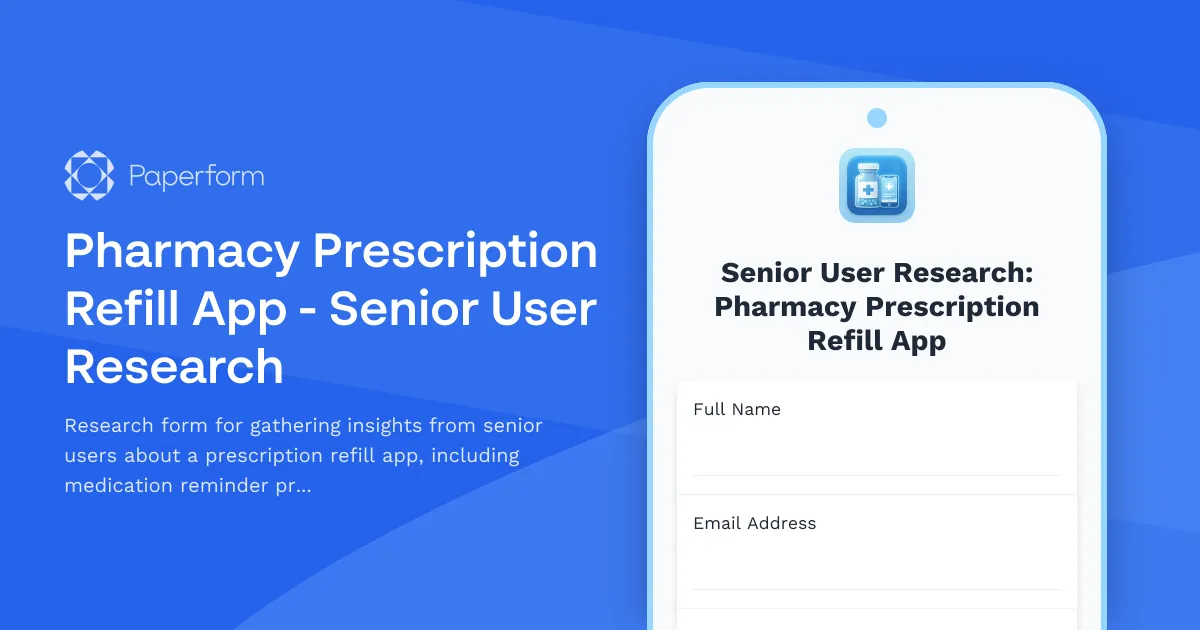
Senior User Research for Prescription Refill App
Understanding the unique needs of senior users is critical when designing healthcare technology. This Senior User Research Form helps UX teams gather detailed insights about how older adults interact with pharmacy apps, their accessibility requirements, and the role family caregivers play in medication management.
Whether you're developing a new prescription refill app or improving an existing one, this template helps you collect essential feedback on medication reminder preferences, visual accessibility needs, and family caregiver involvement patterns.
Who should use this form?
This research form is ideal for:
- UX researchers conducting user interviews with senior populations
- Product managers in digital health and pharmacy tech
- Healthcare app developers building medication management tools
- Pharmacy chains modernizing their digital services
- Healthcare consultants advising on senior-friendly design
What makes this template valuable?
The form is structured to capture both quantitative and qualitative insights across key areas that impact senior user experience: technology comfort levels, visual and cognitive accessibility needs, medication management habits, reminder preferences, and caregiver dynamics. It balances demographic screening with open-ended questions that reveal deeper behavioral patterns.
By using Paperform, you can create a welcoming, accessible research experience that reflects the empathy you want to bring to your final product. The form's clean, readable design can be customized with larger fonts and high-contrast themes to make participation easier for senior users.
Once responses are collected, connect this form to tools like Airtable or Google Sheets for analysis, or use Paperform's AI Insights to quickly identify common themes around readability challenges, reminder preferences, and caregiver involvement patterns.
For teams running ongoing research programs, Stepper can automate follow-up workflows—like scheduling video interviews with qualified participants, sending thank-you incentives, or flagging high-priority accessibility concerns for immediate review.
This template demonstrates how Paperform supports sensitive, human-centered research in healthcare contexts, helping you build products that truly serve the needs of senior users and their families.

More templates like this
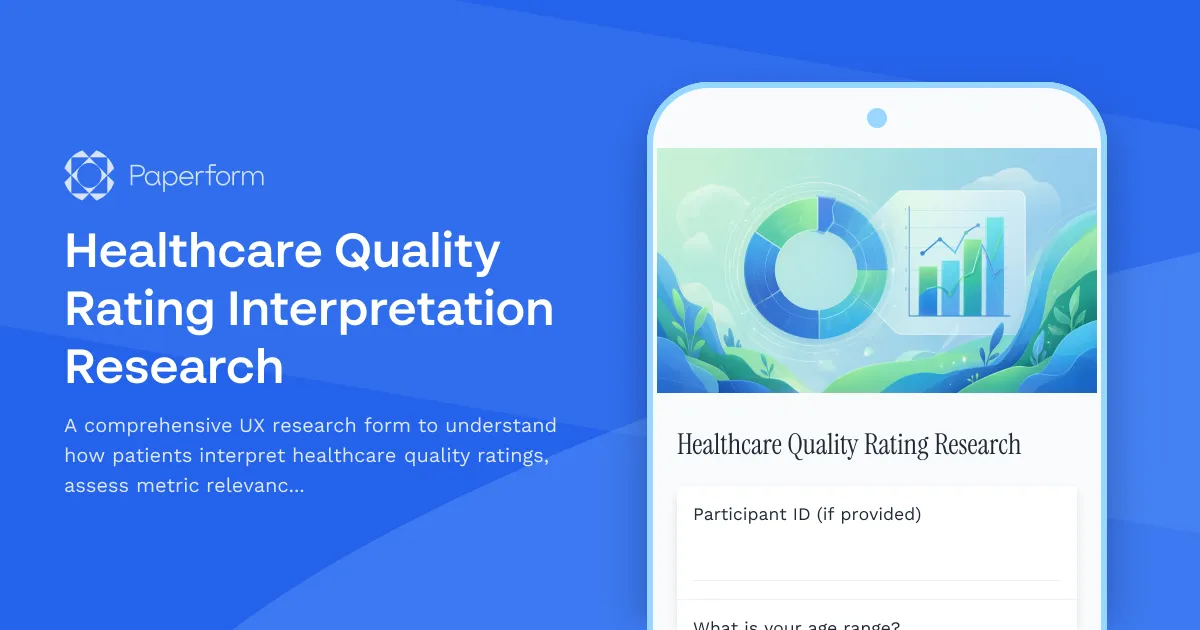
Healthcare Quality Rating Interpretation Research
A comprehensive UX research form to understand how patients interpret healthcare quality ratings, assess metric relevance, evaluate comparison methodologies, and identify decision-making factors.
Alternative Medicine Practitioner Booking Research Form
Conduct user research on how patients select and book alternative medicine practitioners, exploring decision factors around treatment modalities, credentials, and insurance coverage.
Care Coordination Platform Family Research Study
A comprehensive UX research form for understanding family member collaboration needs, information sharing preferences, and task management clarity in care coordination platforms.
Clinical Trial Patient Recruitment Portal Research Form
A comprehensive research form to gather patient feedback on clinical trial recruitment experiences, focusing on eligibility screening, informed consent, and appointment scheduling processes.
Healthcare Cost Estimator Tool Research
A user research form designed to evaluate perceptions of healthcare cost estimator accuracy, insurance calculation confidence, and out-of-pocket expectations for UX teams developing pricing transparency tools.
Healthcare Patient Portal Usability Research Form
A comprehensive UX research form designed to evaluate patient portal usability, assess accessibility needs, measure task success rates, and understand digital literacy levels for healthcare technology improvement.
Home Health Aide Scheduling Portal - Family Research Survey
A comprehensive research survey to understand family and caregiver needs for home health aide scheduling, consistency preferences, task verification, and emergency backup coordination.
Hospice Care Family Communication Portal Research Survey
A user research form designed to gather insights from hospice care families about their experiences with care plan visibility, provider communication, and advance directive documentation.

Mental Health Therapy Platform Client Research
A comprehensive user research form for mental health therapy booking platforms to gather insights on therapist matching, insurance verification, and appointment flexibility preferences.
Senior Care Facility Family Portal Research
Gather user feedback on family portal features for senior care facilities, including preferences for resident updates, medication tracking, and billing transparency.
Telehealth Platform Technical Requirements Check
Assess user device compatibility, internet connectivity, and technical readiness for telehealth platform participation with backup planning.
Addiction Recovery Support App User Research
A confidential user research form designed to gather insights from individuals using or interested in addiction recovery support apps, with a focus on anonymity protection, milestone tracking motivation, and crisis resource accessibility.