
Streamline Your Product Feature Post-Mortems with Paperform
Product managers juggling competing priorities, stakeholder expectations, and development timelines need a structured way to evaluate what worked—and what didn't. This Product Feature Prioritization Post-Mortem template helps product teams capture critical lessons learned after implementing a prioritization framework, ensuring continuous improvement across planning cycles.
Built for Product Teams Who Ship and Learn
Whether you're running a SaaS startup, leading product at an agency, or managing features for an enterprise team, this template helps you systematically assess:
- Stakeholder alignment: Did everyone understand the "why" behind your priorities?
- Development velocity: How did your framework impact sprint completion and engineering happiness?
- Customer satisfaction: What did usage data and feedback reveal about your choices?
The form captures quantitative metrics alongside qualitative insights, creating a complete picture of your prioritization outcomes. Use conditional logic to dive deeper into areas that underperformed, and collect team feedback in a structured format that's easy to analyze later.
Turn Post-Mortems into Action with Stepper
Once your retrospective is complete, use Stepper to automatically route insights to the right places. Create workflows that send key findings to your project management tool, notify stakeholders of action items, update product roadmaps in Notion or Airtable, and trigger follow-up surveys based on satisfaction scores.
Designed for Continuous Improvement
Paperform's document-style editor makes this template easy to customize for your team's unique frameworks—whether you're using RICE, ICE, WSJF, or a proprietary scoring system. Embed it in your project management platform, share it via custom domain, or use it internally as part of your sprint retrospective cadence.
With AI Insights, you can quickly synthesize patterns across multiple post-mortems, identifying recurring bottlenecks or celebrating consistent wins. Trusted by product teams worldwide, Paperform provides the SOC 2 Type II compliance and data security you need to capture sensitive product and business insights safely.
Ready to build better products through structured reflection? Start with this template and make every prioritization cycle smarter than the last.
More templates like this
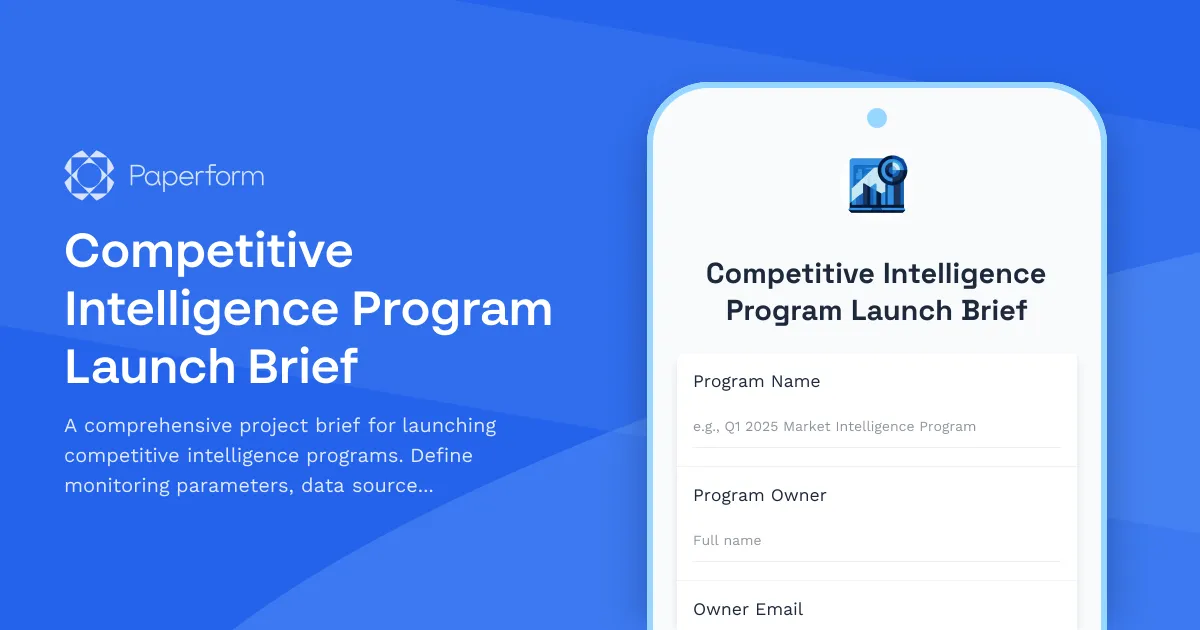
Competitive Intelligence Program Launch Brief
A comprehensive project brief for launching competitive intelligence programs. Define monitoring parameters, data sources, analysis frameworks, reporting formats, and stakeholder distribution to activate market insights effectively.
Customer Churn Reduction Project Brief
A comprehensive project brief template for planning and documenting customer churn reduction initiatives, including cohort analysis, exit interview insights, retention strategies, and success metrics.
Partner Ecosystem Development Project Brief
A comprehensive project initiation form for planning and launching partner ecosystem development initiatives, covering value propositions, recruitment strategies, enablement, co-marketing, revenue sharing, and success metrics.
Strategic Narrative Development Project Brief
A comprehensive project brief for strategic narrative development projects, capturing company story assessment, messaging architecture, proof points, visual storytelling needs, stakeholder alignment, and communication rollout planning.
Agile Sprint Budget Planning Form
Plan and forecast sprint budgets with resource allocation, vendor costs, and financial tracking for agile teams managing project finances.
Agile Sprint Retrospective Form
A structured retrospective template to capture what went well, areas for improvement, action items, and team sentiment after each sprint.
Competitive Intelligence Scope of Work Template
Define competitive intelligence projects with clear source identification, monitoring parameters, analysis frameworks, and reporting protocols for strategic insights.
Competitive Response Playbook Development Project Brief
A comprehensive project initiation form for developing competitive response playbooks with competitor monitoring, scenario planning, approval workflows, and sales enablement tracking.
Corporate Innovation Lab Project Portfolio Tracker
Track innovation experiments, test hypotheses, allocate resources, and make data-driven scaling decisions for your corporate innovation lab portfolio.

Corporate Innovation Lab Stakeholder Briefing
A comprehensive stakeholder briefing form for corporate innovation labs to report on pilot projects, proof of concept results, IP development, startup partnerships, and commercialization strategies.
Customer Co-Creation Program Launch Kickoff Form
Launch your customer co-creation program with this comprehensive form for participant recruitment, engagement planning, ideation frameworks, prototype development, and feedback integration.
Impact Mapping Workshop Form
A structured form for running impact mapping workshops that helps teams define goals, identify key actors, discover impacts, and prioritize deliverables using agile methodologies.