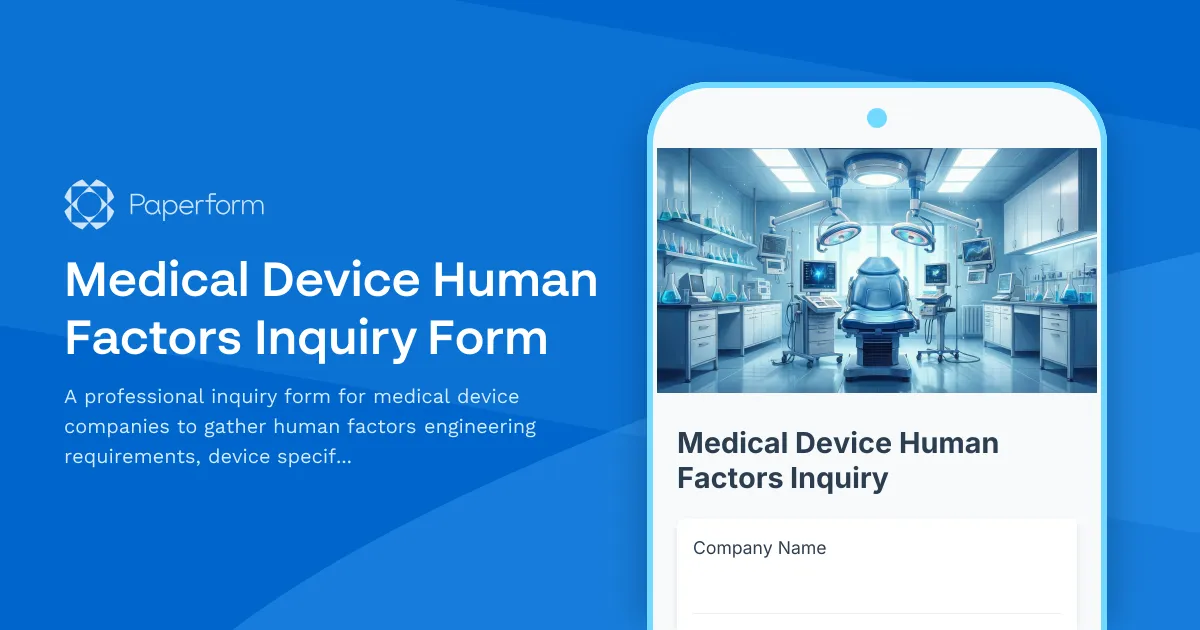
Medical Device Human Factors Inquiry Form: Essential for Regulatory Success
When developing or bringing a medical device to market, human factors engineering (HFE) isn't optional—it's a regulatory requirement. FDA guidance, IEC 62366, and international standards demand rigorous analysis of how users interact with medical devices to prevent use errors that could harm patients.
This Medical Device Human Factors Inquiry Form is designed for medical device manufacturers, HFE consultancies, regulatory affairs professionals, and testing laboratories who need a streamlined way to capture critical project requirements from clients and stakeholders.
Why Human Factors Engineering Matters
Use errors with medical devices can have serious consequences—from minor patient discomfort to life-threatening complications. Human factors engineering identifies potential risks early in the design process by analyzing:
- User populations and their capabilities, limitations, and training levels
- Use environments where devices will be operated, from sterile ORs to chaotic emergency departments
- Critical tasks that, if performed incorrectly, could result in patient harm
- Risk scenarios that require mitigation through design or labeling
A comprehensive HFE inquiry at the project's outset ensures you gather all the information needed to design appropriate validation studies, satisfy regulatory requirements, and ultimately create safer, more usable medical devices.
Who This Template Is For
This form is perfect for:
- Human factors consultancies onboarding new medical device clients
- Regulatory affairs teams scoping HFE validation studies
- Medical device manufacturers coordinating with internal product development teams
- Testing laboratories defining study protocols for usability validation
- Quality assurance professionals documenting HFE requirements for design history files
What This Template Captures
Our medical device human factors inquiry form systematically collects:
Device Classification & Specifications: Regulatory class, intended use, device type, and whether it's a new device or modification—all critical for determining the appropriate level of HFE scrutiny.
User Group Analysis: Identification of primary and secondary users (clinicians, patients, caregivers), their experience levels, training requirements, and any special considerations like age, physical limitations, or stress conditions.
Use Environment Details: Where and under what conditions the device will be used—from controlled clinical settings to home use, including environmental factors like lighting, noise, space constraints, and emergency situations.
Critical Tasks & Use Scenarios: The specific tasks users must perform with the device, particularly those where errors could result in harm. This section helps prioritize testing focus areas.
Risk Analysis Requirements: Information about known hazards, previous use errors, complaint history, and risk mitigation strategies already implemented.
Validation Study Needs: Scope for formative and summative validation, sample size requirements, timeline constraints, and regulatory submission targets.
Streamlining Medical Device Development with Paperform
For organizations managing multiple medical device projects, staying organized and compliant is paramount. This inquiry form template helps you:
Standardize client intake across all HFE projects, ensuring no critical information is missed at the discovery phase.
Create professional, branded forms that reflect the technical sophistication of your services—no generic survey tools that undermine credibility.
Automate your workflow by connecting form submissions to your project management tools, CRMs, or quality management systems. With Stepper (stepper.io), you can automatically create project folders, assign team members, generate study protocols from templates, and trigger client onboarding sequences based on device classification.
Secure sensitive information with SOC 2 Type II compliance, ensuring that proprietary device information and regulatory documentation meet strict security standards.
Collaborate efficiently with conditional logic that adapts the form based on device type and regulatory requirements, collecting only the most relevant information for each project type.
Beyond the Initial Inquiry
Once you've gathered the essential HFE requirements through this form, Paperform can support your entire project lifecycle:
Use custom branded forms for participant screening and recruitment for your validation studies.
Create consent forms with eSignatures via Papersign (papersign.com) for study participants, maintaining clean audit trails for regulatory submissions.
Build post-test questionnaires with conditional routing based on task performance to capture both quantitative and qualitative usability data.
Deploy AI Insights to analyze open-ended feedback from usability sessions, identifying themes and patterns across multiple test participants without manual coding.
Trusted by Medical Device Professionals
Medical device development demands precision, compliance, and collaboration across disciplines. Paperform provides the flexible, secure platform you need to manage human factors projects from initial inquiry through regulatory submission.
Whether you're a boutique HFE consultancy handling 5 projects a year or a large medical device manufacturer managing dozens of concurrent validation studies, this template adapts to your workflow while maintaining the rigor regulatory bodies expect.
Start with this comprehensive inquiry form to ensure every human factors project begins with complete, organized requirements—setting the foundation for validation studies that satisfy FDA, EU MDR, and international regulatory standards.



More templates like this
Clinical Data Management Inquiry Form
A professional inquiry form for clinical data management services, capturing study requirements, eCRF platform needs, timeline expectations, and data cleaning protocols.
Medical Device Clinical Evaluation Inquiry Form
A professional inquiry form for medical device manufacturers seeking clinical evaluation services. Captures device specifications, available clinical data, regulatory pathways, and literature review requirements.
Medical Device Post-Market Surveillance Inquiry Form
A comprehensive form for reporting and tracking medical device incidents, adverse events, and product complaints as part of post-market surveillance programs and regulatory compliance.
Medical Device Usability Testing Inquiry Form
Request usability testing services for medical devices. Specify device type, target user population, testing scenarios, environmental requirements, and reporting needs.

Addiction Intervention Services Inquiry Form
A compassionate inquiry form for families seeking professional addiction intervention services, collecting essential information about substance use, living situation, insurance coverage, and treatment readiness.
Clinical Genomics Laboratory Patient Test Data Request Form
Request access to patient genomic test data, variant interpretations, family history, and genetic counseling notes from clinical genomics laboratories.
Clinical Research Patient Registry Inquiry Form
A comprehensive inquiry form for clinical researchers and institutions planning to establish or expand patient registries, collecting essential details about disease focus, data requirements, consent frameworks, and collaboration opportunities.
Clinical Trial Patient Eligibility Data Access Request Form
Request access to clinical trial patient eligibility data, including medical history screening records, enrollment status, and travel reimbursement information for authorized research and administrative purposes.
Clinical Trial Protocol Modification Request Form
Request modifications to clinical trial protocols with IRB submission requirements, patient safety assessment, regulatory compliance checklist, and principal investigator approval workflow.
Clinical Trial Recruitment Scope of Work Form
A comprehensive scope of work template for clinical trial recruitment projects, covering eligibility screening criteria, participant outreach strategies, enrollment targets, retention plans, and regulatory compliance requirements.
Healthcare Compliance Consulting Inquiry Form
A professional inquiry form for healthcare organizations seeking compliance consulting services. Capture facility details, compliance concerns, audit history, and project requirements to deliver tailored consultation proposals.
Healthcare Patient Portal Usability Research Form
A comprehensive UX research form designed to evaluate patient portal usability, assess accessibility needs, measure task success rates, and understand digital literacy levels for healthcare technology improvement.