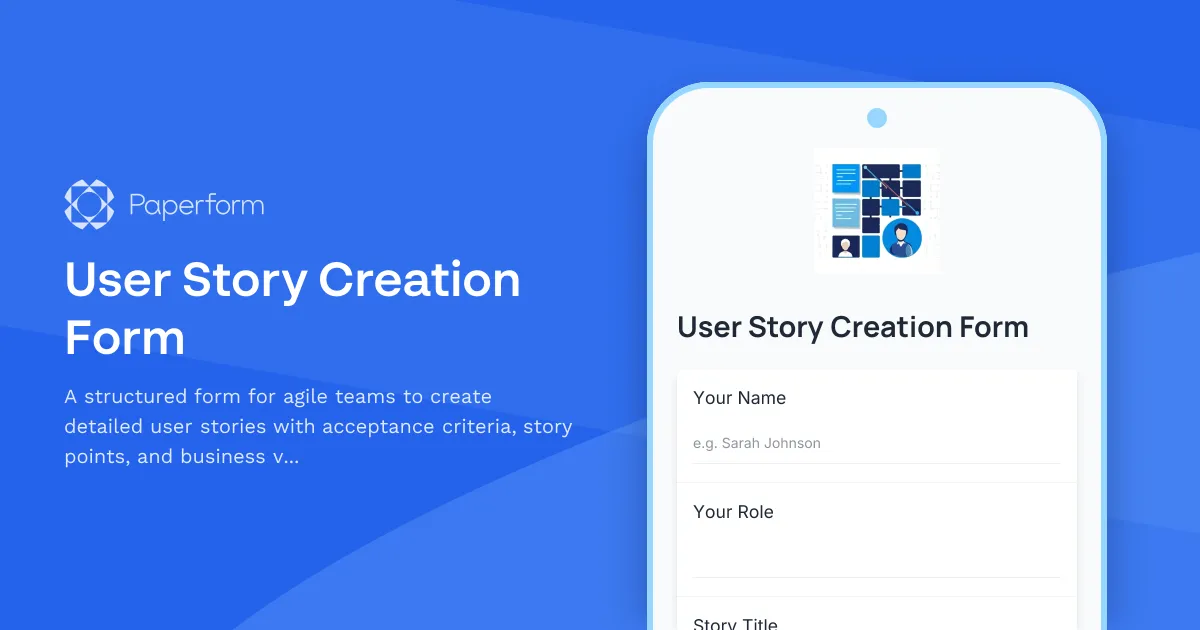
Streamline Your Agile Workflow with a User Story Creation Form
Building great products starts with understanding what users need—and in agile teams, that means writing clear, actionable user stories. This User Story Creation Form gives product managers, scrum masters, and development teams a consistent way to capture every detail needed for sprint planning, from the core "as a user" statement through to acceptance criteria and story points.
Why use a dedicated form for user stories?
Switching between project management tools, sticky notes, and email threads slows down your sprint planning. With Paperform, you can centralise user story intake in one branded form that's easy for stakeholders, product owners, and team members to fill out. Each submission automatically feeds into your backlog, ready to prioritise and assign during your next planning session.
Built for product teams and agile workflows
This template is designed for software teams, SaaS companies, product managers, scrum masters, and agile consultancies who need a repeatable process for capturing user stories. Whether you're preparing for sprint planning, refining your backlog, or running discovery workshops, this form ensures every story includes the context, criteria, and value needed to make smart prioritisation decisions.
Use conditional logic to tailor follow-up questions based on story type, and connect your form to Stepper (stepper.io) to automatically route new stories into Jira, Linear, Asana, or Notion, notify the right squad leads, and kick off estimation workflows—no manual copying required.
How Paperform supports agile teams
With Paperform's doc-style editor, you can embed helpful examples, guidelines, and links to your definition of done right inside the form. Add headings, images, and formatting to make the form feel like part of your team's process, not a generic survey. Use multi-page layouts to separate story details from technical specs and acceptance criteria, or switch to Guided Mode for a conversational experience that walks submitters through each section step by step.
Once submitted, responses flow into your connected tools, or you can review them in Paperform's built-in dashboard with filters, exports, and AI-powered insights to spot patterns across requests. Trusted by agile teams worldwide, Paperform brings structure and speed to your sprint planning without adding complexity.
Start capturing better user stories today—so your team can focus on building features that matter.
More templates like this
Agile Project Intake Form
A comprehensive agile project intake form for capturing epic descriptions, business cases, success metrics, and initial story mapping to kick off new sprints and initiatives.
Agile Team Capacity Planning Form
Calculate sprint capacity based on team availability, skill sets, focus factors, and planned time off. Perfect for sprint planning and resource allocation in agile teams.
Impact Mapping Workshop Form
A structured form for running impact mapping workshops that helps teams define goals, identify key actors, discover impacts, and prioritize deliverables using agile methodologies.

Agile Community of Practice Proposal Form
A structured form for proposing and establishing agile communities of practice, covering focus areas, membership, meeting structure, and success metrics to build collaborative learning environments.
Agile Contract Negotiation Form
A comprehensive contract negotiation form designed for agile projects with flexible scope, fixed-price iterations, built-in change request processes, and clear acceptance criteria.
Agile Definition of Ready Checklist
Ensure user stories are fully prepared and ready for sprint planning with this comprehensive Definition of Ready checklist covering story completeness, dependencies, acceptance criteria, and team understanding.

Agile Experiment Design Form
A structured form for designing and documenting agile experiments with clear hypotheses, test approaches, data collection methods, and success criteria to drive data-informed decision making.
Agile Governance Review Form
A comprehensive governance review form for evaluating agile process adherence, analyzing sprint metrics, documenting improvement recommendations, and providing leadership updates on team performance.
Agile Leadership Support Request Form
Request leadership intervention for sprint impediments, resource needs, policy exceptions, and strategic alignment issues. Escalate blockers and get the support your agile team needs to deliver.
Agile Metrics Dashboard Submission Form
Track sprint performance with comprehensive agile metrics including velocity, cycle time, lead time, and quality indicators for continuous team improvement.
Agile Sprint Budget Planning Form
Plan and forecast sprint budgets with resource allocation, vendor costs, and financial tracking for agile teams managing project finances.
Agile Team Skills Matrix Form
Track team competencies, learning goals, and knowledge sharing opportunities to optimize sprint planning and resource allocation in agile teams.