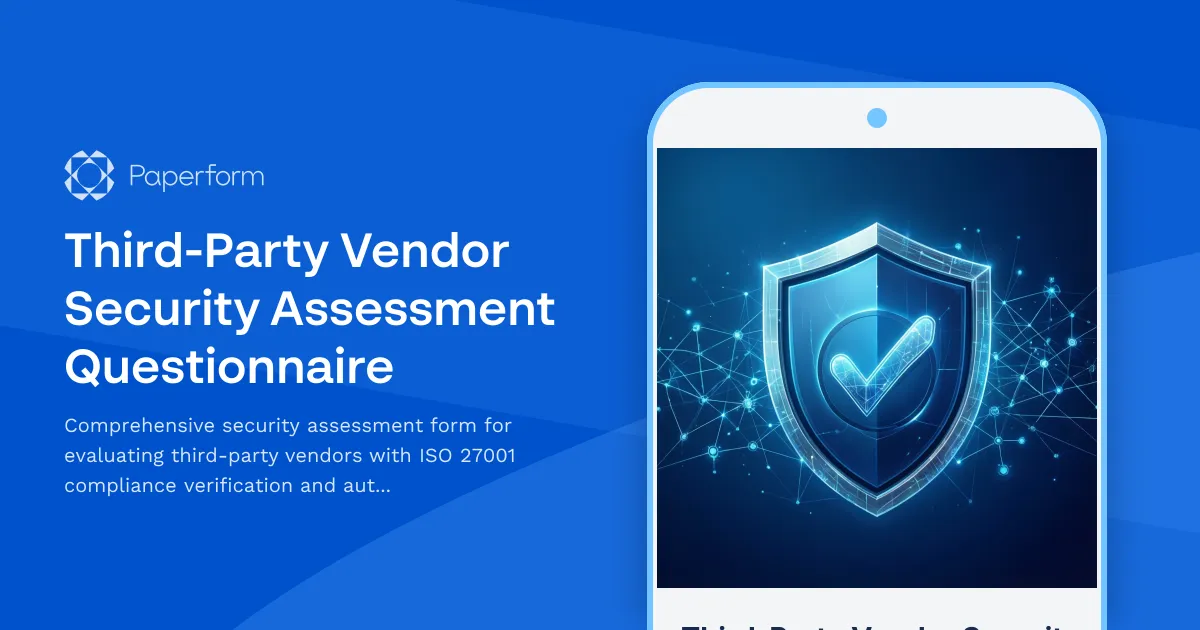
Streamline Vendor Security Assessments with Automated Risk Scoring
When your organization works with third-party vendors, contractors, or service providers, understanding their security posture isn't optional—it's essential. Data breaches, compliance violations, and security incidents increasingly originate from weak points in the supply chain. That's why IT teams, security professionals, and compliance officers need a systematic way to evaluate vendor risk before granting access to sensitive systems or data.
This Third-Party Vendor Security Assessment Questionnaire template helps you conduct thorough security evaluations with built-in ISO 27001 compliance verification and automated risk scoring. Whether you're onboarding new vendors, conducting annual reviews, or responding to audit requirements, this template streamlines the entire assessment process.
Why Paperform for Vendor Security Assessments?
Traditional vendor security questionnaires often live in static PDFs or lengthy email chains, making them difficult to track, score, and act upon. Paperform transforms this critical workflow into an intelligent, automated process that saves time while improving accuracy.
Professional, branded experience: Your vendor security assessment represents your organization's commitment to security. With Paperform's doc-style editor, you can create a polished, professional questionnaire that reflects your brand while maintaining the technical rigor required for compliance frameworks like ISO 27001, SOC 2, and NIST.
Automated risk scoring: This template includes built-in calculation fields that automatically score vendor responses across key security domains—information security policies, access controls, incident response, data protection, and compliance certifications. As vendors complete the form, their risk profile is calculated in real-time, giving your security team immediate visibility into potential concerns.
Conditional logic for efficient assessments: Not every vendor requires the same depth of evaluation. Using Paperform's conditional logic, this template adapts questions based on the vendor's role, data access level, and services provided. Cloud service providers see different questions than on-premise contractors, ensuring relevant, targeted assessments without overwhelming vendors with irrelevant questions.
File uploads for evidence collection: Security assessments require documentation. Vendors can upload SOC 2 reports, ISO 27001 certificates, penetration test results, insurance policies, and other compliance documentation directly within the form, keeping all evidence centralized and accessible for audit trails.
Built for IT Security Teams and Compliance Professionals
This template is designed specifically for:
- IT security managers conducting vendor risk assessments and third-party security reviews
- Compliance officers managing ISO 27001, SOC 2, GDPR, and HIPAA vendor requirements
- CISOs and security teams building vendor risk management programs
- Procurement teams evaluating security before contract execution
- Risk management professionals maintaining third-party risk registers
The questionnaire covers essential security domains including information security governance, access management, encryption standards, vulnerability management, incident response capabilities, business continuity planning, and regulatory compliance. Each section is designed to align with ISO 27001 controls and industry best practices.
Automate Your Vendor Security Workflow with Stepper
Once a vendor completes their security assessment, the real work begins—reviewing responses, flagging risks, routing for approval, and updating your vendor risk register. That's where Stepper becomes invaluable.
With Stepper's AI-native workflow automation, you can:
Route high-risk vendors automatically: If a vendor's risk score exceeds your threshold, Stepper can immediately notify security leadership, create a review task in your project management tool, and flag the vendor for additional due diligence.
Update vendor risk registers: Push assessment results directly into your GRC platform, spreadsheet, or database, maintaining a single source of truth for vendor risk across your organization.
Trigger approval workflows: Route vendor assessments through the appropriate approval chain—security review, compliance sign-off, and procurement approval—based on risk level and vendor type.
Schedule reassessments: Set up automated reminders for annual or quarterly vendor reassessments, ensuring your vendor risk program stays current without manual tracking.
Generate executive reports: Aggregate vendor security scores and compliance status into executive dashboards and board reports, providing leadership with visibility into third-party risk.
Stepper connects Paperform to your existing security stack—whether that's ServiceNow, Jira, Notion, Airtable, your CRM, or custom internal tools—creating a seamless vendor security workflow from initial assessment through ongoing monitoring.
Integration with Your Security Ecosystem
Paperform integrates natively with the tools security and compliance teams already use. Send completed assessments to Google Sheets or Airtable for centralized tracking, ping Slack channels when high-risk vendors are identified, or use webhooks to push data into your GRC platform or SIEM.
For teams that need audit-ready documentation, every submission is timestamped, tracked, and can be exported with full response history. Paperform's SOC 2 Type II compliance and data residency controls ensure that your vendor assessment data is handled with the same security standards you're evaluating in others.
Secure, Scalable Vendor Risk Management
As your vendor ecosystem grows, so do your security obligations. This template scales with your program, supporting everything from a handful of critical vendors to enterprise-wide third-party risk management programs with hundreds of suppliers.
Using Paperform's roles and permissions, you can control who can view sensitive vendor responses, while Agency+ features let managed service providers and consulting firms manage vendor assessments across multiple clients from a single account.
Whether you're building your first vendor security program or optimizing an existing process, this Third-Party Vendor Security Assessment Questionnaire template gives you the structure, automation, and flexibility to protect your organization from supply chain risk—without drowning in spreadsheets or chasing down PDFs.
Get started today and transform your vendor security assessments from time-consuming paperwork into a streamlined, intelligent workflow that actually reduces risk.

More templates like this
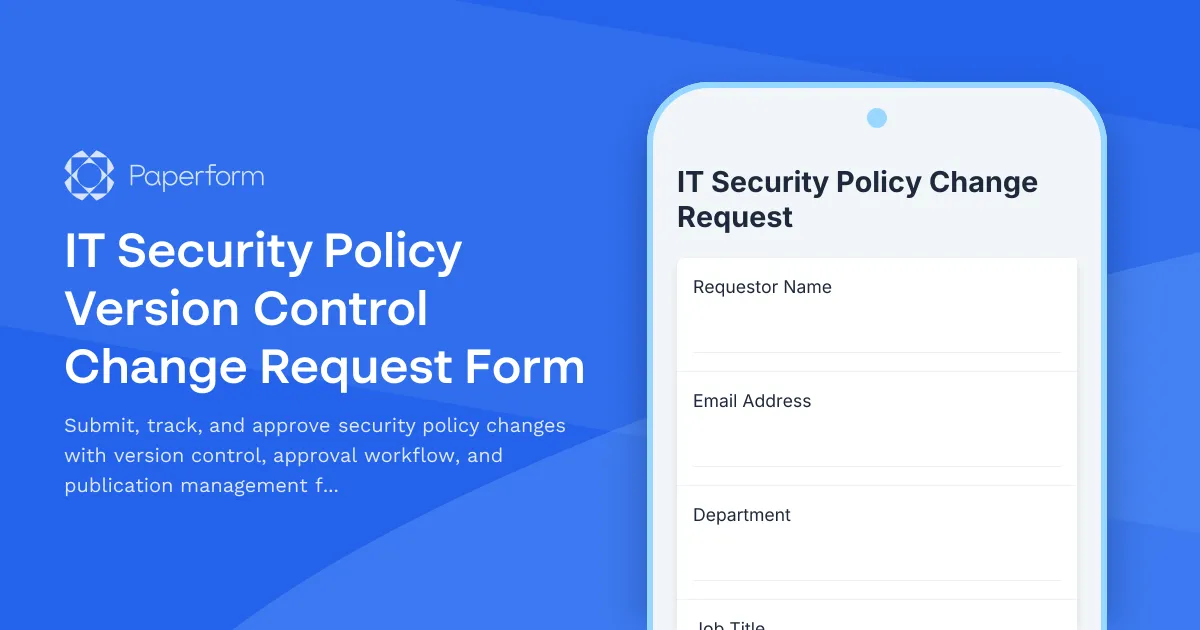
IT Security Policy Version Control Change Request Form
Submit, track, and approve security policy changes with version control, approval workflow, and publication management for IT governance and compliance.
Security Investment Portfolio Review & Budget Allocation
A comprehensive security investment analysis form for evaluating budget allocation, identifying control coverage gaps, and prioritizing strategic security initiatives across your organization.
Cybersecurity Exception Approval Request Form
A comprehensive form for requesting cybersecurity policy exceptions with risk assessment, compensating controls, business justification, and remediation plans requiring CISO authorization.
IT Security Architecture Roadmap Update Change Request
Submit and track IT security architecture roadmap changes, strategic initiatives, technology adoption plans, and investment requests for approval.
IT Security Compliance Change Request Form
Submit and track IT security compliance obligation changes, regulatory updates, and implementation requirements to ensure your organization meets evolving security standards.
Security Awareness Campaign Planning Form
Plan and structure your security awareness campaigns with audience segmentation, content scheduling, and effectiveness tracking to build a security-conscious culture across your organization.
Security Vendor Risk Assessment Form
Comprehensive vendor security assessment covering financial stability, breach history, compliance standards, and contractual security requirements for third-party risk management.
Cyber Crisis Communication Drill Evaluation Form
Evaluate crisis communication readiness with media simulation exercises, spokesperson performance reviews, and message consistency checks for cybersecurity incidents.
Cybersecurity Awareness Training Quiz
Test employee knowledge on phishing detection, password security, and data protection with this comprehensive cybersecurity awareness quiz designed for workplace training programs.
Cybersecurity Incident Post-Mortem Report
Conduct thorough post-incident analysis with attack vector documentation, response timeline tracking, and security gap identification to strengthen your organization's cybersecurity posture.
IT Security Architecture Exception Approval Form
Request and approve security architecture exceptions with technical justifications, alternative approaches, risk assessments, and time-bound permissions for IT change management.
IT Security Incident Response Communication Change Request Form
Request changes to security incident response communication protocols, including notification groups, escalation paths, and stakeholder contact information.