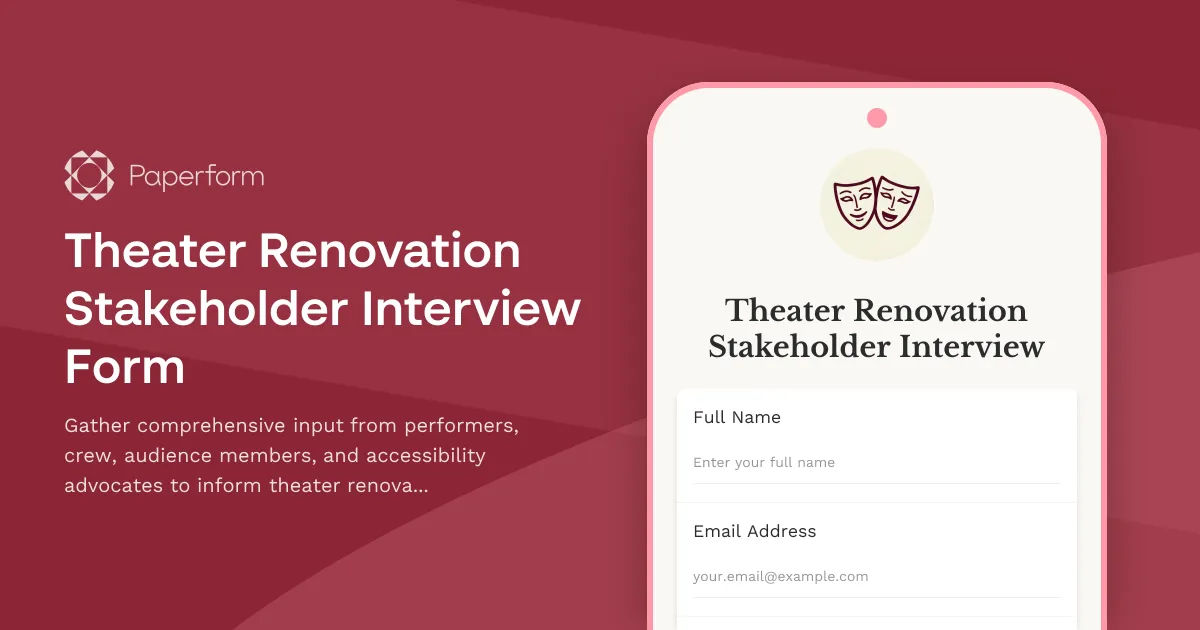
Transform Your Theater Space with Input from Those Who Matter Most
Renovating a theater is a significant undertaking that impacts everyone who walks through your doors—from the performers who bring stories to life on stage, to the technical crew working behind the scenes, to the audience members who fill the seats night after night. The most successful renovations don't just focus on aesthetics; they're built on a foundation of genuine stakeholder input that addresses real needs and creates inclusive, functional spaces.
This Theater Renovation Stakeholder Interview Form template helps performing arts venues, community theaters, educational institutions, and cultural organizations gather structured feedback from all key stakeholders during the planning phase. Whether you're updating a historic venue or completely reimagining your space, this template ensures you capture insights on stage configuration, seating arrangements, acoustic priorities, backstage facilities, and critically important accessibility features.
Why Stakeholder Input Matters in Theater Renovations
Theater spaces are complex ecosystems where form must follow function. A beautiful auditorium that doesn't serve performers, crew, and diverse audiences will ultimately fall short of its potential. By conducting thorough stakeholder interviews early in your renovation process, you can:
- Identify hidden challenges that only regular users of the space understand
- Prioritize investments based on what will have the greatest impact
- Create inclusive designs that serve audiences and performers of all abilities
- Avoid costly mistakes by catching issues before construction begins
- Build community buy-in by demonstrating that everyone's voice matters
Who Should Complete This Interview Form
This template is designed to gather input from four critical stakeholder groups:
Performers (actors, dancers, musicians, speakers) who can speak to stage size, sightlines, wing space, performer amenities, and the relationship between stage and audience.
Audience Members (season ticket holders, accessibility advocates, families, students) who experience the venue from the house and can provide feedback on seating comfort, sightlines, acoustics, accessibility, and overall atmosphere.
Technical Crew (stage managers, lighting designers, sound engineers, stagehands, costume and prop teams) who know the behind-the-scenes requirements for lighting positions, rigging, sound systems, storage, and workflow efficiency.
Accessibility Advocates (patrons with disabilities, accessibility consultants, inclusive design experts) who can ensure the renovated space serves everyone through wheelchair access, assistive listening systems, sensory considerations, and universal design principles.
What This Template Covers
The form uses conditional logic to present relevant questions based on each respondent's stakeholder group, ensuring everyone can contribute their unique perspective:
- Stage configuration preferences including proscenium vs. thrust designs, stage dimensions, and performance area flexibility
- Seating arrangements covering capacity, comfort, sightlines, accessibility seating placement, and social distance considerations
- Acoustic priorities for music, spoken word, and amplified performances
- Backstage and technical facilities including dressing rooms, green rooms, storage, loading access, and technical booth placement
- Inclusive design features addressing mobility access, sensory accommodations, assistive technologies, and universal design
- Current challenges with the existing space that renovation should address
- Vision and priorities for what matters most in the renovated theater
How Paperform Makes Stakeholder Research Easier
Collecting detailed feedback from diverse groups can quickly become overwhelming, but Paperform's intelligent form builder streamlines the entire process. The conditional logic engine shows relevant questions based on stakeholder type, creating a personalized interview experience that doesn't waste anyone's time with irrelevant questions.
The document-style editor lets you include context, images of proposed designs, or video walkthroughs to help stakeholders visualize possibilities. This is especially valuable when gathering feedback on technical or accessibility features that might be unfamiliar to some respondents.
For theater managers coordinating input from dozens or hundreds of stakeholders, Paperform's AI Insights feature is a game-changer. Instead of manually reading through hundreds of responses, AI Insights can summarize common themes, identify the most frequently mentioned priorities, and surface unexpected insights you might otherwise miss. This means your renovation committee can quickly understand what matters most across all stakeholder groups and make data-informed decisions.
Automate Your Renovation Planning Workflow
Once you've collected stakeholder input, Paperform helps you act on it efficiently. Connect your form to project management tools like Asana, Monday.com, or Notion to automatically create tasks based on feedback themes. Use Stepper to build workflows that route different types of feedback to the right team members—accessibility suggestions to your accessibility consultant, technical requirements to your production manager, and design preferences to your architect.
You can also set up automatic email notifications to acknowledge each participant's contribution and keep them updated on how their input is shaping the renovation plans. This ongoing engagement builds community support and excitement for your project.
Built for Arts Organizations and Cultural Venues
Whether you're a community theater working with volunteer performers, a university drama department, a regional performing arts center, or a municipal cultural venue, this template adapts to your context. Customize the questions, adjust the visual design to match your brand, and embed the form on your website or share it via social media to reach all stakeholders.
Paperform is trusted by cultural organizations, educational institutions, and nonprofits worldwide for its combination of professional design capabilities and powerful automation features—all wrapped in an interface that's approachable enough for any team member to manage.
With SOC 2 Type II compliance and GDPR standards, you can collect sensitive feedback with confidence. And with flexible pricing that grows with your needs, Paperform works whether you're gathering input from 50 stakeholders or 5,000.
Start Building Your Dream Theater Space
Great theater renovation projects begin with listening. This template gives you a structured, professional way to hear from everyone who will use and love your renovated space. Customize it for your specific project, share it widely, and let Paperform help you transform stakeholder voices into renovation reality.
More templates like this
Jazz Festival Stakeholder Interview Form
Gather insights from musicians, venue owners, sponsors, attendees, and community members about lineup curation, venue selection, ticketing, local business involvement, and community impact for jazz festival planning.
Waste Reduction Initiative Stakeholder Interview
Gather strategic input from operations staff, procurement, employees, and sustainability teams on waste reduction targets, recycling infrastructure, composting feasibility, supplier engagement, and behavior change strategies.
Job Placement Program Stakeholder Interview Form
A comprehensive stakeholder interview form for job placement programs to gather insights from job seekers, employers, trainers, and social service partners about skill assessments, training needs, employer requirements, support services, and placement success metrics.
Film Production Stakeholder Interview
Comprehensive stakeholder interview form for film productions to gather input from producers, directors, crew heads, and location managers on creative vision, budget, scheduling, equipment, and risk management.
Financial Services Digital Transformation Stakeholder Interview
Gather critical input from stakeholders on security requirements, user experience expectations, regulatory compliance needs, integration priorities, and change management concerns for your financial services digital transformation initiative.

Gaming Tournament Platform Stakeholder Interview
Gather feedback from competitive players, organizers, sponsors, and spectators to inform the development of a gaming tournament platform with matchmaking, prize structures, streaming, anti-cheat, and community features.
Membership Organization Discovery Form
A comprehensive discovery form for membership organizations to assess value proposition, dues structure, member benefits, recruitment strategies, retention initiatives, and engagement measurement.
Nonprofit Donor Management Stakeholder Interview
Gather insights from development staff, major donors, board members, and volunteers about donor stewardship, communication preferences, recognition, and impact reporting to strengthen your fundraising strategy.
Retail Omnichannel Strategy Stakeholder Interview
Gather strategic insights from retail stakeholders on customer service, inventory management, technology requirements, staffing needs, and brand consistency to inform your omnichannel transformation.
Volunteer Management Platform Stakeholder Interview
Gather insights from nonprofit staff, volunteers, board members, and beneficiaries about volunteer management needs, recruitment tools, scheduling features, communication methods, impact tracking, and recognition programs.
Volunteer Program Design Discovery Form
A comprehensive discovery form to design and structure effective volunteer programs, including role definition, screening requirements, training needs, and retention strategies.
Youth Mentorship Program Stakeholder Interview Form
Gather structured input from mentors, mentees, parents, schools, and community partners about program design, matching processes, activities, safety measures, and success metrics for youth mentorship initiatives.