
Optimize Your Manufacturing Operations with Production Throughput Analysis
For manufacturing operations managers, production supervisors, and continuous improvement teams, understanding production throughput is critical to maintaining competitiveness and profitability. This Production Throughput Analysis Form provides a structured framework for measuring cycle times, identifying bottlenecks, tracking capacity utilization, and capturing improvement opportunities across your production floor.
Whether you're running a single production line or managing multiple manufacturing cells, this template helps you systematically collect the data you need to make informed decisions about resource allocation, process optimization, and capital investment. The form captures essential metrics including takt time, cycle time variance, downtime causes, and equipment utilization—all the factors that directly impact your OEE (Overall Equipment Effectiveness) and bottom line.
Built for real-world manufacturing environments, this form can be completed by shift supervisors, quality managers, or lean manufacturing coordinators during production reviews, shift handovers, or continuous improvement sessions. The structured format ensures consistency in data collection across shifts and facilities, making trend analysis and comparative benchmarking straightforward.
Use this template to establish baseline performance metrics, track the impact of process improvements, justify equipment upgrades, or prepare data for kaizen events and Six Sigma projects. Once you've collected your throughput data, you can automatically route submissions to production managers, trigger follow-up tasks in project management tools, or feed data into dashboards using Stepper workflows—helping you close the loop from data collection to action.
Paperform's calculation fields let you automatically compute key metrics like capacity utilization percentages and cycle time efficiency ratios, while conditional logic can route high-priority bottleneck reports to the right stakeholders immediately. For manufacturing organizations managing multiple sites or production lines, this form provides the data foundation for continuous improvement programs that drive measurable results.



More templates like this
Manufacturing Process Flow Documentation Form
Document manufacturing processes with input materials, transformation steps, quality control parameters, and output specifications for production optimization and compliance.

Production Value Stream Mapping Form
A comprehensive value stream mapping tool for manufacturing operations to document process flows, identify waste, and optimize production efficiency through detailed cycle time and inventory analysis.

5S Workplace Organization Audit Form
A comprehensive 5S audit form to evaluate workplace organization across Sort, Set in Order, Shine, Standardize, and Sustain with scoring and improvement action tracking.
Finished Goods Inspection Report
A comprehensive quality control form for final product inspection, covering visual checks, dimensional measurements, functional testing, and packaging compliance before shipment.
Manufacturing Capacity Analysis Form
Comprehensive capacity analysis form for evaluating theoretical capacity, available capacity, actual output, utilization rates, and identifying production constraints in manufacturing operations.
Manufacturing Equipment Effectiveness Tracker
Track and calculate Overall Equipment Effectiveness (OEE) with automated calculations for availability, performance, and quality rates to optimize production efficiency.
Manufacturing Equipment Maintenance Checklist
A comprehensive preventive maintenance checklist for manufacturing equipment, covering inspection tasks, lubrication points, safety checks, and technician documentation.
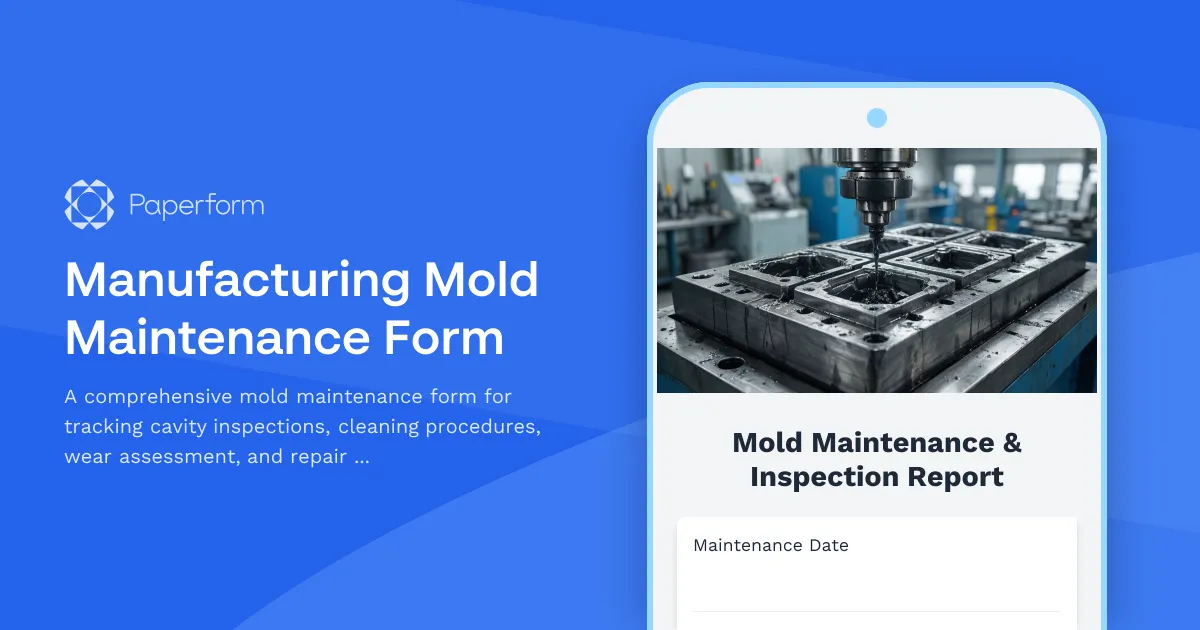
Manufacturing Mold Maintenance Form
A comprehensive mold maintenance form for tracking cavity inspections, cleaning procedures, wear assessment, and repair documentation to ensure consistent production quality.

Manufacturing New Product Introduction Checklist
A comprehensive checklist for manufacturing teams to manage new product introductions, covering design validation, process validation, equipment installation, and operator training requirements.
Manufacturing Tooling Calibration Record
Document equipment calibration, verify measurement standards, record tolerance checks, and certify technician completion for manufacturing quality control compliance.
Metrology Lab Sample Submission Form
Submit samples to your metrology lab for precision measurement and quality control inspection with detailed measurement requests, tolerance specifications, and reporting requirements.
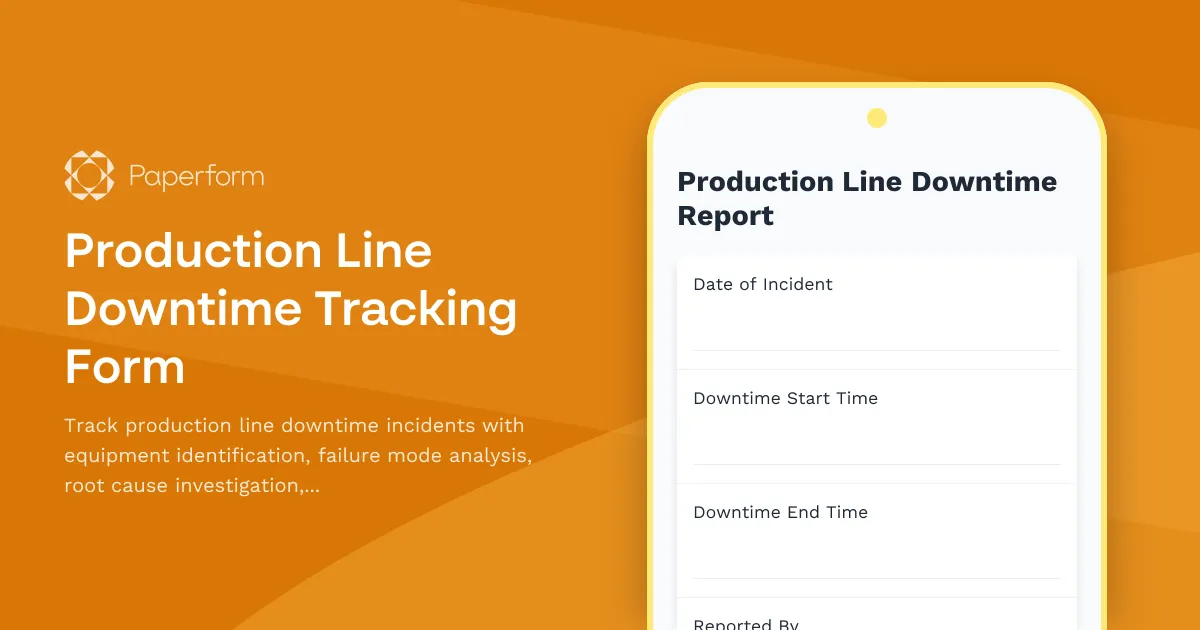
Production Line Downtime Tracking Form
Track production line downtime incidents with equipment identification, failure mode analysis, root cause investigation, and resolution time tracking to improve manufacturing efficiency.