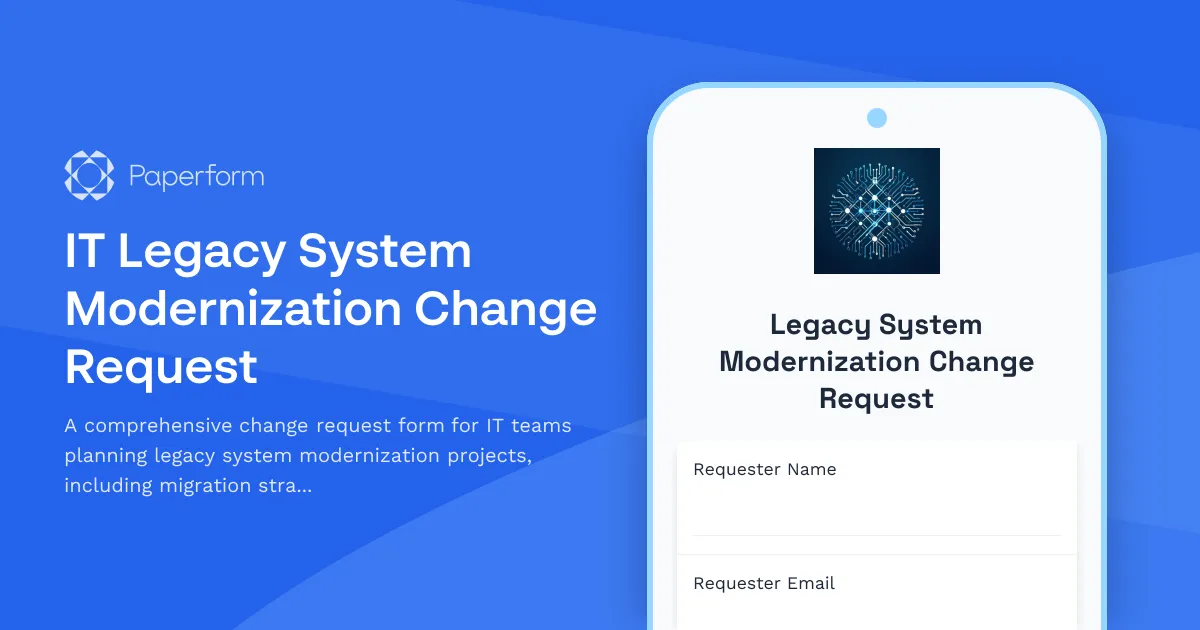
Streamline Your Legacy System Modernization with Paperform
Modernizing legacy systems is one of the most complex and high-risk initiatives IT teams undertake. This IT Legacy System Modernization Change Request template provides a structured framework for documenting migration strategies, data conversion plans, and parallel run procedures—ensuring every stakeholder understands the scope, risks, and rollout timeline before you flip the switch.
Built specifically for IT departments, systems architects, and change management teams, this form captures the critical details needed for CAB (Change Advisory Board) approval: current system dependencies, business impact assessments, rollback procedures, and post-migration validation criteria. Whether you're moving from on-premises infrastructure to the cloud, replacing a monolithic application, or consolidating multiple legacy platforms, this template helps you present a clear, defensible plan.
Why IT teams choose Paperform for change management
With Paperform's conditional logic, you can tailor the form based on project complexity—revealing additional fields for high-risk changes or large-scale migrations. Integration with Slack, Jira, ServiceNow, and project management tools means every submission can trigger the right approval workflow, create tracking tickets, and notify stakeholders automatically.
Take it further with Stepper to build multi-stage approval pipelines: route requests to architects, security teams, and business owners in sequence, track sign-offs, and keep your change calendar synchronized across tools—all without manual handoffs or email chains.
For organizations requiring audit trails and compliance documentation, Paperform is SOC 2 Type II certified, and you can export detailed submission logs to demonstrate governance and accountability throughout the modernization lifecycle.
Stop managing legacy system upgrades in spreadsheets or static PDFs. Use this template to bring structure, visibility, and accountability to every modernization project—so your team can focus on execution, not chasing down missing information.
More templates like this
Application Version Upgrade Change Request Form
A comprehensive IT change management form for requesting application version upgrades with dependency analysis, rollback planning, and user communication strategy.
Cloud Infrastructure Change Request Form
A professional cloud infrastructure change request form for AWS and Azure modifications, including cost impact analysis, compliance review, and multi-level approval workflows.
Infrastructure Emerging Technology Evaluation Form
Evaluate new infrastructure technologies with structured use case analysis, pilot planning, success metrics, and production readiness assessments.
IT Secure Software Development Lifecycle Change Request Form
Comprehensive SDLC change request form with built-in security gates, testing requirements, and release criteria for secure software deployments.
Data Center Migration Progress Report
Track and report on data center migration progress including server inventory, application migration status, network reconfiguration, and disaster recovery testing with this comprehensive weekly update form.
Disaster Recovery Site Setup Request Form
Request form for disaster recovery infrastructure setup with RTO/RPO requirements, replication methods, failover testing schedules, and runbook documentation for business continuity planning.
Identity and Access Management Rollout Phase Completion Form
Complete IAM project milestones with directory sync verification, SSO testing, privilege reviews, and security architect approvals for secure deployment sign-off.
IP Address Allocation Request Form
Streamline IP address allocation with this comprehensive request form. Manage subnet selection, static/DHCP assignments, DNS registration, and network documentation updates efficiently.
IT Automation Script Deployment Change Request Form
Streamline IT automation script deployments with structured change requests, code review documentation, testing results, and deployment scheduling approvals.
IT Infrastructure Migration Post-Mortem Form
Comprehensive post-mortem template for documenting IT infrastructure migrations, tracking downtime incidents, verifying data integrity, and capturing user adoption challenges for continuous improvement.
IT Security Tool Integration Testing Change Request
A comprehensive change request form for IT security tool integration testing, including connectivity validation, data flow verification, and performance benchmarking assessments.
IT Security Tool Licensing Optimization Change Request
A comprehensive change request form for optimizing IT security tool licenses with usage analysis, rightsizing recommendations, and cost-saving calculations to improve software spend efficiency.