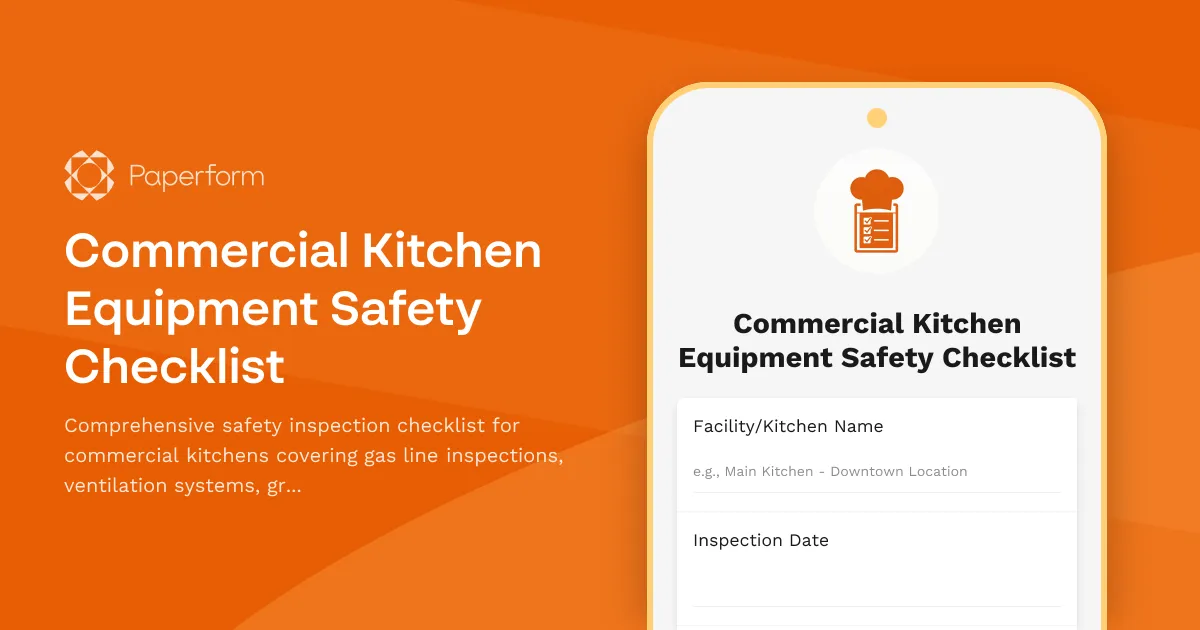
Commercial Kitchen Equipment Safety Checklist Template
Running a commercial kitchen means balancing speed, quality and safety every single day. Whether you're managing a restaurant, catering business, hotel kitchen or institutional food service operation, regular safety inspections aren't just about compliance—they're about protecting your team and keeping your business running smoothly.
This Commercial Kitchen Equipment Safety Checklist helps you systematically inspect critical safety areas including gas line integrity, ventilation system performance, grease trap maintenance, hot surface guards and employee burn prevention protocols. Built for kitchen managers, safety officers and facilities teams, this template turns complex safety requirements into a clear, repeatable process that you can complete in minutes.
Why commercial kitchens need dedicated safety checklists
Commercial kitchens are high-risk environments. Between open flames, hot oil, pressurised gas lines, electrical equipment and fast-moving teams, there's little room for error. Regular safety inspections help you:
- Prevent fires and gas leaks before they become emergencies
- Maintain compliance with health department, fire marshal and insurance requirements
- Protect your team from burns, slips and equipment-related injuries
- Avoid costly downtime from equipment failures or forced closures
- Document due diligence for audits, claims and regulatory visits
Paper checklists and clipboards get lost, damaged or forgotten. Digital forms built with Paperform give you a permanent, searchable record of every inspection, with photos, timestamps and automatic alerts when issues are found.
What this template covers
This checklist is organised around the most critical safety areas in commercial kitchen operations:
Gas line inspection: Check for leaks, proper shut-off valve function, flexible connector condition, sediment trap integrity and emergency shut-off accessibility. Gas leaks are one of the leading causes of commercial kitchen fires, making regular inspection non-negotiable.
Ventilation and hood system: Verify exhaust fan operation, hood filter cleanliness, ductwork integrity, grease buildup levels and fire suppression system readiness. Proper ventilation protects air quality and reduces fire risk from accumulated grease.
Grease trap maintenance: Confirm trap capacity, odour levels, drainage flow, cleaning schedule compliance and documentation of professional servicing. Neglected grease traps can cause backups, fines and serious health code violations.
Hot surface guards and barriers: Inspect oven door seals, fryer splash guards, range surface protections, steam equipment insulation and salamander/broiler guards. These barriers are your first line of defence against burns.
Employee burn prevention: Review availability and condition of oven mitts, heat-resistant gloves, aprons, proper footwear and documented safety training records. Equipment is only as safe as the team using it.
General kitchen safety: Check fire extinguisher accessibility and inspection tags, first aid kit supplies, emergency exit signage, floor slip hazards and electrical cord conditions.
Each section uses a combination of yes/no checks, photo uploads for issues and text fields for notes, giving you a complete picture of your kitchen's safety status after every inspection.
How Paperform makes safety inspections faster and more reliable
Paperform is designed for teams that need professional, easy-to-use forms without technical overhead. Here's how it streamlines commercial kitchen safety:
Mobile-first inspections: Complete your checklist on a phone or tablet as you walk the kitchen. Take photos of issues in real time and attach them directly to the relevant section of your form.
Conditional logic: Show or hide follow-up questions based on responses. If someone marks "No" on a critical item like gas leak detection, automatically reveal fields for incident details and corrective action plans.
Automatic notifications: Set up instant alerts to notify managers, maintenance teams or facilities staff when critical safety issues are flagged, so problems get addressed immediately—not after the report sits in someone's inbox.
Rich media and formatting: Add reference photos, instructional videos or links to equipment manuals directly in your checklist, so inspectors always have the right context at their fingertips.
Branded and professional: Customise fonts, colours and logos to match your restaurant or hospitality brand. Forms can be embedded on internal portals or accessed via direct links.
Centralised records: Every completed checklist is stored securely in Paperform, searchable by date, location, inspector or issue type. Pull up past inspections during audits or use the data to spot recurring problems.
Automate your safety workflows with Stepper
Once you've identified issues, the real work begins: assigning tasks, tracking repairs and closing the loop. That's where Stepper (stepper.io) comes in.
Stepper is your AI-native workflow automation platform that connects directly to Paperform. When a safety checklist submission flags a critical issue—say, a gas line leak or a missing fire extinguisher—Stepper can automatically:
- Create a maintenance ticket in your facilities management system
- Notify your equipment servicing contractor via email or SMS
- Post an alert in your team's Slack or Microsoft Teams channel
- Add a task to Asana, Monday or your project management tool
- Schedule a follow-up inspection for one week later
- Log the incident in your safety management database
All of this happens without manual handoffs, reducing response time and ensuring nothing falls through the cracks. Stepper's visual workflow builder is designed for operations teams, so you can set up and adjust automations yourself—no developers required.
Who benefits from this template
This checklist is built for hospitality, food service and facilities professionals including:
- Restaurant managers and operators running full-service kitchens, quick-service restaurants or ghost kitchens
- Executive chefs and kitchen managers responsible for daily safety oversight
- Facilities and maintenance teams managing multi-site food service operations
- Safety and compliance officers ensuring adherence to fire, health and insurance standards
- Hotel and resort food & beverage directors overseeing multiple kitchens, banquet spaces and catering operations
- Institutional food service managers in schools, hospitals, corporate cafeterias and senior living facilities
- Catering companies operating from commissary kitchens or mobile facilities
Whether you're running a single location or a portfolio of kitchens, this template scales with you.
Getting started
Paperform's AI can help you customise this template to your exact needs. Add fields for equipment serial numbers, adjust inspection frequencies, include site-specific hazards or translate the form into multiple languages for international teams.
Once your checklist is live, share it via link, embed it on your intranet or add it to a QR code posted in the kitchen for easy access. Inspectors can complete the form in minutes, and you'll have peace of mind knowing your kitchen is operating safely and in compliance.
Commercial kitchen safety isn't just a box to tick—it's the foundation of a sustainable, professional food service operation. With Paperform and Stepper working together, you can turn safety inspections from a tedious chore into a streamlined, automated process that keeps your team safe and your business protected.



More templates like this
Commercial Kitchen Hood & Suppression System Inspection Checklist
Comprehensive inspection checklist for commercial kitchen hood systems, fire suppression equipment, grease buildup assessment, and cleaning verification to ensure fire safety compliance.
Cryogenic Nitrogen Ice Cream Shop Safety Checklist
Comprehensive safety inspection checklist for ice cream shops using liquid nitrogen, covering ventilation, nitrogen handling, burn prevention, food safety, and emergency protocols.
Nightclub & Bar Safety Inspection Checklist
Comprehensive safety inspection and compliance checklist for nightclubs and bars covering occupancy limits, emergency exits, security protocols, and incident management procedures.
Nitrogen-Infused Beverage Bar Safety Checklist
Comprehensive daily safety checklist for nitrogen-infused beverage operations covering cryogenic handling, ventilation systems, protective equipment, and emergency protocols to ensure staff and customer safety.
Restaurant Crisis Management Planning Form
A comprehensive crisis preparedness form for restaurants to document emergency scenarios, communication protocols, staff training plans, insurance coverage, and emergency contacts to ensure business continuity during unexpected events.
Restaurant Health and Safety Audit Checklist
Comprehensive health and safety audit checklist for restaurants covering food storage, temperature logs, cross-contamination prevention, hygiene compliance, pest control, and equipment sanitation.
Restaurant Health & Safety Inspection Checklist
Comprehensive health and safety inspection checklist for restaurants covering food storage, temperature control, hygiene compliance, cross-contamination prevention, and critical violation tracking.
Brewery Emergency Evacuation & Headcount Form
A comprehensive emergency evacuation form designed for brewery production facilities to account for all personnel, monitor equipment shutdown procedures, and track hazardous area clearances during emergency situations.
Commercial Refrigeration Maintenance Checklist
Professional maintenance tracking form for commercial refrigeration units in restaurants. Monitor compressor performance, door seals, temperature variances, and critical system components to ensure food safety and equipment longevity.
Event Venue Safety Inspection Checklist
A comprehensive safety inspection checklist for event venues covering crowd capacity, emergency exits, temporary structures, electrical systems, and weather contingency planning to ensure compliance and attendee safety.
Food Truck Daily Operations Report
A comprehensive daily report for food truck operators to track location, sales, inventory, equipment issues, and health compliance in one simple form.
Infrared Sauna Facility Safety Inspection Checklist
Comprehensive safety inspection checklist for infrared sauna facilities covering electrical systems, temperature controls, emergency mechanisms, sanitation protocols, and client health screening compliance.