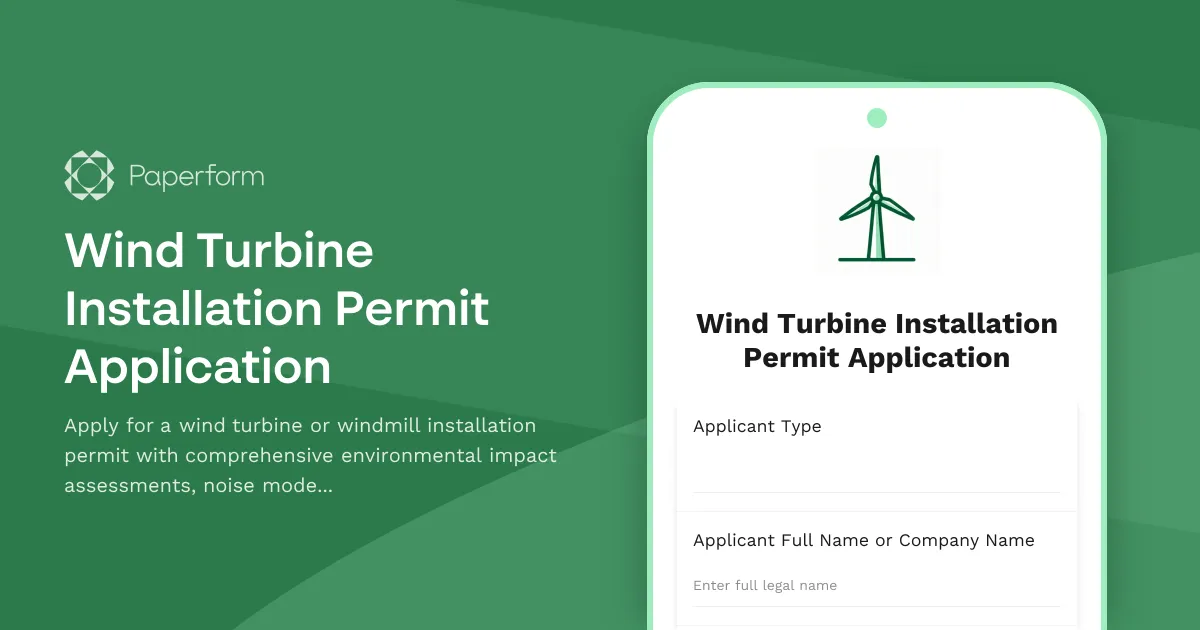
Streamline Your Wind Turbine Permit Application with Paperform
Applying for a wind turbine installation permit involves navigating complex regulatory requirements, environmental assessments, and technical specifications. This Wind Turbine Installation Permit Application template provides municipalities, planning departments, and renewable energy developers with a comprehensive digital solution that captures all necessary information in one professional, easy-to-complete form.
Why Use This Wind Turbine Permit Application Template?
Traditional permit applications often involve stacks of paper forms, missing documentation, and back-and-forth communication that delays project timelines. This Paperform template modernizes the entire process by collecting detailed information about the proposed installation, environmental impact assessments, safety calculations, and financial guarantees—all in a single, logical workflow.
The template is designed for municipal planning departments, county zoning offices, environmental regulatory agencies, and renewable energy project developers who need to streamline the permit application process while ensuring regulatory compliance and community safety.
What's Included in This Template
This comprehensive form captures everything required for a thorough wind turbine permit evaluation:
Project & Applicant Information: Complete details about the applicant, property owner, project location, and professional team including engineers, environmental consultants, and legal representatives.
Turbine Specifications: Technical details including turbine model, manufacturer, height dimensions (hub height and total height), rotor diameter, rated capacity, expected energy output, and proposed number of units.
Site Assessment & Setback Calculations: Detailed setback measurements from property lines, occupied structures, roads, and other critical infrastructure. The form calculates whether proposed setbacks meet regulatory minimums and allows applicants to explain any variance requests.
Noise Impact Modeling: Upload noise modeling studies that demonstrate predicted sound levels at nearby properties, including both operational and low-frequency noise. Applicants describe modeling methodology, baseline ambient noise levels, and predicted noise at various distances.
Shadow Flicker Analysis: Documentation of shadow flicker modeling showing the duration and frequency of shadow effects on neighboring properties throughout the year, with mitigation strategies if thresholds are exceeded.
Wildlife Impact Assessment: Environmental impact studies addressing potential effects on birds, bats, and other wildlife, including migration patterns, endangered species considerations, and proposed mitigation measures.
Visual Impact & Aesthetics: Details about turbine appearance, lighting requirements (FAA obstruction lighting), viewshed analysis, and efforts to minimize visual impact on the community.
Decommissioning Plan & Bond: Comprehensive decommissioning plan including expected turbine lifespan, removal procedures, site restoration commitments, and financial security (bond or escrow) to ensure proper decommissioning when the turbine reaches end of life.
Safety & Engineering Documentation: Upload structural engineering reports, foundation designs, electrical interconnection plans, and safety protocols for construction and operation.
Perfect for Multiple Industries and Use Cases
This template serves renewable energy developers, farmers adding wind power to agricultural land, commercial property owners, municipal planners, and environmental consultants working on wind energy projects. Whether you're processing dozens of applications as a county planning office or submitting a single-turbine application as a landowner, this form adapts to your needs.
How Paperform Transforms the Permit Application Process
Paperform's document-style editor means this template looks professional and feels intuitive—more like a guided conversation than a bureaucratic form. Conditional logic ensures applicants only see questions relevant to their specific project type, reducing confusion and incomplete submissions.
File upload fields make it simple to attach required documentation like noise studies, environmental assessments, site plans, and engineering reports—all organized in one place rather than scattered across emails and physical mail.
For planning departments, Stepper (stepper.io) can automate what happens after submission: route applications to different reviewers based on turbine size or location, send acknowledgment emails with application numbers, create review tasks in project management tools, and notify applicants when additional information is needed. This transforms permit review from a manual, paper-based process into a modern digital workflow.
Papersign (papersign.com) integration allows applicants to digitally sign declarations and property owner consent forms, while planning departments can send approval letters or conditional use permits for eSignature—creating a complete audit trail from application through approval.
Collect Payments and Bonds Digitally
The template includes payment fields for application fees, with Stripe, PayPal, or Square integration built into Paperform. For decommissioning bonds or financial guarantees, you can collect initial deposits or documentation of surety bonds, streamlining the financial compliance aspect of permitting.
Built for Compliance and Professional Review
The form's structure ensures that all regulatory requirements are addressed before submission, reducing the number of incomplete applications that slow down the review process. Applicants receive clear guidance about what's required, while reviewers get consistently formatted applications that are easier to evaluate.
With Paperform's AI Insights, planning departments can analyze trends across multiple applications—identifying common issues, tracking approval rates, or spotting patterns in wildlife impact concerns that might inform policy updates.
Trusted by Government Agencies and Professional Services
Paperform is SOC 2 Type II and GDPR compliant, offering the security and data protection that government agencies and professional consultants require. With roles and permissions, multiple staff members can access applications without compromising data security, while SSO integration supports enterprise authentication requirements.
Whether you're a rural county implementing your first wind energy ordinance or an established planning department handling dozens of renewable energy applications annually, this template provides a modern, efficient foundation for wind turbine permitting that respects both regulatory requirements and applicant experience.
Start using this template today to reduce processing time, improve application quality, and support the growth of clean energy in your community.

More templates like this
Coastal Development Permit Application
Apply for a coastal development permit for beachfront construction. Includes sea level rise assessment, beach access preservation, visual impact analysis, and erosion control planning.
Dock & Pier Construction Permit Application
Apply for a waterfront construction permit for dock, pier, or marine structure with environmental impact assessment and navigational clearance documentation.
Peru Geothermal Energy Concession Application
Comprehensive application form for geothermal energy concession permits in Peru, including reservoir assessment, drilling plans, and electricity purchase agreements for MINEM submission.
Well Drilling Permit Application
Comprehensive permit application for residential and commercial well drilling projects, including aquifer studies, spacing requirements, water quality testing plans, and geological surveys.
Wetland Alteration Permit Application
Apply for a wetland alteration permit with comprehensive environmental impact documentation, mitigation plans, and species protection measures.
Aquaculture Permit Application
Apply for an aquaculture permit for fish farming operations. Submit details about your water sources, species, feed storage, effluent treatment systems, and escapement prevention measures.
Composting Facility Permit Application
Apply for a permit to operate a composting facility with comprehensive odor control, leachate management, temperature monitoring, and residential setback compliance requirements.
ERC Certificate of Public Convenience Application for Power Generation
Apply for an Energy Regulatory Commission (ERC) Certificate of Public Convenience for power generation facilities in the Philippines, including environmental clearance and fuel supply documentation.
Greenhouse & Hoop House Permit Application
Apply for a commercial greenhouse or hoop house permit with structure specifications, heating systems, water usage, pesticide storage details, and agricultural zoning compliance.
Helipad Construction Permit Application
Apply for a helipad construction permit with FAA compliance verification, noise impact assessment, lighting specifications, emergency access planning, and fuel storage safety requirements.
Licensed Environmental Site Assessor Application
Apply for professional environmental site assessor certification with Phase I ESA training verification, contamination assessment experience, and environmental professional exam registration.
Licensed Pesticide Consultant Application
Apply for professional pesticide consultant certification with integrated pest management training verification, agricultural experience documentation, and exam registration.