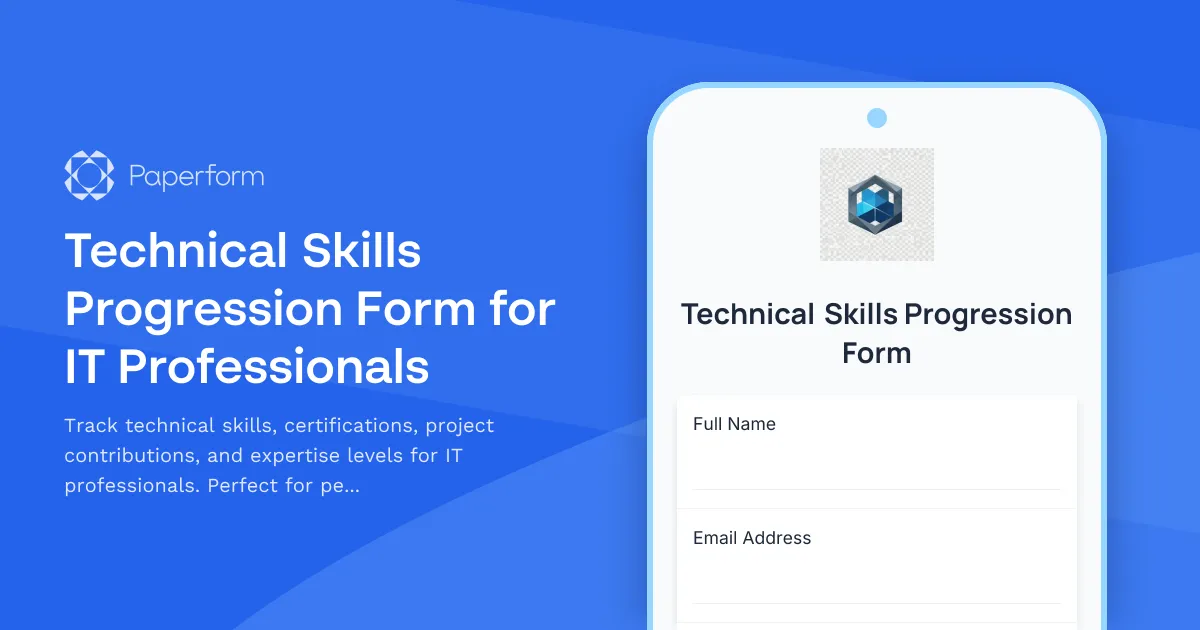
Technical Skills Progression Form for IT Professionals
Building a high-performing IT team requires clear visibility into technical capabilities, growth trajectories, and development needs. This Technical Skills Progression Form gives you a structured way to assess and document the evolving expertise of developers, engineers, system administrators, and other IT professionals.
Perfect for technology companies, IT departments, and agencies managing technical talent, this form helps you track certifications earned, evaluate proficiency across key technical domains, document meaningful project contributions, and set actionable career development goals. Whether you're running quarterly performance reviews or planning annual promotions, this template ensures you capture the full picture of each team member's technical journey.
What makes this form valuable:
Use it during performance review cycles to create a consistent, data-driven assessment across your technical team. Replace scattered spreadsheets and subjective notes with a centralized record that tracks skills progression over time. Managers can identify skill gaps, recognise high performers, and make informed decisions about promotions, training investments, and project assignments.
The form works equally well for self-assessments and manager evaluations. Encourage team members to reflect on their own growth, then compare their self-ratings with manager assessments to identify alignment or areas for calibration. This two-way dialogue builds trust and creates more meaningful development conversations.
How Paperform enhances your skills tracking:
With Paperform's conditional logic, you can tailor sections based on role, seniority level, or department—showing relevant technical domains for backend engineers versus DevOps specialists, for example. The built-in calculation engine can automatically compute overall proficiency scores or flag team members ready for promotion based on certification status and expertise ratings.
Want to turn completed assessments into action? Connect your form to Stepper to automatically trigger follow-up workflows: schedule development planning meetings, assign training resources, update HR systems, or notify senior leadership when a team member achieves a key certification milestone. You can also sync submission data to Airtable, Notion, or your HRIS to maintain a living skills matrix across your entire technical organization.
Use Paperform's AI Insights to analyze patterns across multiple submissions—quickly identify which technical skills are most commonly flagged for development, which certifications your team is pursuing most, and where expertise gaps might impact upcoming projects.
This template helps IT leaders move beyond gut feelings to build a data-informed culture of continuous technical growth, ensuring your team stays ahead in a rapidly evolving technology landscape.
More templates like this
IT Technical Skills Gap Analysis Form
Assess current technical proficiencies, identify skill gaps, and prioritize training needs for software development teams with certification tracking and personalized development planning.
Remote DevOps Engineer Onboarding Form
A comprehensive onboarding form for remote DevOps engineers covering personal details, technical setup, CI/CD pipeline access, infrastructure monitoring tools, incident response procedures, and on-call scheduling.
Distributed Engineering Team Onboarding Form
A comprehensive remote onboarding form for distributed engineering teams covering cloud access, repository permissions, sprint preferences, documentation standards, and on-call rotation availability.

Distributed Machine Learning Engineer Onboarding Form
A comprehensive virtual onboarding form for distributed machine learning engineers covering infrastructure access, data permissions, experiment tracking tools, peer review protocols, and ethics guidelines.
IT Professional Technical Skills Inventory & Career Pathway Assessment
A comprehensive self-assessment for IT professionals to evaluate their technical skills, programming proficiency, certifications, and map their career advancement pathway.
Systems Analyst Skills Evaluation Form
Assess technical and analytical competencies of systems analysts, identify skill gaps in requirements gathering, process mapping, and solution design, and create targeted development plans.
Cybersecurity Analyst Exit Interview & Handover Form
A comprehensive exit form for cybersecurity analysts covering threat intelligence handover, incident documentation, security tool access removal, and vulnerability assessment reports.
Enterprise Software Implementation Team Code of Conduct
A comprehensive code of conduct agreement for software implementation teams covering client data security protocols, professional conduct standards, scope management guidelines, and escalation procedures.
IT Secure Software Development Lifecycle Change Request Form
Comprehensive SDLC change request form with built-in security gates, testing requirements, and release criteria for secure software deployments.
IT Security Architecture Review Board Submission Form
Submit security architecture proposals to the review board for evaluation, approval, and decision documentation with comprehensive risk assessments and compliance considerations.
IT Security Code Review Tool Integration Change Request
Request approval for integrating security code review tools with static analysis configuration, finding workflows, and developer training requirements.
Load Balancer Configuration Access Request
Request access to load balancer configuration, traffic routing permissions, SSL certificate management, and failover testing environments with detailed justification and approval workflow.