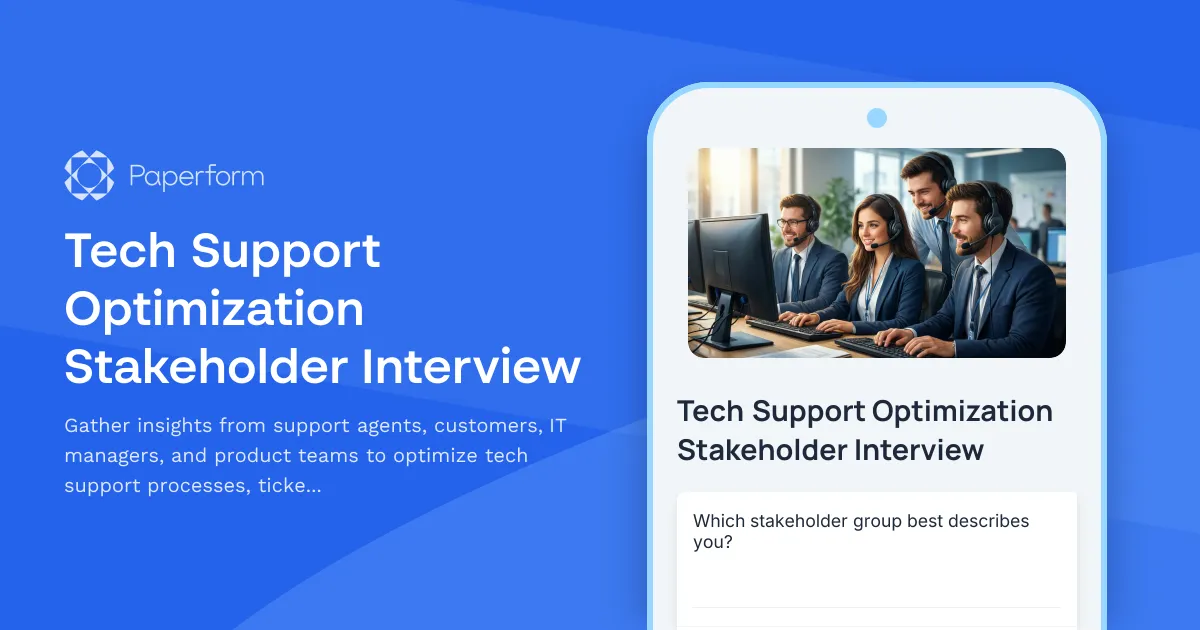
Optimize Your Tech Support Operations with Stakeholder Insights
Building a world-class technical support operation requires input from everyone involved in the support ecosystem—from frontline agents handling tickets to customers experiencing your service, and from IT managers overseeing infrastructure to product teams building the solutions. This Tech Support Optimization Stakeholder Interview template helps you systematically gather insights to improve ticket routing, knowledge management, self-service capabilities, escalation workflows, and overall satisfaction metrics.
Why Stakeholder Research Matters for Tech Support
Technical support is often the last line of defense between customer frustration and customer loyalty. When support processes break down—tickets get lost, agents can't find answers, escalations stall, or self-service options fall short—the entire customer experience suffers. The best way to identify these friction points is to ask the people who live them every day.
This template is designed for IT managers, support operations leaders, customer experience teams, and product managers who want to conduct thorough discovery research before implementing new support tools, redesigning workflows, or addressing persistent pain points. By interviewing multiple stakeholder groups with the same structured framework, you'll uncover patterns, contradictions, and opportunities that single-perspective surveys miss.
Who Should Use This Template?
This stakeholder interview form is ideal for:
- IT managers and directors evaluating helpdesk software, ticketing systems, or knowledge base platforms
- Customer support operations leaders seeking to reduce resolution times and improve agent satisfaction
- Product teams gathering requirements for new support features or self-service tools
- CX consultants and agencies conducting discovery for support transformation projects
- Business analysts and operations managers mapping current-state support workflows before optimization
Whether you're a growing SaaS company scaling your support team, an established enterprise modernizing legacy systems, or a consulting firm helping clients improve their support operations, this template gives you a structured approach to stakeholder research.
What This Template Covers
The interview captures insights across the entire support ecosystem:
Stakeholder Context: Identifies which group the respondent represents (support agent, customer, IT manager, product team) and their specific role, allowing you to segment feedback and identify role-specific pain points.
Current Experience Assessment: Explores what's working well and what's frustrating about current support processes, ticket handling, and resolution workflows from each stakeholder's unique perspective.
Ticket Routing & Assignment: Investigates how tickets currently flow through your organization, where bottlenecks occur, and how different stakeholders perceive the effectiveness of routing logic and agent assignment.
Knowledge Base & Documentation: Examines the quality, accessibility, and usefulness of existing knowledge resources—both for agents trying to solve problems and customers attempting self-service.
Self-Service Capabilities: Assesses current self-service options (FAQs, community forums, chatbots, automated troubleshooting) and identifies gaps where customers could solve problems without agent involvement.
Escalation Protocols: Maps how complex issues get escalated to senior agents, specialists, or engineering teams, and identifies where escalation processes succeed or fail.
Performance & Satisfaction Metrics: Captures what each stakeholder group considers "success" in tech support, from first-response time to customer satisfaction scores to agent happiness and retention.
Future Needs & Priorities: Gathers forward-looking input on desired improvements, new capabilities, and the changes that would have the biggest impact on support quality and efficiency.
Why Paperform is Perfect for Stakeholder Research
Unlike rigid survey tools that force everyone through the same questions, Paperform's conditional logic adapts the interview based on stakeholder type. Support agents see questions about internal tools and workload, customers see questions about their support experience, IT managers see questions about infrastructure and metrics, and product teams see questions about feature requests and roadmap alignment. Everyone gets a relevant, focused interview that respects their time and expertise.
The doc-style editor lets you create an interview that feels conversational rather than interrogatory. Mix explanatory text, images showing current workflows or mockups, and even video to set context before asking questions. This helps stakeholders understand what you're trying to solve and why their input matters, leading to richer, more thoughtful responses.
After you've collected interviews from across your organization, use Paperform's AI Insights to analyze open-ended responses and identify common themes, unexpected patterns, and priority areas for improvement. Instead of manually reading through dozens of stakeholder interviews, AI can summarize key findings, highlight contradictions between groups, and surface actionable recommendations—giving you a head start on your optimization roadmap.
Automate Your Research-to-Action Workflow with Stepper
Discovery research is only valuable if insights translate into action. With Stepper (stepper.io), Paperform's AI-native workflow automation platform, you can automatically route completed interviews to the right teams, trigger follow-up actions, and keep stakeholders engaged throughout the optimization process.
For example, when a support agent submits feedback highlighting knowledge base gaps, Stepper can automatically create a task in your project management tool, assign it to your documentation team, and notify relevant stakeholders. When multiple customers mention the same pain point, Stepper can aggregate those responses, flag high-priority issues, and send summaries to product leadership—ensuring customer voice directly influences your roadmap.
You can also use Stepper to schedule follow-up interviews, send personalized thank-you messages, or keep stakeholders updated on changes implemented based on their feedback. This closes the loop and demonstrates that their input drives real improvements, increasing participation in future research initiatives.
Best Practices for Conducting Stakeholder Interviews
Segment your outreach: Send the interview to different stakeholder groups at different times, with customized introductions explaining why their specific perspective matters. This increases completion rates and response quality.
Set expectations upfront: Let participants know how long the interview will take (aim for 10-15 minutes), how their feedback will be used, and when they can expect to see changes based on the research.
Follow up with deeper conversations: Use this form as a screening tool to identify stakeholders with particularly valuable insights or strong opinions, then schedule live interviews for richer qualitative research.
Analyze by stakeholder group: Look for areas where different groups agree (universal pain points worth addressing first) and where they disagree (potential blind spots or communication gaps between teams).
Share findings transparently: Once you've completed your analysis, share summarized findings back with participants. This builds trust and engagement for future research efforts.
Drive Continuous Improvement in Tech Support
Technical support optimization isn't a one-time project—it's an ongoing commitment to listening, learning, and adapting. This stakeholder interview template gives you a repeatable framework for gathering insights, identifying opportunities, and validating improvements over time.
Whether you're evaluating new helpdesk software, redesigning escalation workflows, building out self-service capabilities, or simply trying to understand why support metrics aren't improving, starting with structured stakeholder research ensures your optimization efforts address real problems rather than assumed ones.
Ready to transform your tech support operations? Start gathering stakeholder insights today with Paperform's flexible, intelligent interview forms.



More templates like this
Agile Transformation Stakeholder Interview
Gather critical insights from development teams, product owners, and executives about current process pain points, collaboration challenges, and requirements for a successful agile transformation.
CMS Migration Stakeholder Interview Form
Gather comprehensive stakeholder feedback on CMS migration requirements, workflow needs, integration priorities, and training expectations from marketing, IT, content, and executive teams.
Cybersecurity Initiative Stakeholder Interview
Gather strategic input from IT staff, executives, and end users on cybersecurity priorities, threat assessment, compliance needs, and training requirements to inform your security roadmap.
Data Governance Framework Stakeholder Interview
Gather strategic input from data owners, analysts, compliance officers, and IT teams to establish comprehensive data governance standards, access controls, and stewardship responsibilities.
Financial Services Digital Transformation Stakeholder Interview
Gather critical input from stakeholders on security requirements, user experience expectations, regulatory compliance needs, integration priorities, and change management concerns for your financial services digital transformation initiative.
CRM Implementation Discovery Form
A comprehensive discovery form for CRM implementation projects that captures sales process requirements, lead management workflows, integration needs, and data migration planning to ensure successful CRM deployment.
Disaster Recovery Planning Discovery Form
A comprehensive discovery form for assessing disaster recovery needs, documenting critical systems, defining recovery objectives, and establishing backup and communication protocols for business continuity planning.
Enterprise CRM Implementation Stakeholder Interview
Gather comprehensive stakeholder input from sales, marketing, customer service, and IT teams on CRM feature requirements, integrations, data migration, training needs, and adoption concerns.
Investment Advisory Platform Stakeholder Interview
A comprehensive stakeholder research form for investment advisory platforms to gather insights from advisors, clients, compliance officers, and technology teams on portfolio management, reporting, risk assessment, and regulatory needs.
IoT Implementation Discovery Form
A comprehensive discovery form for IoT implementation projects, covering sensor deployment, connectivity requirements, data processing, device management, security protocols, and scalability planning.
SaaS Product Discovery & Implementation Form
A comprehensive discovery form for SaaS implementations that maps business processes, defines user roles, captures integration requirements, scopes data migration, and assesses training needs.
Software Development Client Discovery Form
A comprehensive discovery form for software development projects that captures project requirements, user stories, technical constraints, timeline expectations, budget parameters, and ongoing maintenance needs.