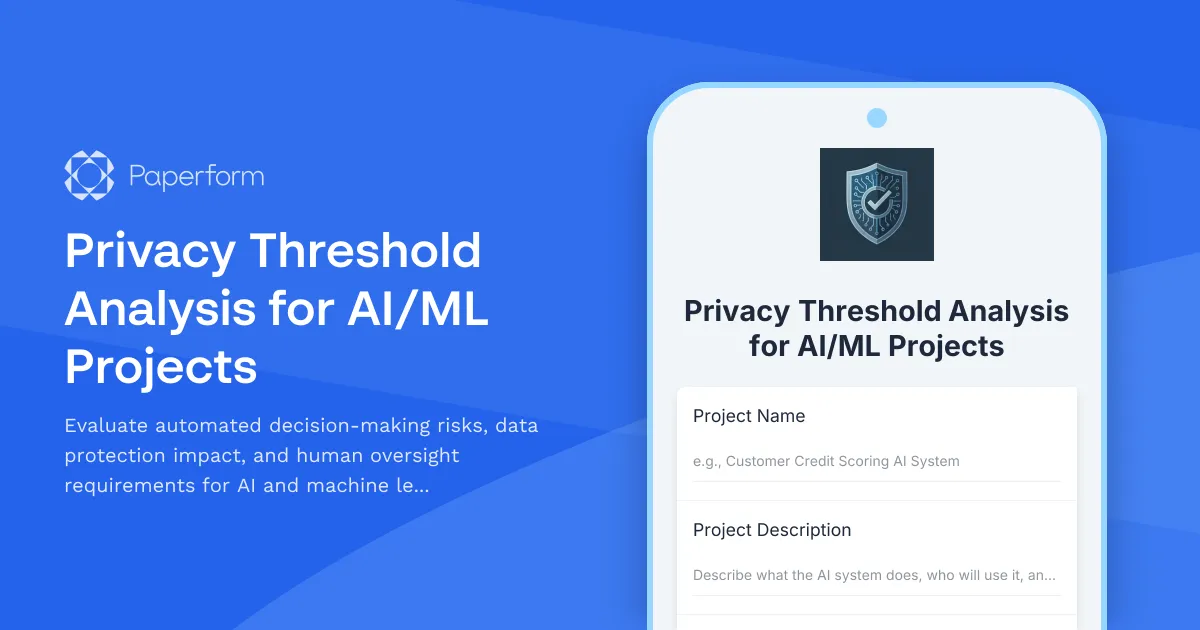
Privacy Threshold Analysis for AI/ML Projects: GDPR Compliance Made Simple
As artificial intelligence and machine learning become integral to modern business operations, ensuring GDPR compliance for automated decision-making systems is no longer optional—it's a legal requirement. This Privacy Threshold Analysis template helps organisations evaluate the privacy risks, data protection impacts, and human oversight requirements of AI/ML projects before deployment.
Why Privacy Threshold Analysis Matters for AI Projects
Under GDPR Article 35, organisations must conduct a Data Protection Impact Assessment (DPIA) when processing operations are likely to result in high risk to individuals' rights and freedoms. AI and machine learning projects—especially those involving automated decision-making, profiling, or processing of sensitive data—typically trigger this requirement.
A privacy threshold analysis serves as your first line of defence, helping you:
- Identify high-risk processing activities that require full DPIA
- Document human oversight mechanisms to satisfy GDPR Article 22 requirements
- Evaluate bias, discrimination and fairness risks in algorithmic decision-making
- Map data flows and processing purposes for transparency obligations
- Establish accountability frameworks before systems go live
This template is designed for data protection officers, compliance teams, AI project managers, legal counsel, and product teams who need to assess whether their AI/ML initiatives meet GDPR's stringent standards.
Who Should Use This Privacy Threshold Analysis Template
This form is ideal for:
- Technology companies and SaaS providers building AI-powered features or products
- Financial services firms deploying credit scoring, fraud detection or risk assessment algorithms
- Healthcare organisations implementing diagnostic AI or patient triage systems
- HR departments and recruitment agencies using automated candidate screening or employee monitoring
- Marketing agencies and eCommerce businesses running personalisation engines or behavioural profiling
- Legal and consulting firms advising clients on AI governance and GDPR compliance
- Public sector bodies evaluating automated decision systems for citizen-facing services
What This Template Covers
The form guides you through a comprehensive evaluation covering:
Project Fundamentals: Capture project name, description, stakeholders, deployment timeline and business objectives to establish context for the privacy assessment.
Data Processing Scope: Document what personal data will be processed, the lawful basis under GDPR, data sources, volume of data subjects affected, and whether special category data (health, biometric, ethnic origin, etc.) is involved.
Automated Decision-Making Assessment: Evaluate whether the AI system makes decisions that produce legal effects or similarly significant effects on individuals—the key trigger under GDPR Article 22. This includes decisions about creditworthiness, employment, access to services, or other rights-affecting outcomes.
Risk Evaluation: Assess risks related to discrimination, bias, accuracy, transparency, security breaches, and potential harm to data subjects. This section helps you determine the severity and likelihood of privacy risks.
Human Oversight & Intervention: Document what human review mechanisms exist, who is responsible for oversight, how individuals can contest automated decisions, and whether meaningful human intervention is possible at critical decision points.
Transparency & Explainability: Evaluate whether the AI system's logic can be explained to data subjects in clear language, how individuals will be informed about automated processing, and what information rights (access, rectification, erasure) are supported.
Mitigation Measures: Identify technical and organisational safeguards such as privacy-by-design principles, data minimisation, anonymisation, testing protocols, bias detection, and regular audits.
Threshold Determination: Based on the collected information, the form helps you determine whether a full DPIA is required, whether the project can proceed with standard safeguards, or whether significant modifications are needed before deployment.
GDPR Compliance Built In
This template is purpose-built around GDPR's core requirements for AI and automated decision-making:
- Article 22 compliance: Documents whether purely automated decisions are made and what safeguards exist
- Article 35 DPIA triggers: Helps identify when a full Data Protection Impact Assessment is mandatory
- Accountability principle (Article 5): Creates documentation demonstrating compliance efforts
- Transparency obligations: Ensures you've planned how to explain AI decisions to data subjects
- Data protection by design (Article 25): Encourages early identification of privacy risks during project planning
By completing this threshold analysis early in your AI project lifecycle, you create a clear audit trail demonstrating good faith compliance efforts—critical if your data protection authority ever conducts an investigation or if data subjects file complaints.
Streamline Your Compliance Workflow with Paperform
This Paperform template makes privacy threshold analysis faster and more collaborative than traditional spreadsheets or static documents. Features that make a difference:
Conditional logic ensures respondents only see relevant questions based on their project characteristics—if you're not processing special category data, you skip those sections entirely.
Multi-page layout breaks the assessment into digestible sections, preventing overwhelm while maintaining thoroughness.
Team collaboration: Share the form with project managers, data protection officers, legal counsel, and technical leads so everyone can contribute their expertise to the assessment.
Automatic documentation: Every submission creates a timestamped record of your privacy analysis, perfect for compliance audits or accountability documentation.
Integration ready: Connect submissions to your compliance management system, project tracking tools, or document repositories using Paperform's native integrations or Stepper workflows.
Automate Your Compliance Processes with Stepper
Once you've identified risks through this threshold analysis, you'll likely need to take action—commissioning a full DPIA, implementing new safeguards, or routing decisions through approval chains.
That's where Stepper, Paperform's AI-native workflow automation platform, becomes invaluable. Use Stepper to:
- Automatically route high-risk assessments to your Data Protection Officer or legal team for review
- Trigger DPIA workflows when threshold criteria indicate mandatory assessment
- Create tasks in project management tools for implementing recommended mitigation measures
- Send notifications to stakeholders when AI projects require compliance adjustments
- Update compliance registers in Airtable, Notion or your GRC platform
- Generate summary reports for senior management or data protection authorities
With Stepper's no-code workflow builder, your privacy threshold analysis doesn't just collect information—it kicks off the entire compliance process automatically, ensuring nothing falls through the cracks.
Built for Legal, Compliance and Technology Teams
Whether you're a data protection officer managing multiple AI initiatives, a product manager launching a new ML feature, or a compliance consultant advising clients on GDPR, this template speaks your language.
The questions are framed in clear, accessible language that both technical and non-technical stakeholders can understand, while still capturing the nuanced information needed for robust privacy analysis. No PhD in data science or law degree required—just a commitment to responsible AI deployment.
Trusted Compliance Infrastructure
Paperform is SOC 2 Type II certified and GDPR compliant, meaning your privacy assessments are stored on infrastructure that meets the same high standards you're evaluating in your AI projects. With data residency controls, role-based permissions, and enterprise-grade security, you can trust Paperform to handle sensitive compliance information appropriately.
Get Started Today
AI and machine learning offer tremendous opportunities for innovation and efficiency, but they also introduce complex privacy risks that can't be ignored. This Privacy Threshold Analysis template gives you a structured, repeatable process for evaluating those risks early—when mitigation is still straightforward and cost-effective.
Used by technology companies, financial institutions, healthcare providers, and compliance professionals across the EU and beyond, this template helps you balance innovation with responsibility, ensuring your AI projects respect individual rights while delivering business value.
Start your privacy threshold analysis today with Paperform, and build AI systems that are not just powerful, but trustworthy and compliant.



More templates like this
GDPR Data Breach Assessment Form
Structured assessment form to evaluate data breaches and determine if notification to supervisory authority is required under GDPR Article 33 within 72 hours.
Data Mapping Exercise Documentation Form
A comprehensive form for documenting personal data processing activities and data flows across systems to maintain Article 30 GDPR Records of Processing Activities (RoPA) compliance.
French GDPR Data Breach Notification Form
Report personal data breaches to CNIL within 72 hours of discovery, in compliance with GDPR Article 33 and French data protection regulations.
GDPR Binding Corporate Rules Application Form
A comprehensive form for multinational groups to apply for Binding Corporate Rules (BCR) approval, enabling compliant intra-group personal data transfers across borders under GDPR requirements.
GDPR Cross-Border Data Flow Inventory Form
Comprehensive inventory form for documenting international data transfers, mapping legal bases, and recording safeguard mechanisms in compliance with GDPR Articles 44-50.
GDPR Data Breach Notification Form
A compliant template for notifying data subjects of personal data breaches under GDPR Article 34, documenting the incident, potential consequences, and remediation measures taken by your organization.
Privacy Notice Update Notification Form
Notify data subjects of privacy policy changes and collect updated consent in compliance with GDPR requirements. Ensure transparent communication and maintain regulatory compliance.
Privacy Threshold Assessment Form
A structured assessment form to determine whether your new project, initiative, or system change triggers GDPR compliance review requirements or necessitates a full Data Protection Impact Assessment (DPIA).
Corporate Data Breach Whistleblower Report
A secure, anonymous form for employees and stakeholders to report suspected data breaches and security incidents with full GDPR compliance and incident severity assessment.
Data Breach Incident Report Form
Document and manage data breach incidents with comprehensive system impact analysis, user assessment, response tracking, and regulatory notification timelines.
Data Controller Accountability Documentation Form
Comprehensive GDPR compliance documentation form for data controllers to record policies, procedures, training records, and audit results demonstrating accountability under EU data protection law.
Data Controller Change Notification & Consent Form
Notify customers of business ownership transfer and obtain consent for data processing continuity under new data controller, with clear opt-out rights per GDPR requirements.