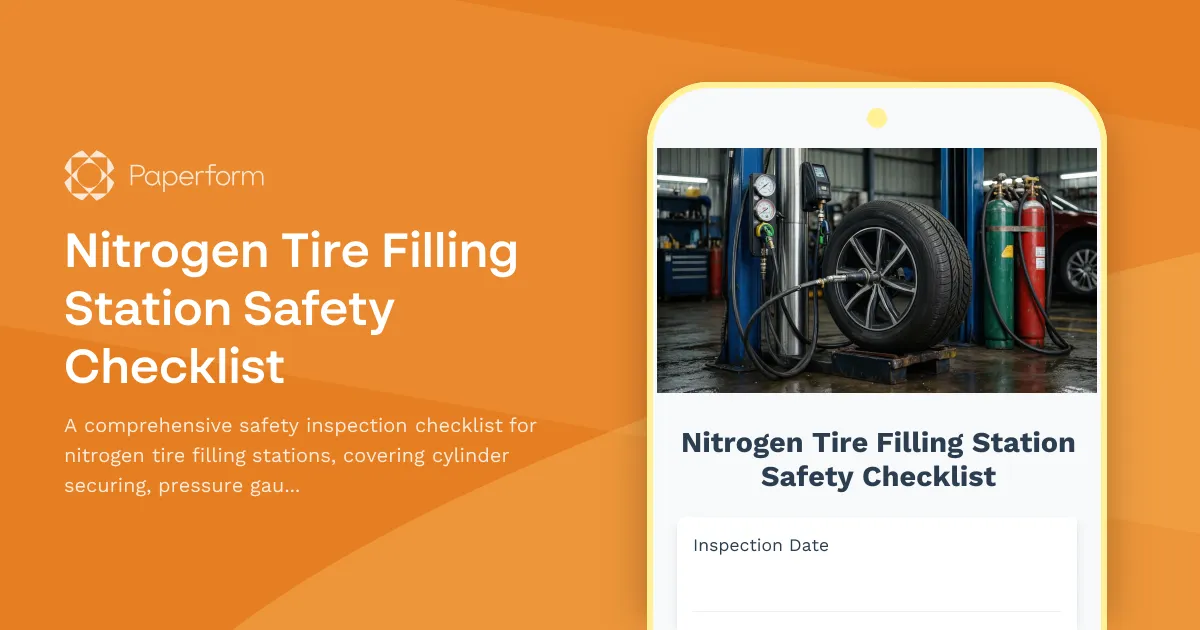
Nitrogen Tire Filling Station Safety Checklist Template
Nitrogen tire filling stations are increasingly common in automotive service centers, tire shops, and fleet maintenance facilities. While nitrogen inflation offers benefits like improved tire pressure retention and reduced oxidation, these stations present unique safety challenges that require systematic monitoring. This Nitrogen Tire Filling Station Safety Checklist is designed to help technicians, safety officers, and facility managers conduct thorough, consistent inspections that protect workers and maintain regulatory compliance.
Why Use This Nitrogen Safety Checklist?
Nitrogen, while inert and non-flammable, poses serious risks when handled improperly. High-pressure cylinders can become projectiles if not secured correctly. In confined spaces, nitrogen can displace oxygen and create asphyxiation hazards without warning—since nitrogen is colorless, odorless, and tasteless. This checklist addresses these critical safety concerns through structured, repeatable inspections that cover:
- Cylinder securing and storage compliance to prevent tip-overs and physical damage
- Pressure gauge calibration and accuracy to ensure safe operating pressures
- Ventilation system adequacy to prevent oxygen-deficient atmospheres
- Oxygen displacement monitoring with proper detection equipment
- Emergency shutdown accessibility for rapid response to incidents
By digitizing this inspection process with Paperform, you eliminate clipboard-based checks that get lost, forgotten, or inconsistently completed. Every inspection is timestamped, assignable to specific personnel, and instantly accessible for audits or incident investigations.
Who Benefits from This Template?
This nitrogen tire filling station safety checklist is essential for:
- Automotive service centers that offer nitrogen tire inflation as a premium service
- Tire retailers and installers managing multiple filling stations across locations
- Fleet maintenance facilities with high-volume nitrogen tire operations
- Safety officers and EHS managers responsible for workplace safety compliance
- Facility managers overseeing automotive service operations
- Insurance risk managers documenting safety protocols and inspection frequency
Whether you're running a single-bay tire shop or managing a multi-location automotive service operation, this template ensures your nitrogen filling stations meet OSHA guidelines and industry best practices.
Key Safety Areas Covered
Nitrogen Cylinder Management: Verify that cylinders are properly secured with chains or brackets, stored upright, protected from physical damage, and clearly labeled. Check that valve protection caps are in place when cylinders aren't connected.
Pressure System Integrity: Inspect pressure gauges for accuracy and calibration dates, check regulators for proper function, examine hoses and fittings for wear or leaks, and confirm operating pressures stay within safe ranges.
Ventilation and Air Quality: Assess mechanical ventilation systems, verify adequate air changes per hour, check that exhaust points are functioning, and ensure natural ventilation pathways aren't obstructed.
Oxygen Monitoring Systems: Confirm oxygen sensors are installed and functional, verify calibration dates, test alarm systems, and ensure monitoring data is being logged properly.
Emergency Response Readiness: Verify emergency shutdown valves are clearly marked and accessible, check that emergency contact information is posted, confirm first responders know the station location, and ensure evacuation routes are clear.
How Paperform Elevates Your Safety Program
Traditional paper checklists create compliance gaps. They're difficult to track, easy to skip, and nearly impossible to analyze for trends. With Paperform's digital approach:
- Conditional logic shows additional questions when hazards are identified, capturing detailed follow-up information
- Photo uploads let inspectors document issues visually, creating clear evidence for corrective action
- Required fields ensure critical items aren't skipped or overlooked
- Automatic timestamps prove when inspections occurred for regulatory compliance
- Email notifications alert managers immediately when safety concerns are identified
For facilities running multiple stations or locations, this creates a centralized safety database that reveals patterns—like recurring pressure gauge failures or ventilation issues—before they cause incidents.
Automate Your Safety Workflow with Stepper
After identifying safety issues through your checklist, what happens next? With Stepper, Paperform's AI-native workflow builder, you can automatically:
- Route high-priority safety issues to facility managers or maintenance teams
- Create work orders in your CMMS when equipment failures are detected
- Schedule follow-up inspections when issues are marked for corrective action
- Update safety logs in Google Sheets, Airtable, or your safety management system
- Send escalation notices when critical issues aren't resolved within set timeframes
This closes the loop between inspection and action, ensuring safety issues don't fall through the cracks between shifts or get buried in email threads.
Built for Automotive and Tire Industry Professionals
This template speaks your language. It's designed around the practical realities of tire service operations—where technicians are busy, space is tight, and safety can't slow down productivity. The checklist items reflect real-world nitrogen filling station hazards based on OSHA guidelines and industry safety standards.
Whether your team works on passenger vehicles, commercial fleets, or specialty equipment, this checklist adapts to your operation. You can customize inspection frequency (daily, weekly, monthly), add location-specific items, and adjust the workflow to match your existing safety management system.
Compliance Documentation Made Simple
When OSHA inspectors arrive, when insurance auditors request safety records, or when investigating an incident, you need proof that safety protocols were followed. Paperform automatically creates that documentation:
- Every submission is permanently stored with timestamp and inspector identification
- Failed items are flagged for easy reporting
- Trends over time reveal equipment that needs replacement or upgraded procedures
- Export options let you share data with stakeholders in any format
For multi-location operations, you can roll up safety performance across all sites, identifying which locations maintain the highest safety standards and which need additional support or training.
Why Paperform for Safety Checklists?
Paperform is trusted by over 500,000 teams worldwide for forms that matter. With SOC 2 Type II compliance and GDPR readiness, your safety data stays secure and accessible. The platform works on any device—desktop, tablet, or smartphone—so inspectors can complete checks right at the nitrogen filling station without returning to an office computer.
The intuitive form builder means your safety team can customize this template without IT support. Add company-specific equipment checks, adjust terminology to match your operation, or integrate with the tools you already use—from Slack notifications to automated reporting in your safety management platform.
Get Started Protecting Your Team Today
Nitrogen tire filling stations are valuable assets that require systematic safety oversight. This checklist template gives you the structure, documentation, and automation to maintain the highest safety standards without adding administrative burden to your team.
Start with this template, customize it to your operation, and build a safety culture where inspections are completed consistently, issues are addressed promptly, and everyone goes home safe at the end of their shift.



More templates like this
Paint Booth and Spray Finishing Safety Checklist
Comprehensive safety inspection checklist for paint booths and spray finishing operations, covering ventilation systems, lighting, fire suppression, solvent storage, and PPE compliance.
Vehicle Fleet Pre-Trip Safety Inspection Checklist
A comprehensive pre-trip vehicle inspection form for fleet managers to ensure commercial vehicles meet safety standards before operation, covering tires, brakes, fluids, lights, and emergency equipment.
Car Wash Facility Safety Inspection Checklist
Comprehensive safety inspection checklist for car wash facilities covering equipment safety, chemical handling, slip hazards, electrical systems, and ventilation compliance.
Coin Laundry Facility Safety Audit Checklist
Comprehensive safety audit checklist for coin laundry facilities covering equipment maintenance, chemical storage compliance, building codes, ADA accessibility, and water efficiency monitoring.

Commercial Roofing Work Safety Checklist
A comprehensive safety inspection checklist for commercial roofing contractors to verify fall protection systems, equipment, weather conditions, and OSHA compliance before starting elevated work.
Construction Site Safety Audit Checklist
A comprehensive safety audit checklist for construction sites covering fall protection, scaffolding, electrical hazards, equipment maintenance, and worker certifications to ensure OSHA compliance and workplace safety.
Construction Site Supervisor Safety Competency Assessment
Comprehensive safety competency evaluation for construction site supervisors, including OSHA regulation knowledge, hazard identification scenarios, and emergency response procedures.
Crane Lift Plan and Safety Inspection Form
A comprehensive crane lift plan and safety inspection form for construction sites. Includes load calculations, rigging inspection checklists, exclusion zone documentation, and safety compliance verification for crane operations.
Dust Suppression System Inspection Form
A comprehensive safety inspection form for evaluating dust suppression systems, water spray functionality, coverage adequacy, and runoff collection compliance on construction sites.
Electrical Safety Inspection Checklist
A comprehensive electrical safety inspection checklist covering panel clearance, grounding systems, extension cords, arc flash labeling, and lockout/tagout procedures for workplace compliance.
Electroplating Line Inspection Checklist
Comprehensive inspection checklist for electroplating operations covering solution concentration testing, rectifier calibration, and waste treatment verification to ensure quality control and regulatory compliance.

Elevator & Lift Safety Inspection Checklist
Comprehensive elevator and lift safety inspection form covering cable wear, emergency brakes, phone systems, weight capacity signage, and annual certification compliance for buildings and facilities.