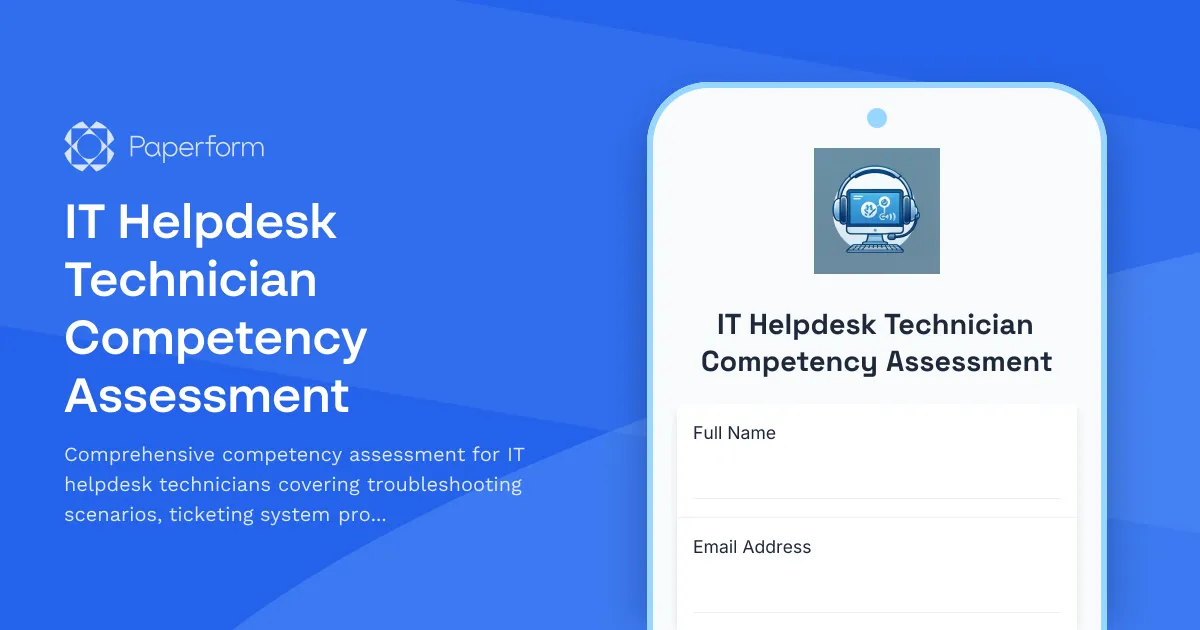
Streamline Your IT Helpdesk Hiring & Training with a Competency Assessment Form
Finding skilled IT helpdesk technicians who can handle real-world technical issues, deliver excellent customer service, and navigate ticketing systems efficiently is critical for IT teams, MSPs, and tech companies. This IT Helpdesk Technician Competency Assessment gives you a structured, standardized way to evaluate candidates and existing team members across the core skills that matter—troubleshooting ability, technical knowledge, customer communication, and ticketing proficiency.
Built with Paperform, this assessment combines multiple question types—scenario-based troubleshooting, technical knowledge quizzes, rating scales, and open-ended responses—all in one clean, professional form that's easy to customize and share. Whether you're screening job applicants, onboarding new hires, or running quarterly skills reviews, you can capture detailed responses that help you identify strengths, knowledge gaps, and training opportunities.
Who This Assessment Is For
This template is designed for IT managers, HR teams, recruitment agencies, MSPs, technical training providers, and internal IT departments who need to:
- Evaluate job candidates during technical interviews
- Assess new hires during onboarding or probation periods
- Conduct annual or quarterly competency reviews for existing technicians
- Identify skills gaps and prioritize training programs
- Standardize evaluations across multiple team members or locations
What Makes This Template Effective
The assessment is organized into clear sections covering the essential competencies for helpdesk technicians:
- Technical troubleshooting scenarios that test problem-solving and diagnostic skills in realistic situations
- Ticketing system proficiency questions to gauge familiarity with ITSM tools, ticket prioritization, and workflow management
- Customer service and communication skills evaluation through situational questions and self-assessment
- Technical knowledge quiz covering hardware, software, networking, security, and common support issues
Each section is designed to reveal not just what someone knows, but how they think, prioritize, and communicate under pressure—the real-world skills that separate great helpdesk technicians from mediocre ones.
Automate Your Assessment Workflow with Stepper
Once submissions come in, you can use Stepper to automate your evaluation and follow-up process:
- Score responses automatically based on correct answers or weighted criteria
- Route completed assessments to hiring managers or team leads for review
- Send personalized feedback emails to candidates based on their performance
- Update your HR system, ATS, or Notion database with assessment results
- Trigger onboarding workflows for candidates who pass, or schedule follow-up interviews for those who need further evaluation
By connecting Paperform and Stepper, you turn a static assessment into an intelligent workflow that saves time, reduces manual admin, and ensures every candidate gets a consistent, fair evaluation.
Built for IT Teams and Hiring Managers
This template is trusted by IT departments, managed service providers, and HR teams who need a professional, scalable way to assess technical competency without reinventing the wheel for every new hire or review cycle. With Paperform's conditional logic and custom scoring, you can tailor the assessment to different skill levels, specializations, or job requirements—and get results that help you make smarter hiring and training decisions.
More templates like this
Cybersecurity Awareness Training Quiz
Test employee knowledge on phishing detection, password security, and data protection with this comprehensive cybersecurity awareness quiz designed for workplace training programs.
Systems Analyst Skills Evaluation Form
Assess technical and analytical competencies of systems analysts, identify skill gaps in requirements gathering, process mapping, and solution design, and create targeted development plans.
Clinical Informatics Specialist Competency Assessment
Comprehensive skills assessment for clinical informatics specialists covering EHR optimization, clinical decision support, data analytics, and workflow analysis competencies.
Cloud Computing Certification Trainer Feedback Form
Comprehensive evaluation form for cloud computing certification instructors, covering AWS/Azure platform navigation, architecture design teaching, cost optimization strategies, and hands-on lab effectiveness.
Healthcare Data Analyst Competency Evaluation
Comprehensive skills assessment for healthcare data analysts covering SQL optimization, data standards, visualization dashboards, and predictive modeling techniques.
Healthcare Informatics Specialist Competency Assessment
Comprehensive competency evaluation for healthcare informatics specialists covering clinical workflows, system configuration, data governance, and interoperability standards.
IT Technical Skills Gap Analysis Form
Assess current technical proficiencies, identify skill gaps, and prioritize training needs for software development teams with certification tracking and personalized development planning.
Talent Acquisition Specialist Competency Evaluation
Assess the skills and expertise of talent acquisition professionals across sourcing strategies, behavioral interviewing, ATS proficiency, and hiring metrics analysis.
Benefits Administrator Competency Assessment
Evaluate benefits administrator competency across HRIS systems, ERISA and ACA compliance, enrollment procedures, and employee counseling scenarios with this comprehensive skills assessment form.
Customer Service Representative Skills Assessment
Comprehensive competency evaluation for customer service representatives covering call handling, product knowledge, CRM proficiency, and essential soft skills.
Cybersecurity Awareness Training Instructor Evaluation Form
Evaluate the effectiveness of cybersecurity awareness training instructors, covering phishing identification, password hygiene, social engineering scenarios, and incident reporting protocols.
Cybersecurity Team Skills Gap Analysis Form
Assess your cybersecurity team's competencies across threat detection, incident response, penetration testing, compliance frameworks, and security awareness to identify training needs and strengthen your security posture.