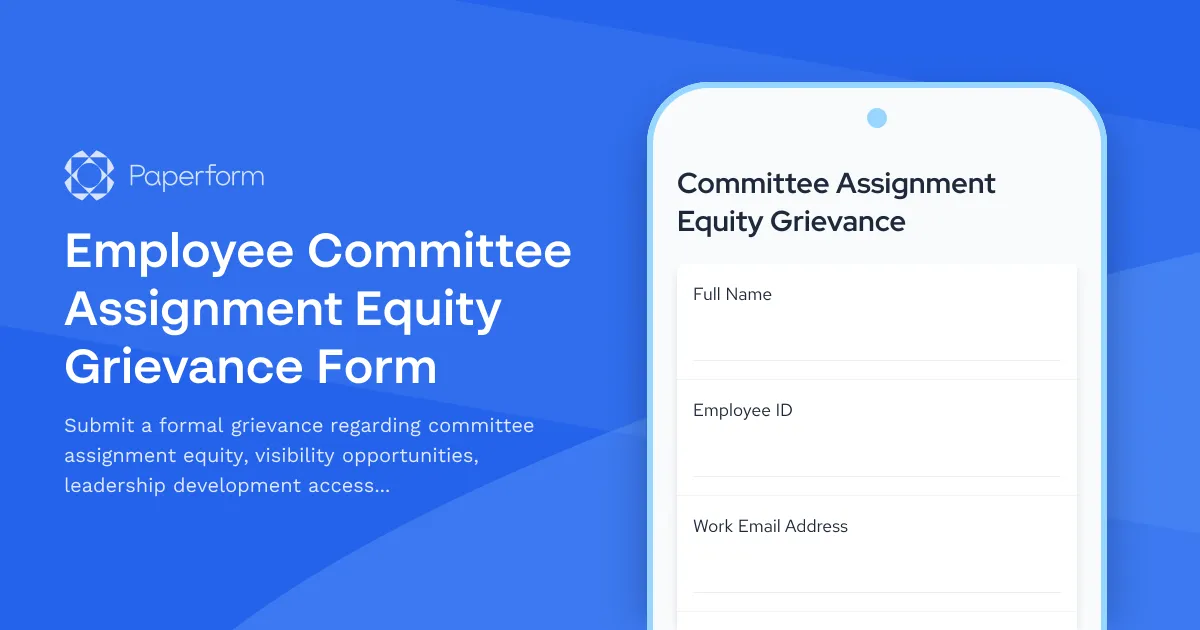
Committee Assignment Equity Grievance Form: Ensure Fair Access to Leadership Opportunities
Committee assignments, task forces, and special projects are more than just extra work—they're critical pathways to visibility, professional development, and career advancement. When selection processes lack transparency or certain employees are consistently overlooked, it creates inequity that can stall careers and erode trust in organizational fairness.
This Employee Committee Assignment Equity Grievance Form template provides a structured, professional way for employees to raise concerns about committee selection processes, unequal access to leadership development opportunities, and transparency issues in assignment decisions. Built with Paperform, this template empowers HR teams and leadership to take employee concerns seriously while creating a clear record of grievances for investigation and resolution.
Why Committee Assignment Equity Matters
Research consistently shows that high-visibility projects and committee work are stepping stones to promotion and leadership roles. When access to these opportunities is inequitable—whether due to bias, favoritism, lack of transparency, or informal selection processes—it disproportionately impacts underrepresented groups and limits organizational diversity at leadership levels.
Common concerns include:
- Lack of transparency in how committee members are selected
- Consistent patterns of the same employees being chosen for high-visibility work
- Informal selection processes that favor certain networks or relationships
- Limited communication about available opportunities
- Unequal access to leadership development and mentorship through committee work
- Retaliation concerns when employees express interest or raise equity questions
This form gives employees a confidential channel to document these concerns with specific details, supporting evidence, and desired outcomes—helping HR and leadership teams conduct thorough, fair investigations.
How This Template Supports Your Organization
Structured Documentation
The form guides employees through providing specific details about their grievance, including dates, committee names, selection processes observed, and patterns of inequity. This structured approach ensures HR receives actionable information rather than vague complaints, making investigations more efficient and effective.
Confidentiality and Safety
Employees can indicate their comfort level with different levels of confidentiality and express concerns about potential retaliation. This helps HR handle sensitive situations appropriately and take proactive steps to protect employees who come forward.
Evidence Collection
The form includes fields for employees to describe supporting evidence, witnesses, and documentation, creating a comprehensive record that supports fair investigation and resolution.
Clear Desired Outcomes
Rather than just collecting complaints, the form asks employees what resolution they're seeking—whether that's policy changes, access to specific opportunities, or systemic improvements to selection processes.
Who Benefits from This Form?
Human Resources Teams
HR professionals gain a standardized intake process for grievances related to opportunity equity, ensuring consistent handling of sensitive workplace issues. The form creates documentation that supports fair investigations and helps identify systemic patterns that require policy intervention.
Diversity, Equity, and Inclusion Leaders
DEI practitioners can use grievance data to identify gaps in opportunity access, track progress on equity initiatives, and build the case for more transparent selection processes and leadership development programs.
People Operations and Leadership Development
Teams responsible for talent development can use insights from grievances to redesign committee selection processes, create more equitable pathways to leadership, and ensure all employees have fair access to career-advancing opportunities.
Legal and Compliance Teams
Having a formal grievance process with proper documentation helps organizations meet legal obligations and demonstrates good-faith efforts to address workplace equity concerns.
Employees at All Levels
Most importantly, this form gives employees a voice and a clear pathway to raise legitimate concerns about fairness and opportunity without fear of being dismissed or ignored.
Streamline Your Grievance Workflow with Paperform and Stepper
This template is more than just a form—it's the foundation of a responsive, equitable grievance process. With Paperform's conditional logic, sensitive information only appears when relevant, creating a respectful, focused experience for employees filing grievances.
When integrated with Stepper (stepper.io), your AI-native workflow automation platform, you can build an end-to-end grievance management process:
- Automatic routing: Send grievances to the appropriate HR business partner, DEI lead, or department head based on severity and content
- Case tracking: Create tickets in your HR system or project management tool automatically
- Acknowledgment emails: Send immediate confirmation to the employee with case numbers and expected timelines
- Investigation workflows: Trigger multi-step investigation processes including witness interviews, document review, and stakeholder consultation
- Escalation rules: Automatically escalate cases that involve senior leadership or require legal review
- Follow-up scheduling: Set reminders for check-ins with the grievant and ensure timely resolution
- Trend analysis: Push data to analytics tools to identify patterns across grievances and inform policy improvements
By connecting this form to your existing HR systems through Stepper, you transform individual complaints into actionable intelligence that drives systemic change.
Building Trust Through Transparent Processes
When employees see that their concerns about equity are taken seriously—with formal processes, timely responses, and visible follow-through—it builds organizational trust. This form template, combined with Paperform's professional design capabilities, signals to your workforce that leadership is committed to fairness and willing to examine potentially uncomfortable truths about opportunity distribution.
The form can be customized to match your organization's branding, tone, and specific policies, ensuring consistency with your broader employee relations approach. Whether you're a mid-sized company building formal HR processes or an established organization enhancing your DEI infrastructure, this template provides a solid foundation.
Get Started with Fair, Transparent Grievance Management
Committee assignment equity is a cornerstone of workplace fairness. When all employees have transparent access to opportunities that build skills, visibility, and leadership experience, everyone benefits—including the organization, which gains from diverse perspectives and more equitable talent development.
Start with this Employee Committee Assignment Equity Grievance Form template to create a clear, professional channel for employees to voice concerns, help HR teams conduct thorough investigations, and build a more equitable workplace culture. With Paperform's intuitive editor and powerful integrations, you can launch your grievance process in minutes and continuously improve it as your organization grows.
Ready to build a more equitable workplace? This form template gives you the tools to listen, document, and act on employee concerns about opportunity access—helping you create a culture where everyone has a fair shot at growth and leadership.
More templates like this
Employee Resource Group (ERG) Participation Survey
Gather employee feedback on ERG participation, affinity group interests, event attendance, and leadership opportunities to strengthen workplace diversity and inclusion initiatives.
Socioeconomic Status Discrimination Report Form
A confidential form for reporting discrimination, harassment, or workplace barriers related to socioeconomic status, class background, or economic circumstances.
Caregiver Discrimination Grievance Form
A comprehensive form for employees to report caregiver discrimination, FMLA interference, family responsibility bias, schedule accommodation denials, and related Title VII violations in the workplace.
Employee Peer Review Bias Grievance Form
Submit formal complaints about bias, manipulation, or retaliation in peer review and 360 feedback processes. Confidential documentation of review integrity concerns.
Workplace Mental Health & Wellbeing Survey
A comprehensive survey to assess employee mental health, stress levels, wellbeing support needs, and gather feedback on existing counseling services and workplace mental health initiatives.
Company Communication Access Grievance Form
A formal grievance form for employees to report communication inequities, information access issues, remote worker exclusion, and concerns about decision-making transparency in the workplace.
Employee Achievement Recognition Disparity Complaint Form
Document concerns about unfair recognition practices, award nomination bias, and visibility inequity in the workplace. Help HR address recognition disparities and improve morale.
Employee Floating Holiday Denial Grievance Form
A formal grievance form for employees to appeal denied floating holiday requests, with special consideration for cultural, religious, and personal accommodations.
Employee Sick Leave Denial Grievance Form
File a formal grievance regarding denied sick leave, FMLA eligibility issues, or policy misapplication. Document your case with medical certification and request review of denied leave requests.
Employee Training Completion Deadline Grievance Form
A formal grievance form for employees to raise concerns about unrealistic training completion deadlines, inadequate paid time allocation, and work-hour conflicts affecting their ability to complete required training.
Unfair Treatment Grievance Form
Report workplace unfair treatment with policy citations, comparative employee data, supporting documentation, and request a formal equity review.
AI Monitoring & Bias Complaint Form
A comprehensive form for employees to report concerns about AI-powered monitoring systems, including facial recognition errors, algorithmic bias, and discriminatory surveillance practices.