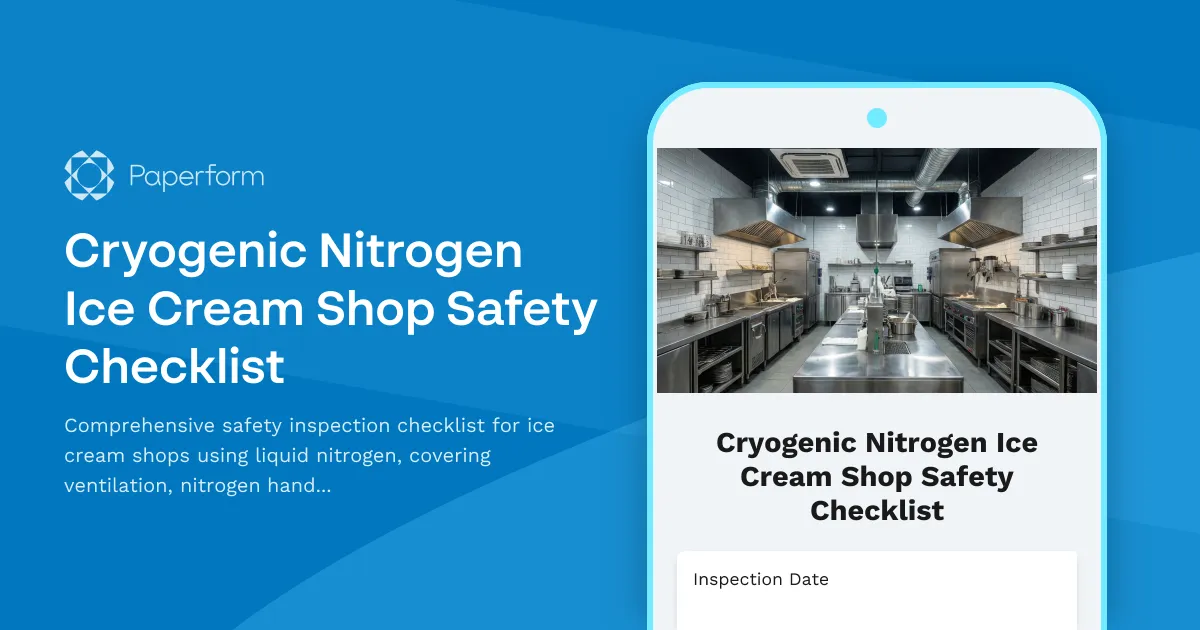
Keep Your Liquid Nitrogen Ice Cream Shop Safe with Professional Safety Checklists
Operating a cryogenic ice cream shop is exciting—watching frozen treats come to life in seconds never gets old. But working with liquid nitrogen at -196°C (-321°F) requires serious safety protocols. One missed ventilation check or overlooked handling procedure could put your staff and customers at risk.
This Cryogenic Nitrogen Ice Cream Shop Safety Checklist template helps ice cream shop owners, managers, and safety officers conduct thorough daily, weekly, or pre-shift safety inspections. Built specifically for businesses using liquid nitrogen in food preparation, this checklist covers everything from ventilation adequacy and nitrogen storage to temperature burn prevention and emergency spill containment.
Why Ice Cream Shops Need Specialized Safety Checklists
Liquid nitrogen creates unique hazards that traditional ice cream shops don't face. When nitrogen evaporates, it displaces oxygen—poor ventilation can lead to asphyxiation risks. Direct contact causes instant frostbite. And because the process happens in front of customers, safety isn't just about compliance—it's about protecting your brand and building trust.
Regular safety inspections help you:
- Prevent workplace injuries from nitrogen burns, frostbite, and oxygen displacement
- Maintain compliance with OSHA regulations and local health department requirements
- Protect customers by ensuring safe demonstration and serving practices
- Document due diligence with timestamped inspection records
- Train staff consistently on proper nitrogen handling procedures
- Identify equipment issues before they become hazards
Whether you're running daily pre-shift checks or monthly deep-dive inspections, having a standardized checklist ensures nothing gets missed—even during your busiest rushes.
What This Template Covers
This comprehensive safety checklist is organized into critical safety zones:
Ventilation & Air Quality: Verify exhaust systems are functioning, air circulation meets requirements, oxygen monitors are calibrated, and ventilation rates are adequate for nitrogen usage levels.
Nitrogen Handling & Storage: Check dewar storage security, fill levels, pressure relief valves, transfer equipment condition, and proper labeling and signage.
Personal Protective Equipment (PPE): Confirm availability and condition of cryogenic gloves, face shields, aprons, closed-toe shoes, and that staff are trained on proper use.
Temperature Burn Prevention: Inspect serving tools, verify proper handling techniques are followed, check customer barrier adequacy, and ensure nitrogen contact prevention protocols are in place.
Food Safety Compliance: Review ingredient storage temperatures, cross-contamination prevention measures, sanitization procedures, and food-grade nitrogen certification.
Emergency Preparedness: Verify spill containment supplies, eyewash station functionality, first aid kit stocking, emergency contact posting, and staff knowledge of emergency procedures.
Equipment Condition: Assess mixing containers for cracks, inspect dispensing equipment, check temperature monitoring devices, and verify all safety interlocks are operational.
Each section uses yes/no questions, conditional follow-ups for issues identified, and space for notes and corrective actions. You can customize the template to match your specific equipment, local regulations, and operational procedures.
How Paperform Makes Safety Inspections Easier
Paperform transforms this safety checklist from a clipboard and paper process into a streamlined digital workflow:
Mobile-friendly inspections: Staff can complete checklists on tablets or phones right on the shop floor, checking items as they inspect each station—no more forgetting to transfer handwritten notes later.
Conditional logic: If someone marks "No" on a critical safety item like "Ventilation system operational," the form automatically reveals follow-up questions about the specific issue and required corrective actions, ensuring nothing gets missed.
Photo documentation: Add image upload fields so inspectors can photograph any issues—a cracked dewar, a damaged glove, or inadequate signage—creating visual evidence attached directly to the inspection record.
Timestamp and accountability: Every submission is automatically timestamped and can capture the inspector's name and signature, creating an audit trail that proves compliance during health inspections or incident investigations.
Automated notifications: Set up email alerts to notify managers immediately when critical safety issues are identified, or send weekly summaries of all inspections completed.
Centralized records: All inspection data flows into one dashboard where you can track trends, identify recurring issues, and prove compliance history to regulators or insurance providers.
Workflow automation with Stepper: Connect your safety checklist to Stepper workflows that automatically create maintenance tickets when equipment issues are identified, notify supervisors of failed inspections, or update your safety management spreadsheet—keeping everyone in the loop without manual follow-up.
Who This Template Is For
This template is designed for:
- Ice cream shop owners and managers conducting daily or pre-shift safety checks
- Food safety officers performing compliance audits
- Staff supervisors training new employees on nitrogen safety protocols
- Health and safety consultants working with novelty ice cream businesses
- Multi-location operators standardizing safety procedures across different shops
- Insurance providers requiring documented safety inspection programs
Whether you're a single artisan ice cream shop or a growing chain of nitrogen dessert locations, this checklist helps you maintain consistent safety standards.
Customize for Your Operation
Every cryogenic ice cream operation is different. Paperform's doc-style editor makes it easy to adapt this template to your needs:
- Add sections for specific equipment you use (automated nitrogen dispensers, custom mixing stations, etc.)
- Include local health code requirements or building-specific safety protocols
- Adjust inspection frequency fields (daily, weekly, monthly) to match your safety program
- Add signature capture for management sign-off on completed inspections
- Include calculation fields that track percentage of items passed vs. failed
You can also create different versions for different inspection types—a quick daily checklist, a comprehensive weekly inspection, and a detailed monthly audit—all while maintaining consistent formatting and data collection.
Build a Culture of Safety
The best safety programs go beyond compliance—they create a culture where every team member understands the risks and takes ownership of safe practices. Using a professional, consistent safety checklist shows your staff that safety is a priority, not an afterthought.
With Paperform's eSignature integration through Papersign (papersign.com), you can even have staff sign off on safety training acknowledgments or confirm they've reviewed the inspection findings, creating legally-binding proof that your team is informed and accountable.
Get Started with Professional Safety Management
Stop relying on paper checklists that get lost, forgotten, or filled out inconsistently. Paperform gives your ice cream shop a professional safety inspection system that's easy to use, proves compliance, and actually helps prevent incidents.
With SOC 2 Type II compliance, secure data storage, and the ability to set custom retention policies, your safety records are protected and accessible when you need them—whether that's next week or next year during a regulatory audit.
Start with this template, customize it to your operation, and build a safety inspection routine that protects your staff, your customers, and your business.


More templates like this
Commercial Kitchen Equipment Safety Checklist
Comprehensive safety inspection checklist for commercial kitchens covering gas line inspections, ventilation systems, grease trap maintenance, surface guards, and burn prevention protocols.
Commercial Kitchen Hood & Suppression System Inspection Checklist
Comprehensive inspection checklist for commercial kitchen hood systems, fire suppression equipment, grease buildup assessment, and cleaning verification to ensure fire safety compliance.
Food Truck Daily Operations Report
A comprehensive daily report for food truck operators to track location, sales, inventory, equipment issues, and health compliance in one simple form.
Mobile Food Truck Daily Safety Checklist
A comprehensive daily safety inspection checklist for mobile food truck operators covering propane systems, fire safety, food storage, ventilation, and wastewater compliance to ensure safe operations and regulatory adherence.
Nitrogen-Infused Beverage Bar Safety Checklist
Comprehensive daily safety checklist for nitrogen-infused beverage operations covering cryogenic handling, ventilation systems, protective equipment, and emergency protocols to ensure staff and customer safety.
Poke Bowl Truck Shift Report
A comprehensive daily shift report for poke bowl food trucks to track fish deliveries, sales, inventory usage, and temperature compliance in one streamlined form.
Bagel Shop Daily Operations Log
Track daily bagel production, baking schedules, cream cheese sales, and catering orders with this comprehensive operations log designed for bagel shops and bakeries.
Bao Bun Truck Daily Operations Log
Track your mobile bao bun kitchen with this comprehensive daily operations log. Monitor steamer capacity, protein sales, pickled vegetable inventory, location performance, and equipment maintenance to optimize your food truck's efficiency and profitability.
Brewery Emergency Evacuation & Headcount Form
A comprehensive emergency evacuation form designed for brewery production facilities to account for all personnel, monitor equipment shutdown procedures, and track hazardous area clearances during emergency situations.
Crêpe Café Daily Service Report
Track daily crêpe sales, batter prep, equipment maintenance, service times, and inventory needs with this comprehensive café shift report.
Donut Shop Morning Production Report
Track daily donut production, glaze preparation, waste, wholesale deliveries, and equipment maintenance with this comprehensive morning shift report for bakeries and donut shops.
Food Truck Health and Safety Inspection Checklist
Complete health and safety inspection checklist for food trucks with equipment temperature logs, water system verification, and permit tracking to ensure compliance with food safety regulations.