
Streamline Your Storage Infrastructure Expansion with Paperform
Managing storage area network (SAN) expansion requests shouldn't involve endless email chains, confusing spreadsheets, or lost tickets. Whether you're an IT manager handling infrastructure requests, a systems administrator planning capacity upgrades, or a data center operations team coordinating storage provisioning, this Storage Area Network (SAN) Expansion Request Form template gives you a professional, structured way to capture all the technical details you need to evaluate and fulfill storage requests efficiently.
Why IT Teams Choose This SAN Expansion Request Template
Storage requests are technical by nature, requiring precise specifications around IOPS performance, disk types, RAID configurations, and capacity forecasting. This template eliminates ambiguity by collecting all critical information upfront—from current utilization metrics to future growth projections—ensuring your storage team has everything they need to provision resources accurately and avoid costly over-provisioning or performance bottlenecks.
Built specifically for IT infrastructure teams, this form captures:
- Requestor and business justification details to prioritize requests and track budgets across departments
- Current storage utilization and performance metrics to understand baseline requirements
- Detailed IOPS requirements for read/write operations to ensure performance SLAs are met
- Disk type selection (SSD, NVMe, SAS, SATA) based on workload characteristics and budget
- RAID configuration preferences to balance performance, capacity, and redundancy needs
- Capacity planning specifications including requested storage, growth projections, and timeline requirements
- Application and workload information to optimize storage allocation and performance tuning
- Compliance and data retention requirements for regulated industries
The form uses conditional logic to show or hide relevant fields based on disk type selection and RAID configuration choices, keeping the request process streamlined while ensuring all necessary technical specifications are captured for different storage scenarios.
How IT Infrastructure Teams Use This Form
Data center managers use this form to standardize storage provisioning requests across multiple business units, ensuring consistent capacity planning and budget tracking. By capturing detailed IOPS requirements and workload characteristics upfront, they can right-size storage allocations and avoid the "request more than you need" mentality that leads to wasted resources.
Systems administrators appreciate having a structured intake process that eliminates back-and-forth questions about technical specifications. The form guides requestors through the decision tree of disk types and RAID configurations, educating them about performance trade-offs while capturing the details needed for provisioning.
Storage architects rely on the capacity planning and growth projection fields to model long-term infrastructure needs, helping them make informed decisions about SAN platform upgrades, deduplication strategies, and tiering policies.
IT finance teams use submission data to track storage costs per department, forecast quarterly infrastructure budgets, and charge back storage consumption to business units based on actual provisioned capacity and performance tiers.
Automate Your Storage Provisioning Workflow
This template becomes even more powerful when you connect it to your existing IT service management and infrastructure automation tools. Here's how Paperform helps you build a complete storage request workflow:
Automatically route requests based on storage size or urgency to the appropriate approval chain—small requests might auto-approve, while large SAN expansions route to storage architects and finance for review.
Connect to your ITSM platform like ServiceNow, Jira Service Management, or Freshservice via Stepper (stepper.io) workflows to automatically create provisioning tickets with all technical specifications pre-populated, eliminating manual data entry.
Trigger capacity planning reviews by sending high-capacity requests or those with aggressive IOPS requirements to your storage architecture team for feasibility assessment before approval.
Update your CMDB automatically with provisioned storage details, ensuring your configuration management database stays current as new LUNs are allocated and mounted.
Send confirmation emails with estimated provisioning timelines, technical contact information, and next steps to keep requestors informed throughout the process.
Generate storage allocation reports by pushing submission data to Google Sheets, Airtable, or your data warehouse for capacity utilization tracking, budget forecasting, and charge-back reporting.
With Stepper's AI-native workflow builder, you can even automate complex approval routing based on multiple conditions—routing requests differently based on disk type, RAID configuration, capacity size, and departmental budget availability—without writing a single line of code.
Designed for IT Professionals, Not Just Form Users
Unlike generic request forms that feel like filling out paperwork, this template is built with IT infrastructure workflows in mind. The form guides requestors through technical decision points with helpful descriptions and realistic options, while conditional logic ensures they only see fields relevant to their selected storage configuration.
For teams managing multiple environments (production, development, DR), the form captures environment designation and priority level, helping you allocate limited storage resources to business-critical systems first. Compliance fields let you flag requests subject to HIPAA, PCI-DSS, or other regulatory frameworks that may require encrypted storage or specific retention policies.
The clean, professional design works equally well embedded in your IT service portal, linked from your intranet, or sent directly to stakeholders planning infrastructure projects. And because it's built on Paperform, your IT team can customize every field, add your organization's storage tiers and pricing, or incorporate your specific approval workflows—all without developer support.
Security and Compliance Your Infrastructure Deserves
Managing storage requests means handling sensitive information about your infrastructure architecture, capacity utilization, and application details. Paperform is SOC 2 Type II compliant, offering the security controls enterprise IT teams require, including SSO integration, role-based access controls, and audit logging.
Data residency controls let you specify where submission data is stored, meeting data sovereignty requirements for global organizations. And with secure webhook delivery and API access, you can integrate storage request data into your infrastructure automation pipelines while maintaining security best practices.
Get Started in Minutes, Not Weeks
Skip the lengthy ITSM platform customizations or custom form development projects. This template gives you a production-ready SAN expansion request form you can deploy today, then customize to match your organization's storage platforms (Dell EMC, NetApp, Pure Storage, IBM, etc.), capacity tiers, and provisioning SLAs.
Whether you're managing a small corporate SAN or a multi-petabyte data center environment, this form template scales with your infrastructure needs—helping you move from ad-hoc storage requests to a structured, auditable, and automated provisioning process that keeps your infrastructure team focused on strategic projects instead of chasing down missing specifications.
Perfect for: IT Infrastructure Teams, Data Center Operations, Storage Administrators, Systems Engineers, Cloud Infrastructure Teams, DevOps Teams, IT Service Management, and Enterprise Architecture Groups
Start streamlining your SAN expansion requests today with Paperform—the form builder trusted by IT teams worldwide for infrastructure automation and service delivery.

More templates like this
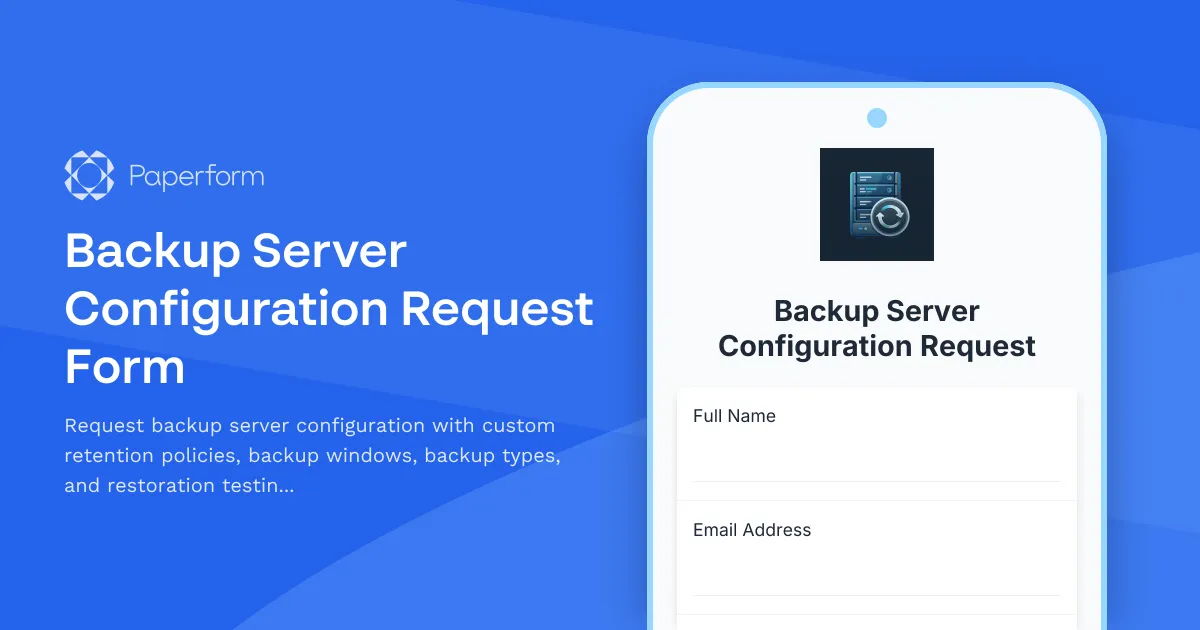
Backup Server Configuration Request Form
Request backup server configuration with custom retention policies, backup windows, backup types, and restoration testing plans for your infrastructure.
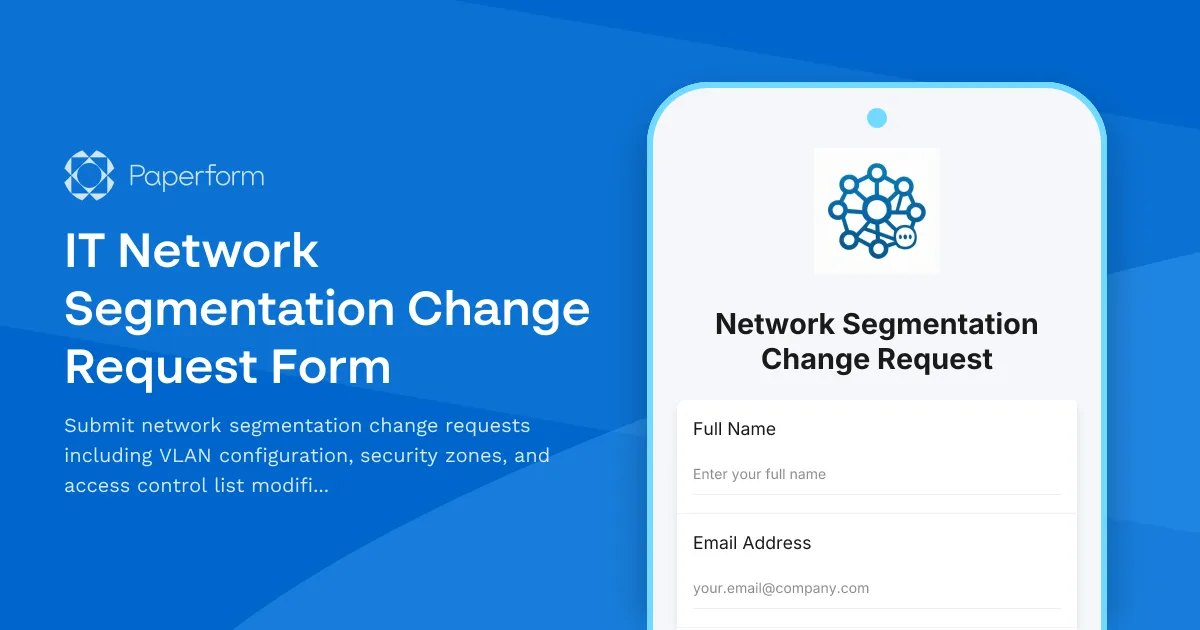
IT Network Segmentation Change Request Form
Submit network segmentation change requests including VLAN configuration, security zones, and access control list modifications with technical details and approval workflow.
IT System Decommissioning Change Request
Submit and track IT system decommissioning requests with data retention, asset disposal, and access revocation management for secure infrastructure changes.
Network DDoS Mitigation Request Form
Submit a request to activate DDoS protection services, configure traffic scrubbing parameters, set detection thresholds, and whitelist legitimate traffic sources for your network infrastructure.
Network Packet Capture Request Form
Request network packet captures for troubleshooting and analysis. Specify interface, filters, duration, and storage preferences for comprehensive network diagnostics.
Remote Desktop Service Configuration Change Request Form
A professional IT change request form for managing remote desktop service configurations, including access policies, performance settings, and security controls with approval workflow.
Application Version Upgrade Change Request Form
A comprehensive IT change management form for requesting application version upgrades with dependency analysis, rollback planning, and user communication strategy.
Data Catalog Access Request Form
Request access to your data catalog and governance platform with granular permissions for metadata management, data dictionary editing, and data product publishing.
Data Center Server Room Access Request Form
Request secure access to data center server rooms with two-factor authentication setup, equipment authorization, and compliance acknowledgment for IT professionals and technicians.
Disaster Recovery Site Setup Request Form
Request form for disaster recovery infrastructure setup with RTO/RPO requirements, replication methods, failover testing schedules, and runbook documentation for business continuity planning.
DNS Record Modification Request
Submit DNS record change requests for A, CNAME, MX, and other record types with subdomain creation and TTL configuration for network infrastructure management.
Infrastructure Security Incident Response Form
Report and respond to infrastructure security incidents with threat classification, containment protocols, forensic preservation, and stakeholder communication tracking.