Streamline Reentry Housing Applications with Paperform
Finding stable housing is one of the most critical challenges facing individuals reentering society after incarceration. Without secure housing, successful reintegration becomes exponentially harder. A reentry housing grant application needs to balance thorough assessment with dignity, moving quickly to connect applicants with housing opportunities while coordinating the wraparound services that support long-term success.
This Reentry Housing Grant Application template is built for nonprofit organizations, housing authorities, reentry programs, and social service agencies implementing housing-first approaches for justice-involved individuals. Whether you're a reentry coordinator, case manager, grants administrator, or housing program director, this template helps you collect comprehensive applicant information, assess eligibility, coordinate supportive services, and process applications efficiently—all while maintaining the compassionate, barrier-reducing approach that housing-first models require.
Why Use Paperform for Reentry Housing Applications?
Traditional paper applications or generic online forms create unnecessary friction in the application process. Applicants may be completing forms on mobile devices from libraries, shelters, or transitional facilities. They need forms that are clear, accessible, and respectful of their circumstances.
Paperform's document-style editor lets you create an application that feels approachable rather than bureaucratic. You can add clear headings, helpful explanations, and supportive language throughout the form. Conditional logic ensures applicants only see questions relevant to their situation, reducing overwhelm and application fatigue.
With Paperform's calculation fields and conditional logic, you can assess eligibility criteria in real-time, route applications to the appropriate housing programs based on family size or special needs, and trigger different workflows for urgent versus standard applications. This means faster processing and quicker connections to housing resources.
Housing-First Principles in Action
This template embodies housing-first principles by minimizing barriers to entry. Rather than requiring sobriety, employment, or perfect credit as prerequisites, the form focuses on identifying housing needs and coordinating appropriate supports. Questions about criminal background are framed within fair chance housing policies, acknowledging that justice involvement shouldn't be an automatic disqualifier.
The form collects information about supportive service needs—mental health support, substance use treatment, employment assistance, family reunification services—so your team can coordinate wraparound services from day one. This approach recognizes that stable housing provides the foundation for addressing other challenges, not the other way around.
For organizations working with landlord incentive programs, the template includes sections to gather information that helps match applicants with participating landlords and identify appropriate incentive packages, whether that's security deposit assistance, damage mitigation funds, or rental guarantees.
Automate Workflows with Stepper
After someone submits their reentry housing application, the real work begins: eligibility verification, housing search, landlord coordination, and service linkage. With Stepper, Paperform's AI-native workflow builder, you can automate these complex processes without writing code.
Set up workflows that automatically:
- Notify case managers when urgent applications arrive (recent release, currently homeless)
- Route applications to different housing programs based on eligibility criteria and availability
- Create tasks for background screening review under your fair chance housing policy
- Send welcome packets with housing search resources to approved applicants
- Update your case management system or CRM with new applicant information
- Trigger landlord outreach for applicants ready for housing placement
- Schedule intake appointments and supportive service assessments
Stepper can also help coordinate between multiple stakeholders—parole officers, mental health providers, employment specialists, housing navigators—keeping everyone informed as applicants move through the process.
Secure Data Handling for Sensitive Information
Reentry housing applications contain highly sensitive information: criminal justice history, mental health needs, substance use history, veteran status, and more. This information requires robust security and careful handling.
Paperform is SOC 2 Type II certified and GDPR compliant, providing enterprise-grade security that protects applicant data. You can control who on your team has access to submissions, set up role-based permissions, and maintain clear audit trails. For organizations with specific data residency requirements, Paperform offers controls to ensure data stays within appropriate jurisdictions.
While Paperform provides strong security foundations for social service data, organizations should ensure their use aligns with all applicable privacy regulations and grant requirements for their specific jurisdiction and funding sources.
Perfect for Multiple Reentry Program Models
This template adapts to various reentry housing program structures:
- Rapid Rehousing Programs focused on quick placement with time-limited rental assistance
- Permanent Supportive Housing for individuals with complex needs requiring ongoing supports
- Transitional Housing Programs offering structured environments with service coordination
- Scatter-Site Housing programs placing individuals in market-rate units with subsidies
- Landlord Partnership Programs leveraging incentives to expand housing options
Conditional logic ensures the application collects the right information for each program type, while maintaining a single streamlined form for applicants.
Designed for Collaboration Across Agencies
Reentry housing work rarely happens in isolation. You're likely coordinating with corrections departments, parole and probation offices, mental health agencies, workforce development programs, and housing authorities.
Paperform's integration ecosystem—including native connections and expanded capabilities through Stepper, Zapier, and Make—allows you to connect your application process to:
- Case management systems like Apricot, ETO, and HMIS platforms
- Communication tools like Slack for team notifications
- Project management platforms like Asana or Monday for tracking application progress
- CRMs like Salesforce or HubSpot for managing applicant relationships
- Document storage like Google Drive or Dropbox for organizing supporting documentation
- Scheduling tools for coordinating intake appointments and housing viewings
This connectivity ensures information flows smoothly between systems without manual data entry, reducing errors and freeing up staff time for direct client support.
Mobile-Friendly for Real-World Access
Many individuals applying for reentry housing assistance don't have regular computer access. They're completing applications on smartphones from libraries, reentry resource centers, or public spaces with limited time.
Every Paperform is automatically mobile-responsive, ensuring your application works beautifully on any device. The clean, intuitive interface makes it easy for applicants to complete the form in multiple sessions if needed, with progress automatically saved (when used with Paperform's partial submissions feature in higher-tier plans).
Built for the People Who Do This Important Work
This template is designed for the dedicated professionals working in reentry services: case managers navigating complex eligibility rules, housing navigators building landlord relationships, program coordinators managing waiting lists, and grants administrators ensuring compliance with funding requirements.
Whether you're with a community-based nonprofit, a government reentry initiative, a faith-based housing ministry, or a public housing authority, this form gives you a professional, compassionate tool that respects both applicant dignity and program accountability.
Get Started in Minutes
With Paperform's template library, you don't need to build a complex reentry housing application from scratch. This template includes all the essential sections—personal information, release information, housing history, family composition, income and benefits, criminal background disclosure, supportive service needs, landlord preferences, and emergency contacts—pre-built and ready to customize.
Add your organization's branding, adjust questions to match your specific program requirements and eligibility criteria, connect your workflows, and launch. You can have a professional reentry housing application live in an afternoon, not weeks of development time.
Supporting individuals transitioning from incarceration to stable housing is challenging, essential work. Your application process should make it easier, not harder. With Paperform, you get a tool that matches the compassion and professionalism your program represents.
Trusted by over 500,000 teams worldwide and SOC 2 Type II certified, Paperform helps social service organizations, nonprofits, and housing agencies create secure, accessible applications that serve people with dignity.



More templates like this
Housing Stability Program Application for Reentry Services
A comprehensive application form for formerly incarcerated individuals seeking housing assistance, employment support, and reentry services designed to prevent recidivism and promote successful community reintegration.
Community Safety Alternatives Grant Application
Apply for funding to implement community-led safety initiatives including non-police crisis response, de-escalation training, mobile mental health teams, and community accountability programs.

Indigenous Youth Leadership Grant Application
Apply for funding to support Indigenous youth leadership development through cultural mentorship, land-based learning, language immersion, and traditional skills training programs.
Anti-Displacement Grant Application
A comprehensive grant application for organizations working on anti-displacement initiatives, community land trusts, tenant protections, and affordable housing preservation in communities facing gentrification.
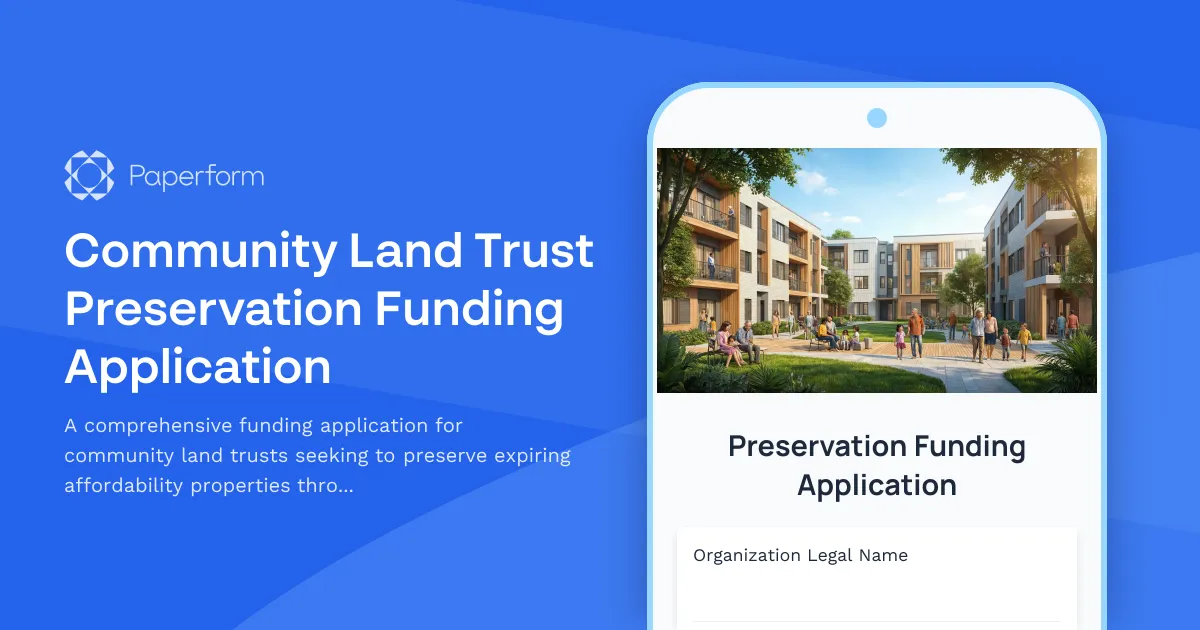
Community Land Trust Preservation Funding Application
A comprehensive funding application for community land trusts seeking to preserve expiring affordability properties through acquisition, capital improvements, and permanent affordability commitments.
Domestic Violence Shelter Permit Application
A comprehensive permit application for establishing a domestic violence shelter with confidential location protocols, security systems, counseling services, child programming, legal advocacy, and 24-hour crisis support.
Emergency Food Assistance Grant Application
Apply for emergency food assistance grants to support distribution programs, nutritional quality standards, client choice models, and SNAP outreach initiatives in your community.
Emergency Housing Placement Application for Domestic Violence Survivors
A confidential application for survivors of domestic violence seeking emergency housing placement, with secure contact methods and integrated safety planning.
Halfway House Application for Reentry Programs
A comprehensive application form for halfway house placement in reentry programs, collecting applicant information, parole officer details, employment status, and program requirements for successful community reintegration.
Homelessness Prevention Grant Application
A comprehensive grant application for organizations seeking funding to implement homelessness prevention programs using rapid rehousing, case management, and housing first principles.
Independent Living Services Application for Transitioning Foster Youth
A comprehensive application form for foster youth aging out of the system to access independent living services, housing support, education and employment resources, life skills assessment, and mentor matching programs.
Nonprofit Program Participant Intake and Consent Form
Comprehensive intake and consent form for nonprofit program participants. Collects eligibility information, referral sources, consent for data collection, and agreement to participate in outcome measurement.