
Managing material traceability is critical for manufacturing operations—whether you're navigating quality audits, responding to supplier issues, or preparing for potential product recalls. This Production Material Traceability Form gives manufacturers a centralized, digital system to link supplier lot numbers, production batches, and customer shipments in one auditable record.
Built specifically for production and quality control teams, this template helps you maintain chain-of-custody documentation that meets ISO, FDA, and industry compliance requirements. Instead of juggling spreadsheets, paper logs, and disconnected systems, you can capture every data point—from incoming raw materials to outgoing finished goods—in a structured format that's ready for recall scenarios or traceability audits.
The form captures supplier details, lot and batch identifiers, material specifications, production dates, quality checkpoints, and customer shipment records. Conditional logic ensures relevant sections appear based on material type and production stage, while required fields guarantee no gaps in your traceability chain.
With Paperform's calculation and logic engine, you can automate batch code generation, flag expiration dates, and route submissions based on quality status. Connect submissions to your ERP, quality management system, or inventory platform via Stepper (stepper.io) to automatically update traceability records, trigger alerts for non-conformances, and keep production and shipping data synchronized across your operation.
When recall readiness matters, having complete, searchable traceability records can mean the difference between a targeted response and a costly blanket recall. This template ensures your manufacturing operation has the documentation structure to trace any material forward to customers or backward to suppliers in minutes, not days.
Trusted by manufacturers requiring professional documentation and SOC2 Type II compliant data handling, Paperform gives quality and production teams the tools to maintain regulatory-grade traceability without custom software development.



More templates like this
Factory Quality Control Sampling Plan Change Request Form
Request changes to quality control sampling plans with statistical validation, inspection station reconfiguration details, training requirements, and manager approval workflow.
Layered Process Audit (LPA) Quality Assurance Form
A comprehensive quality assurance form for conducting layered process audits across manufacturing operations with verification questions, sample frequency tracking, audit layer designation, and non-conformance documentation.
Manufacturing Carbon Footprint Tracking Form
Track and calculate your manufacturing facility's carbon footprint with detailed reporting on energy consumption, material sourcing, waste generation, and emissions data.
Manufacturing Cycle Time Analysis Form
A comprehensive cycle time analysis form for manufacturing teams to document process steps, identify waste, measure value-added time, and set improvement targets to optimize production efficiency.
Manufacturing Equipment Effectiveness Tracker
Track and calculate Overall Equipment Effectiveness (OEE) with automated calculations for availability, performance, and quality rates to optimize production efficiency.
Manufacturing Equipment Maintenance Checklist
A comprehensive preventive maintenance checklist for manufacturing equipment, covering inspection tasks, lubrication points, safety checks, and technician documentation.
Manufacturing Equipment Validation Protocol Form
A comprehensive validation protocol form for manufacturing equipment covering installation qualification (IQ), operational qualification (OQ), performance qualification (PQ), and approval workflows to ensure equipment meets regulatory and operational standards.
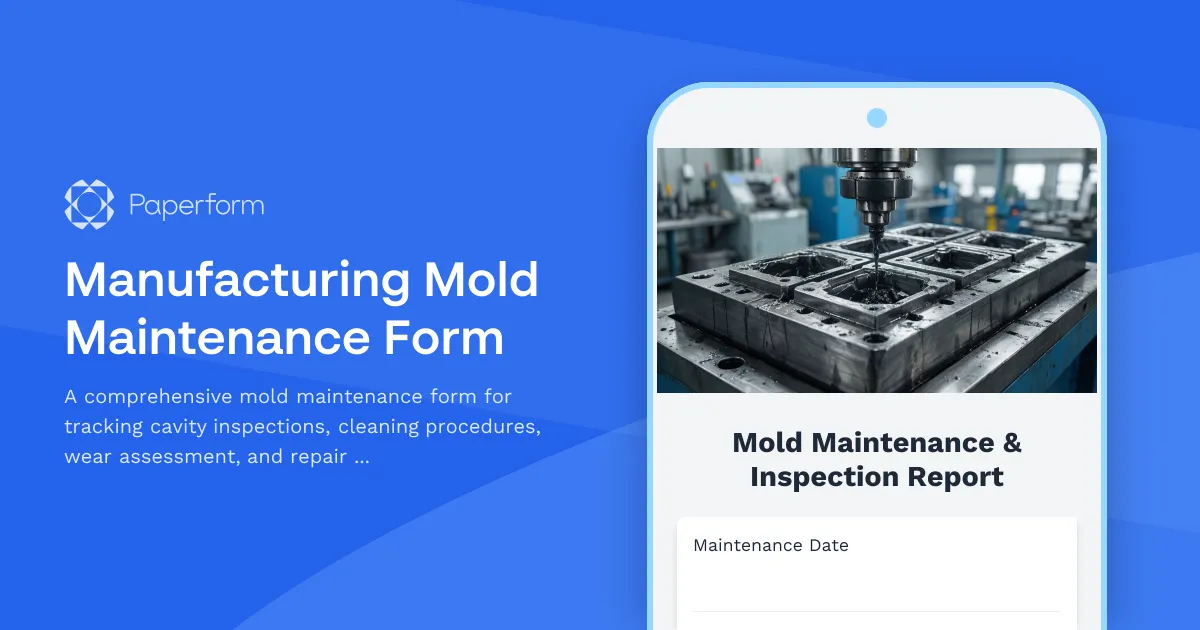
Manufacturing Mold Maintenance Form
A comprehensive mold maintenance form for tracking cavity inspections, cleaning procedures, wear assessment, and repair documentation to ensure consistent production quality.
Manufacturing Process Flow Documentation Form
Document manufacturing processes with input materials, transformation steps, quality control parameters, and output specifications for production optimization and compliance.
Metrology Lab Sample Submission Form
Submit samples to your metrology lab for precision measurement and quality control inspection with detailed measurement requests, tolerance specifications, and reporting requirements.
Pneumatic Conveying System Warranty Claim Form
Submit warranty claims for pneumatic conveying system failures, including material flow issues, pipeline wear, valve failures, dust emissions, and contamination problems.
Predictive Maintenance Alert Form
Report equipment issues before they cause downtime. Capture sensor data, failure predictions, and recommended maintenance actions to keep production running smoothly.