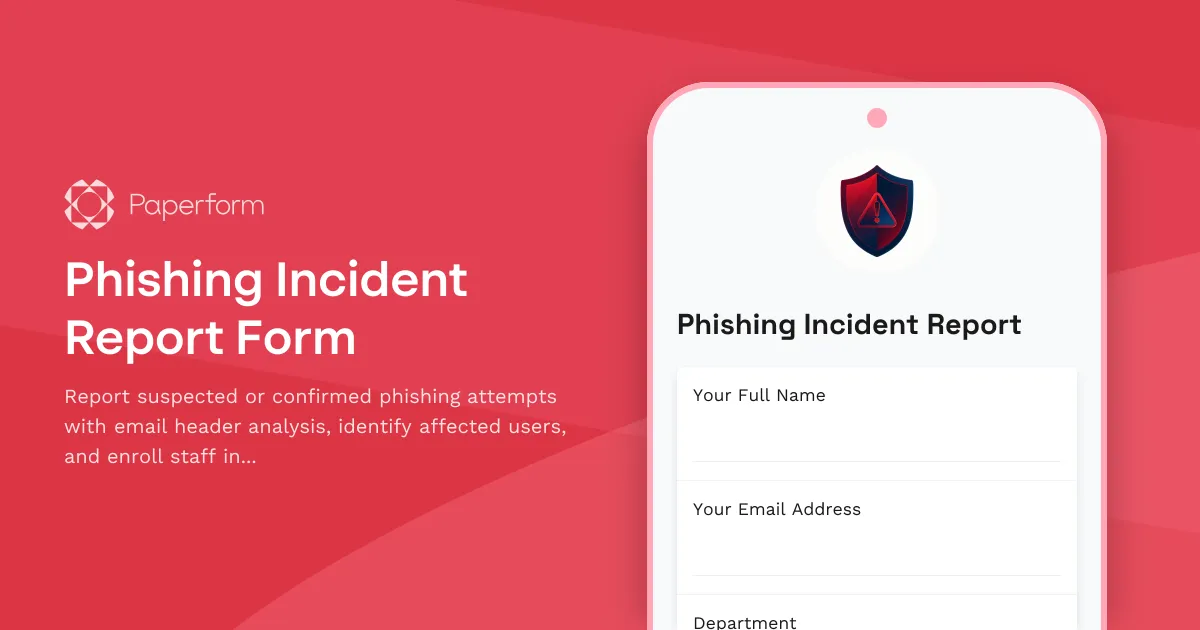
When a phishing email slips through your defenses, speed and detail matter. This Phishing Incident Report Form gives IT and security teams a structured way to capture critical information—email headers, sender details, affected users and incident context—so you can investigate, contain and respond faster.
Built for IT managers, security officers, compliance teams and help desk staff, this template is designed to streamline your incident response workflow. Instead of chasing down details over Slack or parsing forwarded emails, you collect everything you need in one submission: full email headers for forensic analysis, user impact assessment, and the option to immediately enroll affected employees in security awareness training.
Why Paperform works for phishing response
Phishing incidents require fast triage and clear documentation. With Paperform's conditional logic, you can show or hide follow-up questions based on severity, route high-priority reports to your SOC or IT lead, and trigger alerts in Slack or Microsoft Teams the moment a critical submission arrives.
Connect this form to your ticketing system (Jira, ServiceNow, Freshdesk) via Stepper to auto-create incidents, tag them by threat type, and kick off investigation workflows without manual data entry. You can also sync reports to Google Sheets or Airtable for trend analysis, and use Paperform's AI Insights to surface patterns across multiple phishing campaigns—like common sender domains, targeted departments, or recurring social engineering tactics.
For organizations that need an audit trail, every submission is timestamped, stored securely (SOC 2 Type II compliant), and exportable for compliance reporting or post-incident reviews.
Security awareness training, built in
One of the biggest wins from a phishing report isn't just stopping the threat—it's preventing the next one. This template includes an opt-in (or required) enrollment question for security awareness training, so you can immediately flag users who need refresher courses and feed that list into your LMS, HR system or training calendar via Stepper automation.
Whether you're a lean IT team at a growing SaaS company or a security operations center managing hundreds of endpoints, this form gives you the structure, speed and automation to turn phishing reports into actionable intelligence—and a more security-aware workforce.



More templates like this
Cybersecurity Breach Incident Report
Report and document cybersecurity breaches, data exposures, and security incidents with comprehensive system impact assessment and executive notification workflow.
Cybersecurity Incident Post-Mortem Report
Conduct thorough post-incident analysis with attack vector documentation, response timeline tracking, and security gap identification to strengthen your organization's cybersecurity posture.
Data Breach Incident Report Form
Document and manage data breach incidents with comprehensive system impact analysis, user assessment, response tracking, and regulatory notification timelines.
Cybersecurity Awareness Training Quiz
Test employee knowledge on phishing detection, password security, and data protection with this comprehensive cybersecurity awareness quiz designed for workplace training programs.
Insider Threat Investigation Form
Investigate behavioral analytics alerts for potential insider threats with user baseline analysis, HR correlation, and structured escalation workflows for security teams.
IT Security Architecture Decision Record (ADR) Change Request
Document security architecture decisions, technical choices, and rationale with structured approval workflows for IT change management and governance.
IT Security Architecture Exception Approval Form
Request and approve security architecture exceptions with technical justifications, alternative approaches, risk assessments, and time-bound permissions for IT change management.
IT Security Incident Response Communication Change Request Form
Request changes to security incident response communication protocols, including notification groups, escalation paths, and stakeholder contact information.
Security Control Rationalization Review Form
Streamline your security controls by identifying redundancies, analyzing cost-effectiveness, and managing control retirement approvals through a structured review process.
Security Incident Lessons Learned Report
Comprehensive post-incident analysis form for documenting security incident timelines, decision points, root causes, and process improvements to strengthen future incident response.
Cybersecurity Exception Approval Request Form
A comprehensive form for requesting cybersecurity policy exceptions with risk assessment, compensating controls, business justification, and remediation plans requiring CISO authorization.
Identity and Access Management Quarterly Review Form
Conduct comprehensive IAM quarterly reviews with user provisioning audits, role-based access validation, and orphaned account identification to maintain security compliance and minimize access risks.