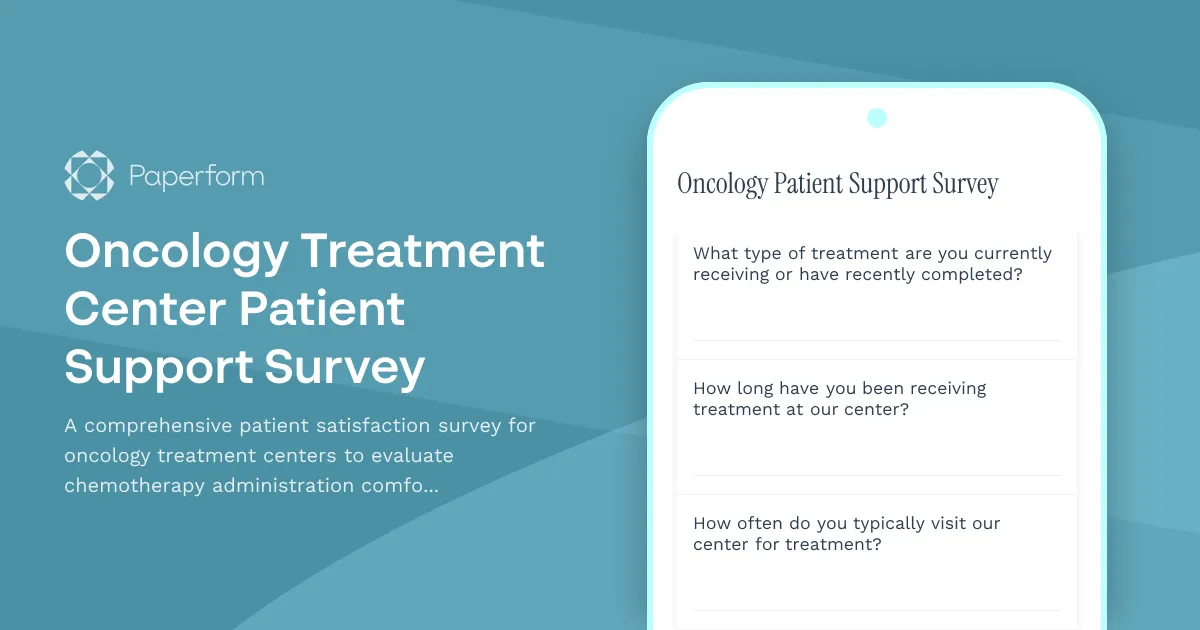
Improve Cancer Care with Patient-Centered Feedback
Oncology treatment centers face unique challenges in delivering compassionate, coordinated care during one of the most difficult times in a patient's life. This Oncology Treatment Center Patient Support Survey template is designed specifically for cancer care facilities to gather meaningful feedback on the patient experience—from chemotherapy administration comfort to emotional support services and care team coordination.
Why This Template Matters for Oncology Centers
Cancer treatment involves complex, multi-faceted care that extends far beyond clinical outcomes. Patients and their families need comprehensive support across physical comfort, symptom management, emotional wellbeing, and clear communication. This survey template helps oncology centers, infusion centers, and cancer support programs systematically evaluate:
- Chemotherapy administration comfort including infusion suite environment, chair comfort, and wait times
- Side effect management effectiveness and patient education on managing treatment symptoms
- Emotional support services such as counseling, support groups, and patient navigation
- Care team coordination between oncologists, nurses, social workers, and other specialists
- Overall satisfaction with the treatment experience and facility
Built for Healthcare Professionals Who Care
This template is ideal for oncology nurse managers, patient experience coordinators, cancer center administrators, quality improvement teams, and healthcare administrators focused on patient-centered care. The questions are designed with sensitivity to the patient journey while capturing actionable data for continuous improvement.
Paperform makes it easy to customize this survey to your specific treatment center, add conditional logic to show relevant questions based on treatment type, and present the form in a calm, professional design that reflects your commitment to patient care. Responses are automatically organized for analysis, and you can use AI Insights to identify trends and themes across patient feedback without manual report compilation.
Automate Your Quality Improvement Workflow
Connect this survey to your quality improvement processes using Stepper to automatically route feedback to the appropriate department leads, flag urgent concerns for immediate follow-up, and compile monthly patient experience reports. You can trigger different workflows based on satisfaction scores—ensuring patients who express concerns receive timely outreach from your patient relations team.
With Paperform's GDPR compliance and secure data handling, you can trust that sensitive patient feedback is protected while still gaining the insights you need to deliver exceptional cancer care.
More templates like this
Hospital Medical Interpreter Service Quality Survey
Evaluate the quality of medical interpretation services with questions on interpretation accuracy, cultural competency, communication effectiveness, and scheduling convenience to improve patient care.
Mobile Health Clinic Community Patient Survey
Gather comprehensive feedback from mobile health clinic patients on service accessibility, multilingual support, health screening quality, and referral coordination to improve community healthcare delivery.
Behavioral Health Program Effectiveness Survey
Gather comprehensive feedback from patients on behavioral health treatment programs, including group therapy, medication management, staff support, and discharge planning effectiveness.
Clinical Laboratory Outreach Program Survey
Evaluate laboratory outreach services including specimen collection convenience, courier timeliness, test result accuracy, and provider integration quality to improve healthcare delivery.
Community Health Needs Assessment Survey
A comprehensive community health needs assessment form to identify health priorities, access barriers, social determinants of health, and gather feedback for program improvement.
End-of-Life Care Preferences Survey
A compassionate survey to understand patient experiences with advance care planning, code status discussions, palliative care services, and family meetings to improve end-of-life care quality.
Fertility Clinic Patient Experience Survey
Comprehensive patient satisfaction survey designed for fertility clinics to gather feedback on IVF cycle support, emotional counseling, success rate transparency, and financial guidance.
Fertility Clinic Patient Satisfaction Survey
A compassionate patient satisfaction survey designed for fertility clinics to gather feedback on treatment experiences, emotional support, financial counseling, and care quality throughout the fertility journey.
Healthcare Care Transition Coach Patient Survey
A comprehensive post-discharge survey to assess hospital-to-home transition support, medication management, follow-up care coordination, and patient understanding of warning signs requiring immediate medical attention.
Healthcare Interpreter Service Patient Satisfaction Survey
Evaluate interpreter service quality including language accuracy, cultural sensitivity, medical terminology comprehension, and appointment coordination. Help improve language access for diverse patient populations.
Healthcare Patient Safety Event Disclosure Survey
A comprehensive survey to assess patient and family experiences following disclosure of a safety event, measuring transparency, apology authenticity, corrective actions, and emotional support provided by healthcare teams.
Healthcare Quality Improvement Patient Advisory Council Survey
A comprehensive survey designed to evaluate patient engagement effectiveness, feedback implementation transparency, co-design participation value, and shared decision-making support within healthcare quality improvement advisory councils.