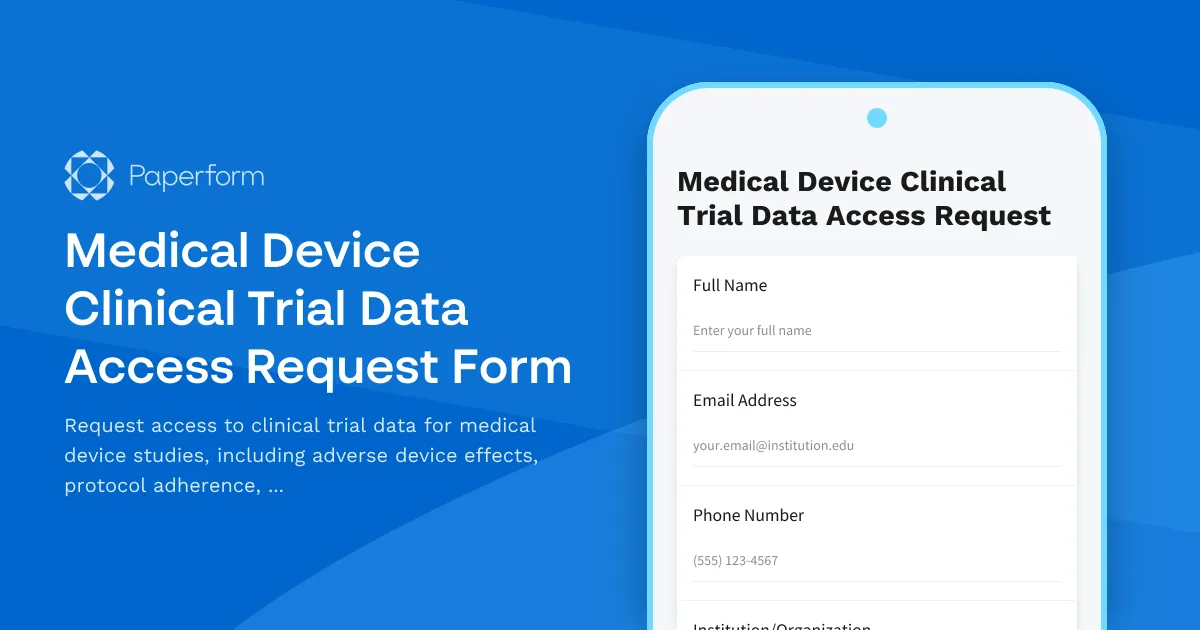
Streamline Medical Device Clinical Trial Data Access with Paperform
Managing access to sensitive clinical trial data requires precision, security, and compliance with strict regulatory standards. Our Medical Device Clinical Trial Data Access Request Form is designed specifically for researchers, clinical teams, regulatory affairs professionals, and data scientists who need structured, compliant access to study participant data from medical device trials.
Why Clinical Trial Data Access Needs a Better Solution
Medical device clinical trials generate massive volumes of sensitive data—from adverse device effects and protocol deviations to primary endpoint measurements and patient demographics. Traditional methods of requesting data access—email chains, PDF forms, and manual approval workflows—create bottlenecks, compliance risks, and frustration for research teams working under tight regulatory timelines.
This Paperform template replaces those outdated processes with a professional, secure intake system that captures all the critical details needed to grant appropriate data access while maintaining audit trails and GDPR compliance.
Who This Template Is Built For
This template serves multiple stakeholders within the clinical research ecosystem:
- Clinical research organizations (CROs) managing multi-site medical device trials
- Medical device manufacturers conducting post-market surveillance studies
- Academic researchers analyzing trial data for publications and meta-analyses
- Regulatory affairs teams preparing submissions to FDA, EMA, and other authorities
- Biostatisticians and data scientists requiring dataset access for analysis
- Quality assurance teams conducting audits and compliance reviews
- Hospital research departments coordinating investigator-initiated trials
Whether you're working with cardiovascular devices, orthopedic implants, diagnostic equipment, or digital health technologies, this template adapts to your specific trial structure and data governance requirements.
What Makes This Template Work
The form captures everything needed to evaluate and approve data access requests:
Requester Information & Credentials: Comprehensive details about who is requesting access, their institutional affiliation, role in the study, and relevant qualifications—critical for maintaining proper data stewardship.
Study & Data Specification: Clear identification of which clinical trial, study phase, device type, and specific data domains are being requested (adverse events, protocol adherence metrics, endpoint measurements, device performance data).
Access Justification: Detailed rationale for the data request, intended use, analysis plan, and how the access aligns with the original study protocol and informed consent parameters.
Data Security & Compliance: Attestations regarding data handling procedures, security measures, HIPAA compliance (for US-based trials), GDPR compliance (for EU trials), and institutional review board (IRB) or ethics committee approvals.
Time-Bound Access: Specific access duration requirements and data retention policies to ensure access permissions don't remain active longer than necessary.
The form uses conditional logic to show relevant fields based on the type of data being requested—for example, if adverse device effects data is selected, additional fields appear regarding Medical Device Reporting (MDR) requirements and reportable events.
Automate Your Clinical Data Access Workflow with Stepper
Once a data access request is submitted through Paperform, you can use Stepper to build an automated approval and provisioning workflow:
- Route for approval based on data sensitivity level—route high-risk data requests to the study's principal investigator and data safety monitoring board, while routine requests go to the data manager
- Trigger compliance checks by integrating with your IRB database or ethics committee records to verify active approvals
- Provision database access automatically by creating time-limited user accounts in your clinical data management system (CDMS) like Medidata Rave, REDCap, or OpenClinica
- Generate audit logs that document who requested what data, when, for what purpose, and who approved it—essential for regulatory inspections
- Send notifications to security teams, the requester, and study leadership with access credentials and data handling guidelines
- Schedule access expiration reminders and automatically revoke permissions when the approved access period ends
This level of automation transforms what used to take days or weeks of email coordination into a streamlined, compliant process that maintains complete visibility and control.
Security and Compliance for Sensitive Health Data
Clinical trial data is among the most sensitive information in healthcare, subject to HIPAA, GDPR, FDA 21 CFR Part 11, and ISO 14155 standards. While Paperform is not HIPAA compliant and should not be used to collect or store protected health information (PHI) directly, this form is designed to capture metadata about access requests—who needs access, to which de-identified or coded datasets, and for what approved research purpose.
Paperform is SOC 2 Type II compliant, offering enterprise-grade security features including:
- Role-based permissions to control who can view and manage data access requests
- Data residency options to keep request data in specific geographic regions
- SSL encryption for all data in transit
- SSO integration for secure authentication through your institution's identity provider
- Comprehensive audit trails showing all form activity
For the actual clinical trial data itself, your CDMS or data warehouse remains the system of record—this Paperform template manages the request and approval workflow, not the underlying trial data.
Designed for Research Teams, Not IT Departments
One of the biggest advantages of using Paperform for clinical data access requests is that research coordinators and clinical operations teams can own the entire process—no need to wait for IT tickets, database administrators, or custom development.
Need to add a new data category because you've launched a trial with a novel device type? Just add it to the dropdown. Want to route cardiology device trial requests differently than orthopedic implant trials? Set up conditional logic in minutes. Need to update compliance attestation language based on new EU MDR requirements? Edit the text directly in the form.
This autonomy is especially valuable in the fast-moving clinical research environment where study protocols, regulatory requirements, and data governance policies evolve continuously.
Integration with Your Clinical Research Stack
Paperform connects seamlessly with the tools clinical research teams already use:
- Google Sheets or Airtable for maintaining a centralized log of all data access requests
- Slack for instant notifications to data stewardship committees
- REDCap, Medidata, or other CDMS platforms via API integrations through Stepper or Zapier
- Microsoft 365 or Google Workspace for generating approval documentation and data use agreements
- CRM systems for tracking external researcher relationships and collaboration agreements
These integrations mean your data access request workflow sits naturally within your existing research infrastructure rather than creating yet another disconnected silo.
Start Managing Clinical Trial Data Access Today
Whether you're running a first-in-human trial of a breakthrough medical device or managing a large-scale post-market surveillance study, this template gives you a professional, compliant starting point for data access governance. The form is fully customizable—adjust the data categories to match your device type and study endpoints, modify approval workflows to match your institutional policies, and brand the form to reflect your organization's identity.
Trusted by research institutions and medical device companies worldwide, Paperform provides the flexibility and security needed for sensitive clinical research operations without the complexity of enterprise software or the limitations of generic form builders.
Get started today and bring structure, speed, and compliance to your clinical trial data access process.



More templates like this
Clinical Genomics Laboratory Patient Test Data Request Form
Request access to patient genomic test data, variant interpretations, family history, and genetic counseling notes from clinical genomics laboratories.
Clinical Trial Participant Data Access Request Form
A comprehensive form for researchers and investigators to request access to clinical trial participant data, with built-in consent verification, de-identification options, and ethics committee approval workflows.
Clinical Trial Patient Eligibility Data Access Request Form
Request access to clinical trial patient eligibility data, including medical history screening records, enrollment status, and travel reimbursement information for authorized research and administrative purposes.
Pharmaceutical Clinical Data Access Request Form
A comprehensive form for researchers requesting access to pharmaceutical clinical trial data, with built-in validation for research purposes, anonymization standards, and publication agreements.
Biobank Consent Update & Participant Recontact Request Form
A comprehensive form for biobank researchers to request participant recontact for consent updates, track new research uses, manage consent withdrawals, and maintain detailed communication logs.
Biobank Specimen Data Request Form
A comprehensive form for requesting access to biobank specimen data, including sample collection details, storage conditions, and consent verification for biotechnology research applications.
Clinical Trial Management System Request Form
Request and configure a clinical trial management system (CTMS) for patient enrollment, protocol compliance, adverse event tracking, and regulatory reporting capabilities.

AI Model Deployment Approval Form
A comprehensive approval form for AI model deployments that evaluates training data, bias assessment, performance metrics, security controls, and ethical considerations before production release.
Biospecimen Repository Access Request Form
A comprehensive form for researchers requesting access to biospecimen repositories, including sample metadata, clinical data linkage, and material transfer agreement terms.
Clinical Research VPN Access Request Form
A comprehensive VPN access request form for clinical research organizations to manage EDC system access, monitoring tools, and regulatory document repositories with full compliance tracking.
Clinical Research VPN Access Request
A secure VPN access request form designed for clinical research teams to request remote access to patient data and research systems with IRB protocol verification.
Genetic Data Analysis Software Request Form
Request access to genetic analysis software with sequencing platform integration, variant calling, annotation databases, and visualization tools for your research or clinical workflow.