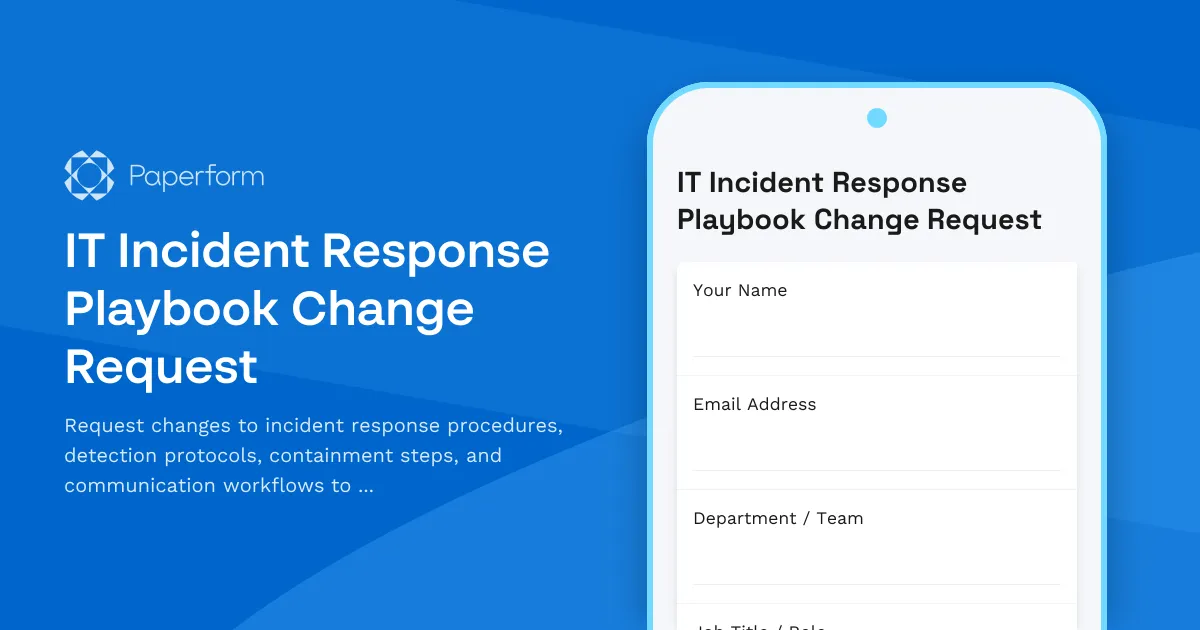
Streamline Your IT Incident Response with Professional Change Management
When security incidents occur, every second counts. Your incident response playbook is your first line of defense—but what happens when those procedures need updating? Whether you're refining detection algorithms, improving containment strategies, or updating communication protocols, managing changes to your incident response framework requires careful documentation and approval.
This IT Incident Response Playbook Change Request Form gives IT teams, security operations centers, and compliance managers a structured way to propose, review, and approve modifications to critical incident response procedures. Built specifically for organizations that need to maintain security posture while evolving their threat response capabilities, this template ensures every change is documented, justified, and properly reviewed before implementation.
Why IT Teams Choose Paperform for Change Management
Managing changes to security-critical systems requires more than just a basic form. Paperform's conditional logic lets you show different approval paths based on change severity—high-impact changes can trigger additional review steps, while routine updates flow through faster approval tracks. With calculation fields, you can automatically assess risk scores based on multiple factors like scope, urgency, and affected systems.
For security and IT operations teams at SMBs, mid-market companies, and enterprise organizations, Paperform provides the flexibility to match your existing change advisory board (CAB) processes without requiring developer resources. The doc-style editor means your IT manager or security lead can customize the form to reflect your organization's specific incident categories, severity levels, and approval hierarchies—no coding required.
Built for Security Operations and IT Service Management
This template addresses the real-world needs of:
- Security Operations Centers (SOCs) managing SIEM rules, playbook procedures, and automated response workflows
- IT Service Management teams coordinating changes across incident, problem, and change management processes
- Compliance and risk managers ensuring audit trails for modifications to security controls
- DevSecOps teams updating CI/CD security gates and automated response integrations
- Managed service providers handling playbook changes across multiple client environments
The form captures everything from detection procedure modifications and containment step refinements to escalation matrix updates and communication template changes. Each submission creates a complete change record with business justification, risk assessment, rollback plans, and impact analysis.
Automate Your Change Approval Workflow with Stepper
Once your incident response change request is submitted, the real work begins—routing to approvers, notifying stakeholders, updating documentation, and tracking implementation. That's where Stepper comes in.
Connect your Paperform submissions to Stepper workflows that automatically:
- Route high-severity changes to your Change Advisory Board while fast-tracking low-risk updates
- Send approval requests to security leads, IT managers, and compliance officers based on change type
- Update your ITSM platform (ServiceNow, Jira Service Management, Freshservice) with change tickets
- Notify relevant teams via Slack or Microsoft Teams when changes affect their systems
- Track change status through approval, testing, implementation, and post-implementation review
- Create audit logs in your documentation system (Confluence, Notion, SharePoint)
- Schedule implementation windows and send automated reminders to responsible parties
Stepper's AI-native workflow builder means you can describe your change management process in plain language—"when a critical severity change is submitted, create a ServiceNow change ticket, notify the security director on Slack, and send approval requests to three CAB members"—and Stepper builds the automation for you.
Professional, Compliant, and Battle-Tested
This template is designed for organizations that take security seriously. It includes fields for documenting rollback procedures, testing requirements, and communication plans—critical elements for compliance frameworks like SOC 2, ISO 27001, and NIST. The built-in risk assessment section helps categorize changes appropriately, while optional file uploads let teams attach playbook drafts, flowcharts, or technical specifications.
For teams managing multiple environments, the form supports documenting affected systems, dependent processes, and integration impacts. Conditional fields ensure requesters only see relevant questions based on their change category—keeping the form streamlined while capturing comprehensive information.
Trusted by IT Teams Worldwide
Built on Paperform's SOC 2 Type II certified platform, this template gives you enterprise-grade security with SMB-friendly ease of use. Whether you're a 20-person startup with a lean security team or a 500-person company with a formal change advisory board, this form scales to match your process maturity.
With Paperform's roles and permissions, you can control who can submit changes, who reviews them, and who accesses historical change records. Use custom domains to host your change request form on your internal portal, or embed it directly into your ITSM tool for seamless integration.
Get Started in Minutes
Import this template, customize the incident categories and severity levels to match your organization's framework, connect your approval workflow through Stepper, and start managing incident response changes with confidence. No more scattered email threads, lost change documentation, or unclear approval status—just a clean, auditable process that protects your security posture while enabling continuous improvement.
For organizations that need to move fast without breaking things, this IT Incident Response Playbook Change Request Form is your foundation for professional, compliant change management.



More templates like this
Cyber Crisis Communication Drill Evaluation Form
Evaluate crisis communication readiness with media simulation exercises, spokesperson performance reviews, and message consistency checks for cybersecurity incidents.
IT Security Architecture Exception Approval Form
Request and approve security architecture exceptions with technical justifications, alternative approaches, risk assessments, and time-bound permissions for IT change management.
IT Security Incident Response Communication Change Request Form
Request changes to security incident response communication protocols, including notification groups, escalation paths, and stakeholder contact information.
IT Security Policy Version Control Change Request Form
Submit, track, and approve security policy changes with version control, approval workflow, and publication management for IT governance and compliance.
Cybersecurity Breach Incident Report
Report and document cybersecurity breaches, data exposures, and security incidents with comprehensive system impact assessment and executive notification workflow.
Cybersecurity Incident Post-Mortem Report
Conduct thorough post-incident analysis with attack vector documentation, response timeline tracking, and security gap identification to strengthen your organization's cybersecurity posture.
Data Breach Incident Report Form
Document and manage data breach incidents with comprehensive system impact analysis, user assessment, response tracking, and regulatory notification timelines.
Insider Threat Investigation Form
Investigate behavioral analytics alerts for potential insider threats with user baseline analysis, HR correlation, and structured escalation workflows for security teams.
IT Security Architecture Decision Record (ADR) Change Request
Document security architecture decisions, technical choices, and rationale with structured approval workflows for IT change management and governance.
IT Security Awareness Gamification Implementation Change Request
Submit change requests for implementing gamified security awareness training programs with game mechanics, reward systems, and engagement tracking features.
IT Security Control Testing Scope Modification Change Request
Submit requests to modify security control testing scope, adjust coverage areas, assess risk implications, and reallocate testing resources for cybersecurity programs.
IT Security Incident Response Plan Annual Review Change Request
Submit change requests for your organization's IT security incident response plan, integrate lessons learned, update emergency contacts, and validate preparedness through tabletop exercises.