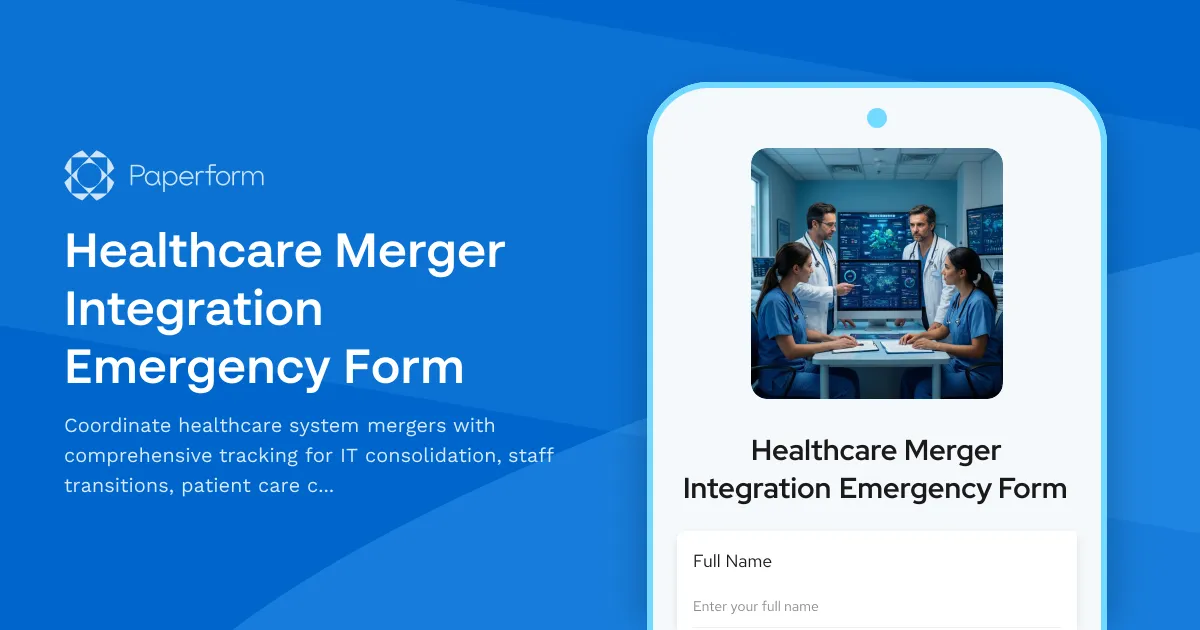
Healthcare Merger Integration Emergency Form: Ensure Seamless Transitions During Critical System Changes
Healthcare mergers and acquisitions represent some of the most complex organizational transitions in any industry. When two healthcare systems combine, the stakes couldn't be higher—patient safety, regulatory compliance, staff coordination, and system integration must all happen flawlessly while maintaining continuous care delivery.
This Healthcare Merger Integration Emergency Form provides a centralized command center for managing the critical phases of healthcare system consolidation. Whether you're merging hospital networks, integrating clinic systems, or combining healthcare IT infrastructures, this template helps you track every moving piece while protecting patient care continuity.
Why Healthcare Mergers Need Specialized Integration Planning
Unlike standard corporate mergers, healthcare consolidations involve:
- Life-critical systems that cannot experience downtime
- Regulatory requirements from HIPAA, state health departments, and accreditation bodies
- Complex IT migrations involving EHR systems, imaging platforms, and clinical databases
- Staff credentialing and licensing that must transfer seamlessly
- Patient record consolidation requiring meticulous data integrity
- Care protocol harmonization across different organizational cultures
- Emergency response coordination during the transition period
A single oversight during integration can result in compromised patient safety, regulatory violations, or operational disruptions that affect thousands of patients.
What This Form Helps You Track
This comprehensive template covers all critical integration domains:
System Consolidation Timeline Protection helps you monitor IT migrations, EHR integrations, network consolidations, and application cutover dates. You'll track system testing phases, rollback procedures, and downtime windows to ensure clinical teams always have access to critical patient data.
Staff Transition Coordination manages credential transfers, department reassignments, role changes, training requirements, and onboarding logistics. The form helps HR teams track which staff members have completed required orientation, who needs additional training, and where gaps in coverage might emerge during the transition.
Patient Care Continuity Verification ensures that patient records migrate correctly, care plans transfer intact, appointment schedules remain accurate, and patients know where to seek care during the integration. You can verify that high-risk patients receive special attention and that chronic care management continues without interruption.
Emergency Contingency Planning documents backup procedures, alternative care sites, manual workaround processes, and emergency contact chains in case of integration complications or system failures.
Who Benefits From This Healthcare Merger Integration Form
This form is essential for healthcare organizations managing complex consolidations:
Healthcare Executives and Integration Leaders can maintain oversight of the entire merger timeline, identify bottlenecks before they become crises, and ensure all workstreams remain coordinated and on schedule.
IT Directors and Clinical Informatics Teams use the form to track technical migrations, coordinate system testing, manage vendor communications, and ensure redundancy for mission-critical applications throughout the integration period.
Medical Staff Leadership and Department Chairs can monitor how the merger affects their clinical areas, identify staff training needs, track credentialing status, and ensure their teams can continue delivering care without disruption.
Patient Safety Officers and Quality Directors verify that safety protocols remain intact, incident reporting continues, and quality metrics don't deteriorate during organizational changes.
Human Resources and Talent Management Teams coordinate staff communications, manage benefits transitions, track training completion, and address employee concerns during the often-stressful merger period.
Compliance and Legal Teams ensure regulatory requirements are met, document due diligence activities, track policy harmonization, and maintain audit trails throughout the integration.
The Paperform Advantage for Healthcare Integration Management
Managing a healthcare merger requires collecting information from dozens of departments, coordinating hundreds of tasks, and ensuring nothing falls through the cracks. Paperform makes this coordination seamless with features purpose-built for complex organizational workflows.
The visual form builder lets you create professional intake forms that match your merged organization's brand identity, helping establish the new unified culture from day one. Unlike rigid enterprise software, Paperform's doc-style editor allows you to add context, instructions, images, and embedded resources directly within the form—essential when different organizational cultures need clear guidance.
Conditional logic ensures each stakeholder sees only the questions relevant to their role and integration area. IT staff see technical migration questions, clinical staff see patient care continuity sections, and HR teams see staffing coordination fields—creating a streamlined experience rather than overwhelming everyone with irrelevant questions.
Real-time notifications alert the right integration team members the moment critical issues are reported. If a staff member reports a system access problem or a clinician identifies a patient care risk, the appropriate response team receives immediate notification to address the concern before it escalates.
For complex merger timelines with multiple phases and dependencies, Stepper integrations transform each form submission into automated workflows. When a department reports completing a milestone, Stepper can automatically notify downstream teams, update project management tools, create follow-up tasks, and trigger the next phase of integration activities—keeping the entire organization synchronized without manual coordination.
If your merger involves formal sign-offs, policy acknowledgments, or service line agreements, Papersign enables electronic signature collection directly from form submissions. Staff can acknowledge new policies, vendors can formalize transition agreements, and executives can approve phase completions—all with secure, legally binding eSignatures that maintain complete audit trails.
Integration Capabilities for Healthcare Technology Stacks
Healthcare organizations rely on specialized technology ecosystems, and Paperform integrates seamlessly with these platforms:
- Project management systems like Asana, Monday.com, or Microsoft Project to track integration milestones and dependencies
- EHR and clinical systems via API connections to verify data migration success and patient record integrity
- Communication platforms including Slack, Microsoft Teams, and email to keep integration teams informed in real-time
- HR systems to coordinate staff transitions, benefits changes, and training completion tracking
- Quality and safety reporting tools to monitor metrics throughout the transition period
- Document management systems to centralize merger documentation, policies, and procedural updates
Through Stepper, native integrations, or webhooks, your healthcare merger integration form becomes the central nervous system connecting all your critical systems and ensuring information flows where it needs to go.
Security and Compliance for Sensitive Integration Data
Healthcare merger data includes employee personal information, patient care details, strategic plans, and confidential business information—all requiring the highest security standards.
Paperform is SOC 2 Type II compliant and GDPR-ready, with data residency controls, encrypted data transmission, and comprehensive access controls. While Paperform is not HIPAA-compliant for patient health information, it's ideal for managing the organizational, administrative, and coordination aspects of healthcare mergers that don't directly involve protected health information.
Role-based permissions ensure integration leaders can manage all submissions, department heads see only their areas, and executives access high-level dashboards—maintaining confidentiality while enabling appropriate transparency.
Best Practices for Healthcare Merger Integration Forms
Start early and iterate: Deploy your integration tracking form well before Day One of the merger. Use the pre-merger period to test workflows, train users, and refine questions based on feedback from pilot departments.
Create role-specific versions: Consider creating variations of the form for different stakeholder groups (clinical staff, IT teams, administrative departments) to ensure each group provides the right information without confusion.
Schedule regular check-ins: Use the form for recurring status updates (weekly or bi-weekly) rather than one-time reporting. This creates a rhythm of communication and helps identify trends and issues early.
Integrate with daily workflows: Embed the form in your intranet, integration hub, or daily briefing emails so reporting becomes frictionless rather than an additional burden during an already stressful transition.
Celebrate milestones: Use conditional success pages to acknowledge when departments complete major integration phases, reinforcing positive momentum during a challenging organizational change.
From Complexity to Coordination
Healthcare mergers don't have to mean chaos, confusion, or compromised patient care. With structured integration tracking, clear communication channels, and proactive issue identification, your organization can navigate even the most complex consolidation while maintaining the high standards of care your patients deserve.
This Healthcare Merger Integration Emergency Form—built on Paperform's flexible, secure platform—gives your integration teams the coordination tools they need to transform organizational complexity into seamless continuity of care.
Trusted by healthcare organizations worldwide, SOC 2 Type II compliant, and designed for the unique challenges of healthcare system integration, Paperform helps you manage mergers with confidence, clarity, and care.



More templates like this
Healthcare TPA Emergency Continuity Form
Comprehensive emergency preparedness form for healthcare third-party administrators to ensure claims processing continuity, customer service backup protocols, and regulatory compliance during crisis situations.
Healthcare Payer Network Emergency Response Form
A comprehensive emergency response form for healthcare payer organizations to ensure provider network continuity, protect contracts, maintain claims processing, and sustain member services during disaster events.
Emergency Medical Staff Credentialing Form
Expedited credentialing form for emergency medical staff onboarding during crisis situations, ensuring continuity of provider verification and hospital privilege maintenance.
Healthcare Contract Management Emergency Form
A comprehensive emergency response form for healthcare contract management, ensuring vendor agreements remain protected during crisis situations while verifying service levels and maintaining critical renewal timelines.
Healthcare Emergency Strategic Planning & Continuity Form
A comprehensive disaster recovery and business continuity form for healthcare organizations to adjust strategic initiatives, manage stakeholder communications, and maintain performance tracking during emergency situations.
Medical Device Trade-In & Exchange Consent Form
A comprehensive consent form for trading in medical devices, including equipment exchange authorization, credit application, device data wiping verification, and refurbishment process acknowledgment.
Ambulatory Surgery Center Emergency Preparedness Form
Comprehensive emergency preparedness form for ambulatory surgery centers to manage patient procedure continuity, staff deployment, and equipment verification during crisis situations.
Ayurvedic Treatment Emergency Contact Form
Comprehensive emergency contact and health information form for Ayurvedic treatment centers, including dosha assessment, Panchakarma eligibility screening, herbal medicine interactions, and detox protocol consent.
Brazilian Healthcare Patient Intake Form
Complete patient intake form for Brazilian private clinics with CPF, SUS card, medical history, and consent documentation.
Clinical Trial Patient Eligibility Data Access Request Form
Request access to clinical trial patient eligibility data, including medical history screening records, enrollment status, and travel reimbursement information for authorized research and administrative purposes.
Corporate Flu Shot Clinic Scheduling Form
Streamline employee flu vaccination scheduling with automated insurance processing, multi-location booking, and digital vaccination record distribution for corporate wellness programs.

Corporate Medical Director to Executive Health Specialist Referral Form
A comprehensive referral form for corporate medical directors to coordinate executive health screenings, cardiovascular risk optimization, preventive imaging, and concierge care for C-suite leadership.