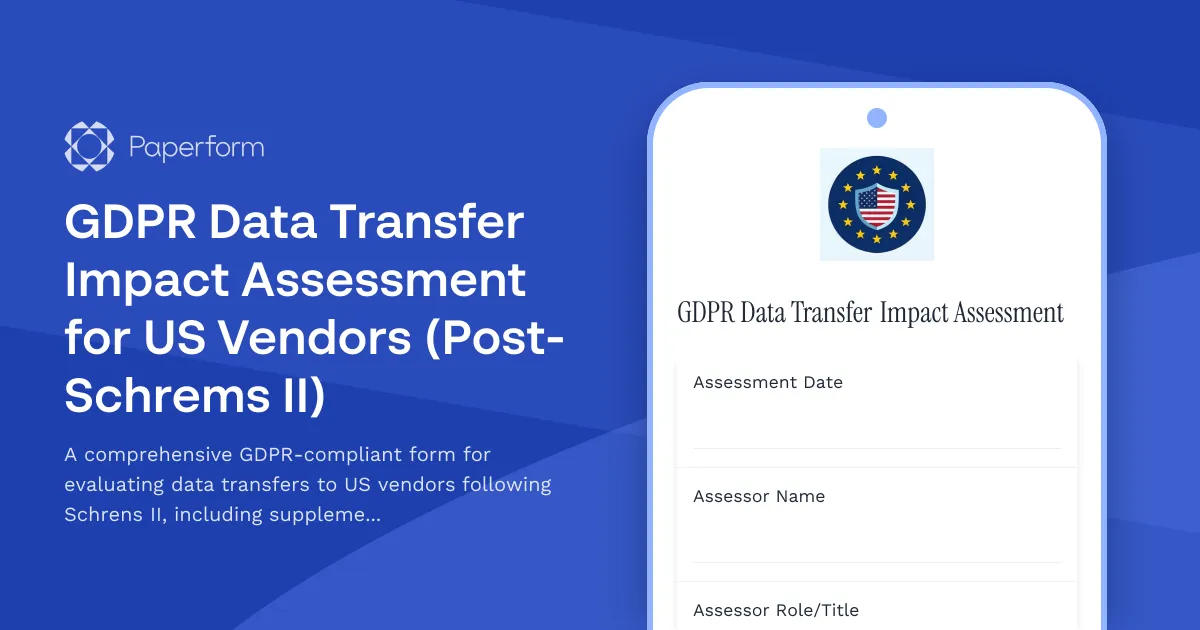
GDPR Data Transfer Impact Assessment for US Vendors (Post-Schrems II)
Transferring personal data to the United States has become more complex since the Schrems II ruling invalidated the EU-US Privacy Shield framework. Organisations subject to GDPR now need to conduct thorough Transfer Impact Assessments (TIAs) before sharing EU personal data with US vendors, especially when relying on Standard Contractual Clauses (SCCs) or other transfer mechanisms.
This GDPR Data Transfer Impact Assessment template helps legal teams, data protection officers and compliance professionals systematically evaluate the risks associated with transferring personal data to US service providers. It guides you through documenting supplementary measures, assessing vendor security practices, evaluating government access risks, and creating an audit trail that demonstrates GDPR Article 46 compliance.
Why this template matters for EU organisations
Following the Court of Justice of the European Union's Schrems II decision, simply signing SCCs is no longer sufficient. Your organisation must assess whether the laws of the destination country (particularly US surveillance laws like FISA 702 and EO 12333) could undermine the effectiveness of those contractual safeguards. This assessment needs to be documented, repeatable and defensible in the event of a supervisory authority audit.
This template structures your TIA process to capture essential information about the vendor, the nature of data being transferred, the legal basis for transfer, technical and organisational supplementary measures, and risk mitigation strategies. It's particularly valuable for organisations working with SaaS platforms, cloud providers, marketing tools, CRM systems and other US-based technology vendors where personal data processing is unavoidable.
Built for legal and compliance workflows
Whether you're a multinational enterprise managing dozens of vendor relationships or a mid-sized business expanding into US technology partnerships, this form provides a standardised framework for documenting your due diligence. The conditional logic adapts based on risk levels, data sensitivity and transfer mechanisms you select, ensuring you capture the right level of detail for each vendor assessment.
Once submitted, responses can feed directly into your compliance documentation, trigger approval workflows via Stepper, or generate reports for your Data Protection Officer and legal counsel. You can also integrate submissions with tools like Airtable, Notion or Google Sheets to maintain a central register of international data transfers—a requirement under GDPR Article 30.
For organisations managing ongoing vendor assessments, Papersign can turn approved TIAs into formal data processing agreements or addendums that require vendor sign-off, creating a complete chain of documented consent and contractual safeguards.
Professional compliance, accessible to non-specialists
Paperform makes it simple to deploy this assessment across procurement, legal and IT teams without requiring deep technical knowledge. The form's clean, professional layout and guided questions ensure consistent, high-quality documentation every time, while built-in calculation and conditional logic handle complexity behind the scenes.
Trusted by compliance-conscious organisations across the EU, Paperform is SOC 2 Type II certified and GDPR compliant, giving you confidence that your assessment process meets the same data protection standards you're evaluating in your vendors.
Get started with this template to bring structure, speed and audit-readiness to your post-Schrems II vendor due diligence.
More templates like this
Data Controller Change Notification & Consent Form
Notify customers of business ownership transfer and obtain consent for data processing continuity under new data controller, with clear opt-out rights per GDPR requirements.
French Data Protection Impact Assessment (AIPD) Form
A comprehensive GDPR-compliant form for conducting data protection impact assessments (AIPD - Analyse d'Impact relative à la Protection des Données) in France, including processing risk evaluation, mitigation measures, and CNIL consultation triggers.
GDPR Article 21 Legitimate Interest Objection Form
Allow data subjects to formally object to processing based on legitimate interests under GDPR Article 21, with space to specify compelling grounds and personal circumstances.
GDPR Article 31 Supervisory Authority Cooperation Form
Document controller/processor assistance and cooperation with supervisory authorities during GDPR investigations and compliance checks under Article 31.
GDPR Binding Corporate Rules Application Form
A comprehensive form for multinational groups to apply for Binding Corporate Rules (BCR) approval, enabling compliant intra-group personal data transfers across borders under GDPR requirements.
GDPR Data Processor Termination Assistance Form
Structured form for managing GDPR-compliant data processor termination, including data return, deletion verification, and certificate of destruction requirements.
GDPR Data Sharing Agreement Form – Joint Controllers (Article 26)
A comprehensive GDPR-compliant agreement form for joint controllers to document shared data processing responsibilities, allocate obligations, and ensure transparent compliance under Article 26 of the GDPR.
GDPR Vendor Data Processing Agreement
A comprehensive data processing agreement (DPA) for GDPR compliance, covering security measures, sub-processor disclosure, and breach notification terms for vendor relationships.
Privacy Notice Update Notification Form
Notify data subjects of privacy policy changes and collect updated consent in compliance with GDPR requirements. Ensure transparent communication and maintain regulatory compliance.
Data Controller Accountability Documentation Form
Comprehensive GDPR compliance documentation form for data controllers to record policies, procedures, training records, and audit results demonstrating accountability under EU data protection law.
Data Mapping Exercise Documentation Form
A comprehensive form for documenting personal data processing activities and data flows across systems to maintain Article 30 GDPR Records of Processing Activities (RoPA) compliance.
GDPR Compliance Self-Assessment for SMBs
A comprehensive self-assessment questionnaire for small and medium businesses to evaluate GDPR compliance, identify data protection gaps, and receive prioritized recommendations for remediation.