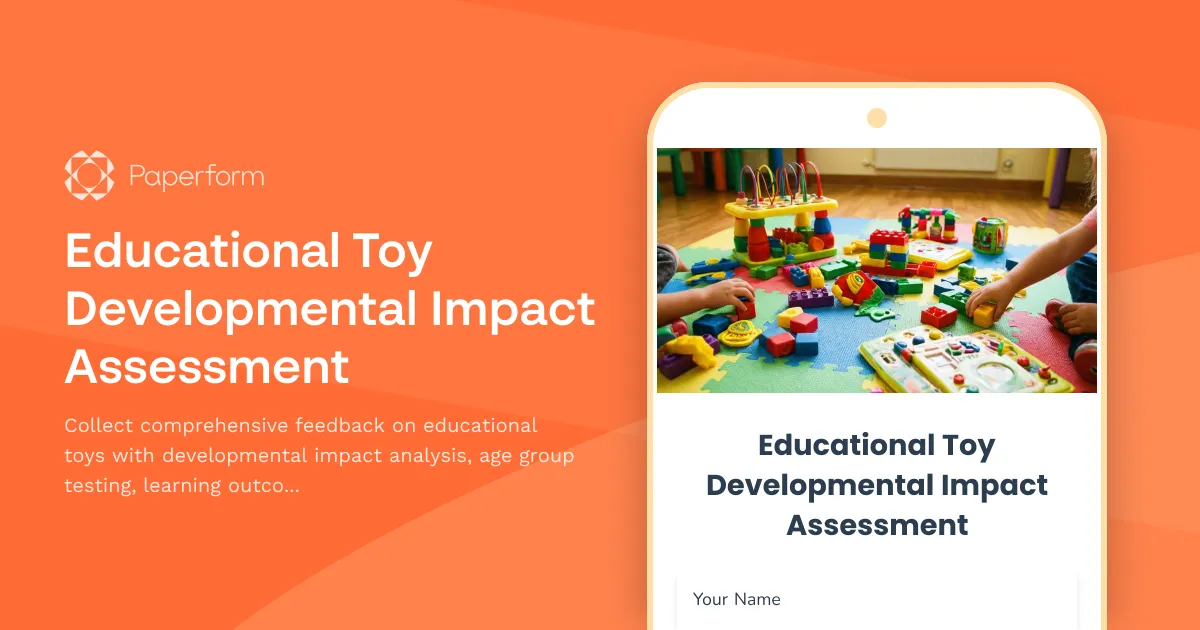
Educational Toy Developmental Impact Assessment Form Template
Finding the right educational toys that truly support child development isn't just about fun and games—it's about measurable learning outcomes, sustained engagement, and expert validation. Whether you're a toy manufacturer, educational product developer, or childcare provider, gathering structured feedback on how toys impact children's development is essential for creating products that make a real difference.
This Educational Toy Developmental Impact Assessment template helps you collect detailed, actionable feedback from educators, parents, and childcare professionals who test educational toys with children across different age groups.
Why structured toy feedback matters
Educational toy development requires more than anecdotal observations. You need systematic data on:
- Age-appropriate learning outcomes across cognitive, motor, social, and creative domains
- Real engagement duration rather than marketing claims
- Educator and expert validation to build credibility
- Developmental milestone alignment to ensure toys match learning stages
- Safety and usability insights from hands-on testing
This form gives toy companies, research teams, and educational institutions a professional framework to assess whether toys deliver on their educational promises.
What this form captures
The Educational Toy Developmental Impact Assessment covers all the critical dimensions of toy evaluation:
Product & Testing Context – Capture which toy is being evaluated, the age group tested, testing duration, and setting (classroom, home, therapy, etc.)
Developmental Learning Outcomes – Assess impact across multiple developmental domains including cognitive skills, fine/gross motor development, language and communication, social-emotional learning, and creative expression
Engagement & Interest Metrics – Track how long children stayed engaged, whether they returned to the toy independently, and their overall interest level throughout the testing period
Educator & Expert Ratings – Collect professional assessment scores for educational value, age-appropriateness, safety, durability, and overall recommendation
Qualitative Observations – Gather open-ended feedback on what worked well, challenges observed, unexpected learning moments, and suggestions for improvement
Demographic & Context Data – Optional fields for group size, special needs accommodations, and environment type to contextualize results
Who this form is for
This template is designed for professionals in the toy industry, education sector, and child development fields:
- Toy manufacturers and designers gathering beta testing feedback and validation data
- Educational product companies building evidence-based marketing and product improvement roadmaps
- Preschools and childcare centers evaluating new toys before purchasing for their programs
- Occupational and speech therapists assessing toys for therapeutic use
- Play researchers and child development specialists conducting formal toy studies
- Parent focus group coordinators collecting structured feedback from family testers
- Toy retailers and distributors curating age-appropriate, development-focused inventory
Why Paperform for educational toy feedback
Paperform makes it easy to collect rich, structured feedback without overwhelming your evaluators. The clean, conversational layout works perfectly for busy educators and parents who don't have time for clunky survey tools.
Conditional logic lets you show different questions based on age groups or toy categories, keeping the form relevant and concise. An educator testing toys for toddlers sees questions about motor skill development, while someone evaluating toys for school-age children gets questions about problem-solving and collaboration.
Rating scales, matrix questions, and slider fields make it simple to capture quantitative developmental impact scores that can be aggregated across multiple testers. You can track patterns like "Toys rated 4+ on cognitive development also scored high on sustained engagement."
File upload fields let evaluators attach photos or videos of children interacting with toys (with proper permissions), giving your product team visual context that written feedback can't capture.
Calculation fields can auto-score composite ratings across developmental domains, giving you an instant "developmental impact score" for each toy tested.
Once responses come in, AI Insights can analyze open-ended feedback to identify recurring themes—like "children lost interest after 10 minutes" or "excellent for group play scenarios"—saving hours of manual review.
Automate your product development workflow
Use Stepper to turn toy feedback into action automatically. When a form is submitted:
- Add the feedback to your product development tracker in Notion, Airtable, or Monday.com
- Alert your product team in Slack when toys receive below-threshold safety or engagement scores
- Send personalized thank-you emails to evaluators with discount codes or early access to new products
- Update your CRM with educator contacts who gave high ratings (potential testimonials and case studies)
- Generate PDF summaries of each toy's performance to share with your design and marketing teams
This means toy feedback doesn't just sit in a spreadsheet—it flows directly into product iterations, marketing validation, and relationship building with your educator network.
Build better toys, backed by real developmental data
Educational toys should do more than entertain—they should support genuine learning and development. This form template helps you collect the professional, structured feedback you need to prove impact, refine designs, and build products that educators, parents, and—most importantly—children truly love.
Whether you're launching a new STEM kit, testing sensory toys for special needs, or validating a language learning game, this template gives you the foundation to gather feedback that drives real product improvement.
Ready to collect developmental impact data on your educational toys? Customize this template in Paperform and start building products backed by evidence, not guesswork.
More templates like this
Cleaning Product Effectiveness Review Form
A comprehensive feedback form for evaluating cleaning product performance across different surfaces, measuring scent, eco-friendliness, and comparing against competitor brands.
Baby Product Safety Evaluation Form
A comprehensive feedback form for parents to evaluate baby products based on safety, age appropriateness, ease of cleaning, durability, and overall value. Perfect for manufacturers and retailers seeking detailed parental insights.
Biodegradable Product Composting Verification Form
A comprehensive form for verifying biodegradable product claims, tracking decomposition timelines, and evaluating composting requirements for sustainable product development.
Neurodivergent-Friendly Product Sensory Feedback Form
A sensory-focused product feedback form designed specifically for neurodivergent users to share detailed sensory experiences, including texture tolerance, sound sensitivity, visual comfort, and meltdown prevention effectiveness.
Accessibility Technology User Feedback Form
Gather detailed feedback on accessibility technology products from users with disabilities, covering effectiveness, usability, independence improvement, learning curve, and caregiver training needs.
Adaptive Clothing Functionality Feedback Form
Gather detailed feedback on adaptive clothing functionality, including ease of dressing, comfort with medical devices, caregiver assistance needs, and dignity preservation for users with mobility or health challenges.

Archaeological Conservation Chemical Specialist Form
A specialized form for archaeological conservation specialists to assess artifact material compatibility, excavation site stability, and documentation requirements for publication-quality preservation.
Automotive Parts Customer Review Form
Collect detailed customer feedback on automotive parts including fitment accuracy, installation difficulty, performance improvements, and technical specifications verification.
Canvas Printing Customization Research
A UX research form designed for canvas printing e-commerce shops to gather user feedback on customization features, image upload experiences, size selection clarity, and preview accuracy expectations.
Daycare Parent Satisfaction Survey
A comprehensive parent feedback survey designed to measure satisfaction with childcare quality, staff communication, safety protocols, and overall daycare experience.

Digital Asset Management System Evaluation Form
A comprehensive evaluation form for institutional repository librarians to assess digital asset management systems, including metadata harvesting capabilities, preservation formats, usage analytics, and open access compliance tracking.

Esports Peripheral Performance Review Form
A professional form for evaluating gaming peripherals in competitive esports environments, covering performance metrics, durability, customization, and competitive advantages.