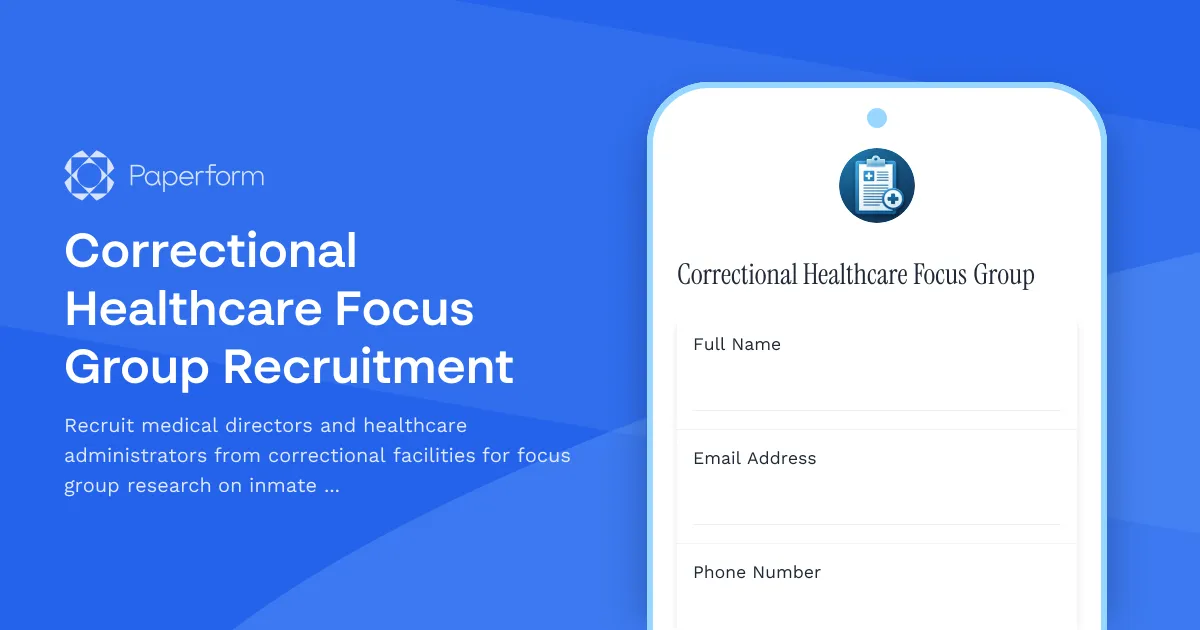
Advance Correctional Healthcare Research with This Focus Group Recruitment Form
Healthcare delivery in correctional facilities presents unique challenges that require specialized research and continuous improvement. This Correctional Healthcare Focus Group Recruitment Form is designed specifically for researchers, healthcare consultants, and organizations studying healthcare systems within jails, prisons, and detention centers.
Why Correctional Healthcare Research Matters
With an estimated 2 million people incarcerated in the United States alone, correctional facilities serve as significant healthcare providers for populations with higher rates of chronic diseases, mental health conditions, substance use disorders, and infectious diseases compared to the general population. Medical directors, healthcare administrators, and clinical staff in these settings navigate complex challenges including:
- Managing high prevalence of chronic conditions (diabetes, hypertension, hepatitis C, HIV/AIDS)
- Delivering mental health and substance abuse treatment in secure environments
- Coordinating emergency medical responses within security constraints
- Addressing continuity of care during intake, transfers, and release
- Balancing security protocols with patient privacy and treatment access
Research that captures the experiences and insights of correctional healthcare leaders is essential for developing evidence-based policies, improving care delivery models, and advocating for system-level improvements.
Built for Healthcare Research in Correctional Settings
This Paperform template streamlines your focus group recruitment by collecting detailed screening information from potential participants. The form gathers:
- Professional background and credentials of medical directors and healthcare administrators
- Facility characteristics including security level, inmate population size, and average length of stay
- Healthcare delivery models and staffing structures
- Chronic disease prevalence data for conditions like diabetes, cardiovascular disease, and infectious diseases
- Mental health service availability including psychiatric care, medication-assisted treatment, and crisis intervention
- Emergency response protocols and coordination with external hospitals
- Participant availability for focus group sessions
By collecting this screening data upfront, you can identify participants who represent diverse facility types, geographic regions, and healthcare delivery models—ensuring your research captures a comprehensive picture of correctional healthcare challenges and innovations.
Designed for Researchers and Healthcare Consultants
Whether you're an academic researcher, a healthcare quality improvement consultant, a public health agency, or a nonprofit organization focused on criminal justice reform, this form template provides a professional, compliant way to recruit qualified focus group participants.
Paperform's conditional logic lets you automatically screen participants based on your inclusion criteria—such as minimum years of experience, facility type, or specific program availability. You can route qualified candidates to schedule their focus group session directly within the form using appointment scheduling fields, eliminating back-and-forth emails.
Streamline Your Research Workflow
Correctional healthcare research often involves coordination across multiple stakeholders, facilities, and review boards. Paperform helps you manage this complexity:
- Secure data collection with SOC 2 Type II compliance, ensuring participant information is protected
- Custom confirmation emails that provide participants with study information, consent forms, and next steps
- CRM and research database integrations via Stepper, Zapier, or webhooks to automatically log participant data in Airtable, REDCap, or your preferred research management system
- Team collaboration features so multiple researchers can review submissions, track recruitment progress, and coordinate focus group scheduling
If your research requires informed consent documentation, you can seamlessly integrate Papersign to send consent forms for electronic signature immediately after a participant is screened and approved—keeping all documentation linked to the original submission.
Automation That Supports Your Research Protocol
Use Stepper to automate your recruitment workflow:
- Automatically send screening results and study information to qualified participants
- Route submissions to different team members based on facility type or geographic region
- Update your recruitment tracking spreadsheet in real-time
- Send reminder emails as focus group dates approach
- Trigger post-participation surveys or incentive distribution
Who This Form Is For
This template is ideal for:
- Academic researchers studying healthcare delivery in correctional settings
- Healthcare consultants conducting needs assessments for correctional healthcare systems
- Public health agencies evaluating the impact of correctional healthcare policies
- Quality improvement organizations working to enhance care standards in detention facilities
- Nonprofit and advocacy groups gathering evidence to support healthcare reform in criminal justice
- Healthcare technology companies conducting user research with correctional medical directors
Professional, Compliant, and Customizable
This form template gives you a strong foundation while remaining fully customizable to your specific research protocol. Adjust questions to match your IRB-approved screening criteria, add fields for incentive information, modify the theme to match your institution's branding, or include video introductions explaining your study.
Paperform's document-style editor makes it easy to add context, embed your IRB approval information, or include visual elements that establish credibility and encourage participation from busy healthcare administrators.
Get Started with Evidence-Based Correctional Healthcare Research
Over 500,000 teams worldwide trust Paperform to manage their most important data collection needs. This template brings together the screening depth required for rigorous qualitative research with the user-friendly experience that encourages participation from time-constrained healthcare professionals.
Start recruiting qualified focus group participants today and contribute to improving healthcare outcomes for one of the most medically underserved populations.
More templates like this
Elderly Care Facility Focus Group Recruitment
A comprehensive screening form to recruit adult children for a focus group about elderly care facility needs, covering care levels, budget, location preferences, and memory care requirements.
Home Healthcare Focus Group Recruitment for Caregivers
Recruit caregivers for home healthcare research focused on patient conditions, care needs, insurance coverage, and respite care services. Screen participants for focus group participation.
Occupational Health Focus Group Recruitment
Screen and recruit employers for an occupational health focus group discussion on workplace injury rates, return-to-work programs, drug testing policies, and wellness integration strategies.
Pharmacy Satisfaction Focus Group Recruitment
A comprehensive recruitment form for pharmacy satisfaction focus groups, screening participants based on prescription volume, insurance usage, pharmacist consultations, and service preferences.
Allied Health Referral Coordination Research
A UX research form to gather insights on specialist availability, appointment urgency, and medical record transfer efficiency in allied health referral coordination workflows.
Clinical Documentation Focus Group Recruitment
Screen and recruit physicians for a focus group on EMR documentation, template usage, dictation tools, and compliance burden. Gather key insights to improve clinical workflows.
Corporate Wellness Focus Group Recruitment Form
A professional screening form to recruit benefits managers for a corporate wellness focus group exploring biometric testing, participation incentives, privacy protections, and follow-up coaching programs.

Food Safety Research Study Signup Form
Recruit participants for food safety research studies with comprehensive consent, dietary habits assessment, and sample collection agreements.
Healthcare Membership Program Value Research
Research form to understand member perceptions of healthcare concierge services, measure cost savings, and evaluate exclusive benefits utilization.
Healthcare Patient Portal Usability Research Form
A comprehensive UX research form designed to evaluate patient portal usability, assess accessibility needs, measure task success rates, and understand digital literacy levels for healthcare technology improvement.
Hospice Care Focus Group Recruitment Form
A compassionate screening form for recruiting family members of hospice patients to participate in focus group discussions about care experiences, preferences, and support needs.
Medical Malpractice Insurance Focus Group Recruitment
Screen and recruit physicians for a focus group exploring medical malpractice insurance needs, specialty risk profiles, claim history, coverage limits, and tail coverage considerations.