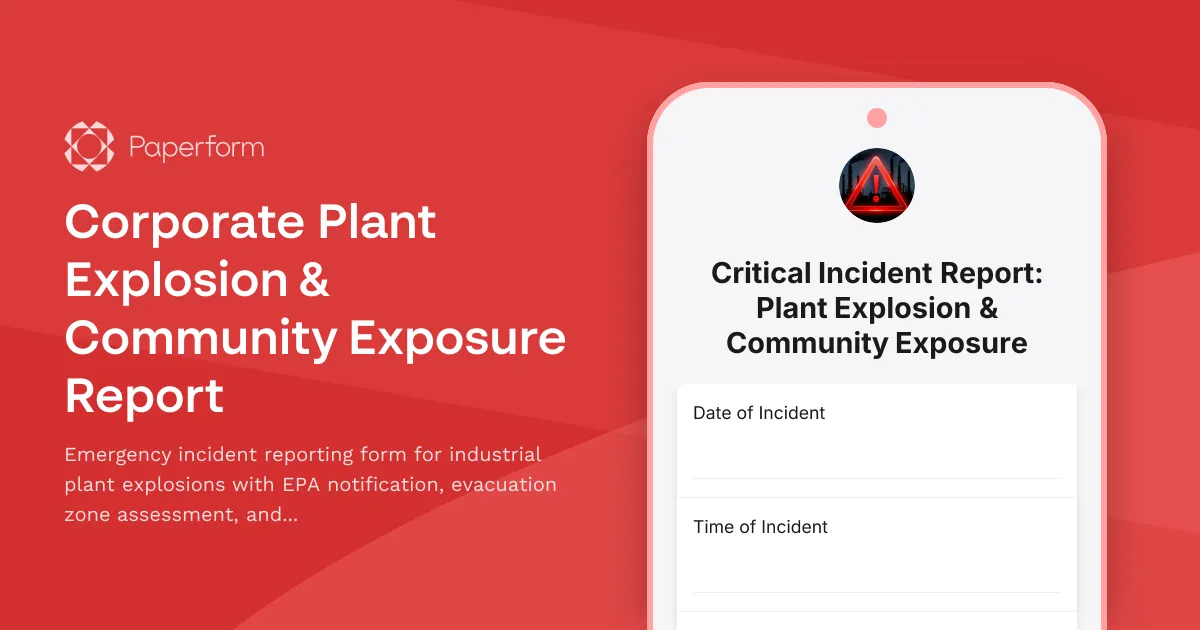
Industrial Emergency Response & Community Safety Reporting
When a critical incident like a plant explosion occurs, every second counts. Industrial facilities, chemical plants, manufacturing operations, and energy companies need a fast, reliable way to document the emergency, notify regulatory authorities, assess community impact, and coordinate immediate health and safety responses.
This Corporate Plant Explosion & Community Exposure Report template is designed specifically for environmental health and safety (EHS) managers, plant safety officers, emergency response coordinators, and corporate compliance teams who need to respond to industrial emergencies with speed and precision.
Why Paperform is the right solution for emergency incident reporting
When an explosion or critical incident happens, you can't afford to fumble with complicated software or wait for IT support. Paperform gives your team a professional, mobile-ready emergency reporting form that can be filled out from anywhere—on-site during an active incident, from an emergency operations center, or remotely by field response teams.
The form captures everything required for immediate regulatory compliance, including EPA emergency notification details, HAZMAT release information, evacuation zone determination, and coordination of community health screenings. With conditional logic built in, the form adapts based on the severity of the incident, the materials involved, and the potential for community exposure.
Built for industrial safety and environmental compliance
This template is ideal for:
- Manufacturing plants handling hazardous materials or operating high-risk equipment
- Chemical facilities subject to EPA Risk Management Program (RMP) and EPCRA reporting
- Oil & gas operations with potential for explosions, fires, or toxic releases
- Energy facilities including power plants and refineries
- Industrial parks with multiple tenants and shared emergency protocols
- Corporate EHS departments managing safety across multiple facilities
The form guides responders through critical decision points: Is there a chemical release? What's the wind direction? How far should evacuation zones extend? Are there residential areas, schools, or hospitals nearby? Every answer triggers the appropriate follow-up questions and action items.
Streamline EPA notifications and regulatory compliance
One of the most stressful parts of an industrial emergency is meeting immediate reporting requirements. Depending on the materials involved and the scale of the incident, your facility may need to notify the EPA National Response Center, state environmental agencies, local emergency planning committees (LEPCs), and community officials—often within minutes.
This template includes fields for all required EPA emergency notification data, including facility identification, release quantities, chemical identifiers (CAS numbers), exposure pathways, and protective action recommendations. You can configure the form to automatically send copies to your regulatory affairs team, legal counsel, and corporate communications, ensuring everyone has the same information at the same time.
Coordinate evacuations and community health screening
Beyond regulatory reporting, this form helps you manage the human impact of an industrial incident. Fields for evacuation zone mapping, downwind population estimates, vulnerable facility identification (schools, hospitals, nursing homes), and community health screening logistics give your incident command team a clear picture of who might be affected and what protective actions are needed.
The form captures contact information for local health departments, hospitals, and emergency medical services, making it easy to coordinate on-site triage, decontamination stations, and follow-up health monitoring for potentially exposed community members.
Automate incident workflows with Stepper
After an emergency report is submitted, the real work of incident management begins. With Stepper (stepper.io), Paperform's AI-native workflow automation platform, you can turn every critical incident report into an automated response workflow:
- Instantly alert your crisis management team, on-call engineers, and corporate leadership via SMS, Slack, or email based on incident severity
- Create incident tickets in your EHS management system or project tools with all report details pre-populated
- Route regulatory notifications to your compliance team with pre-filled EPA forms ready for immediate submission
- Update status boards in real-time so your emergency operations center has live visibility into evacuation zones, exposure numbers, and response actions
- Trigger follow-up tasks like air quality monitoring, community outreach calls, media response preparation, and post-incident investigation scheduling
Stepper keeps your incident response running smoothly even when conditions are chaotic, ensuring nothing falls through the cracks during the critical first hours after an explosion.
Mobile-ready, secure, and always accessible
Emergency responders need tools that work under pressure. This Paperform template is fully mobile-optimized, so safety officers can complete reports from smartphones or tablets while standing in the field. The form works offline if connectivity is limited, storing responses and syncing once a connection is restored.
With SOC 2 Type II compliance, role-based access controls, and data residency options, Paperform ensures your sensitive incident data remains secure while still being accessible to authorized personnel during an active emergency.
Designed for high-stakes industries that can't afford downtime
Industries like manufacturing, oil & gas, chemical processing, and energy generation operate in high-risk environments where emergency preparedness isn't optional—it's regulatory, operational, and ethical. This form template reflects the real-world complexity of industrial incident response, helping your team meet legal obligations, protect community health, and maintain stakeholder trust during the most difficult moments.
Whether you're an EHS manager building out your facility's emergency response plan, a corporate safety director standardizing incident reporting across multiple sites, or a compliance officer ensuring your team can meet EPA notification deadlines, this template gives you a professional, field-tested starting point.
Start with this template, customize it to your facility's specific risks and reporting requirements, and connect it to Stepper workflows that automate the critical tasks that follow every emergency report. Because when an explosion happens, you need systems you can trust—not software that gets in your way.



More templates like this
Water Treatment Facility Contamination Crisis Report
A comprehensive crisis reporting form for water treatment facilities to document contamination incidents, ensure EPA compliance, notify public health officials, and issue boil water advisories when necessary.
Environmental Disaster & Spill Report
Report environmental disasters, hazardous spills, and critical incidents with EPA notification, wildlife impact assessment, and cleanup cost estimation for immediate emergency response.
Nuclear Facility Radiological Incident Report
A comprehensive incident report form for nuclear facilities to document radiological events, assess exposure levels, determine evacuation zones, and ensure NRC notification compliance.
Wastewater Treatment Facility Overflow Crisis Report
Report wastewater overflows and critical incidents with environmental impact assessment, health department notification, and community alert protocols for treatment facilities.
Chemical Spill Emergency Response Form
Report chemical spills and hazardous material incidents with detailed documentation for containment, safety measures, and regulatory compliance.
Water Treatment Plant Evacuation Form
Emergency evacuation form for water treatment facilities to track personnel safety, equipment shutdown status, and critical system monitoring during emergency situations.
Corporate Product Tampering Crisis Report
A comprehensive incident reporting form for documenting product tampering events, coordinating FDA notification, managing national recalls, and activating consumer warning systems.
Correctional Facility Riot Incident Report
Complete riot and critical incident documentation for correctional facilities, including tactical response, injury assessment, and state oversight notification requirements.
Factory Explosion Incident Report
A comprehensive incident report form for documenting factory explosions and critical industrial incidents, including casualty assessment, OSHA coordination, and evacuation protocols.
Hazmat Storage Facility Evacuation & Accountability Form
Emergency evacuation form for hazardous materials storage facilities to track personnel accountability, containment status, exposure assessment, and regulatory notifications during critical incidents.
ISS Ground Control Cooling System Failure Report
Comprehensive cooling system failure reporting form for International Space Station ground control operations with crew safety calculations, mission abort criteria evaluation, and international partner coordination protocols.
Water Treatment Plant Emergency Report Form
Report critical incidents at water treatment facilities with EPA compliance triggers, service area impact assessment, and automated public health notification protocols for regulatory compliance.