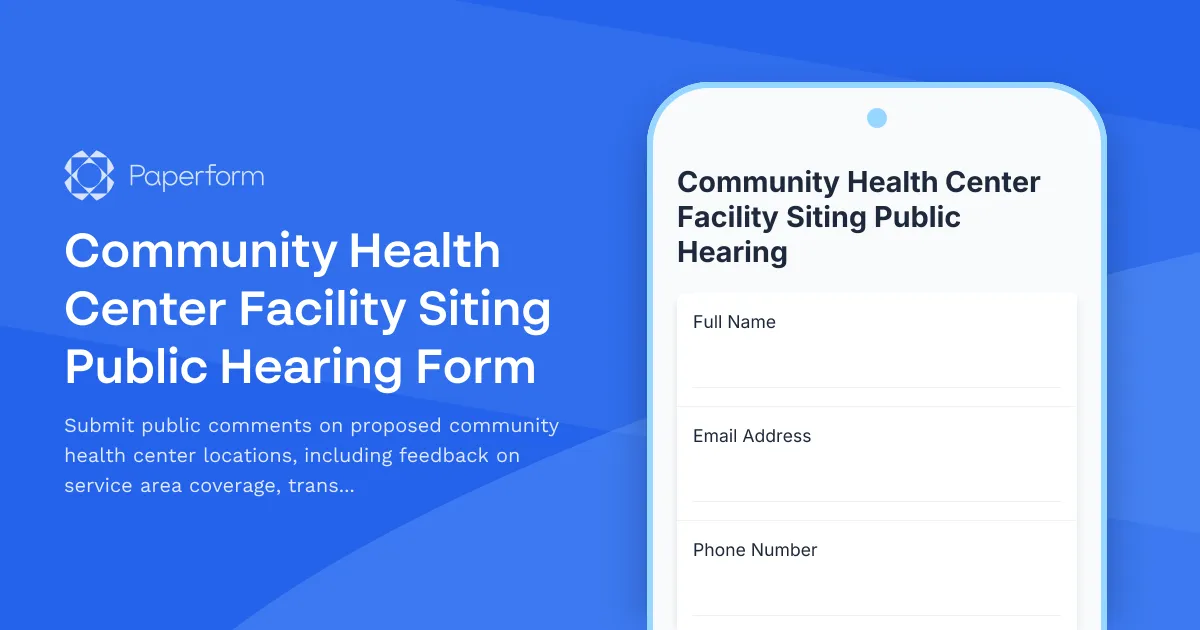
Community Health Center Facility Siting Public Hearing Form
When local governments and health authorities propose new community health center facilities, public input is essential to ensure these vital resources truly serve the needs of residents. This Community Health Center Facility Siting Public Hearing Form makes it easy for citizens, healthcare advocates, and community organizations to submit structured comments on proposed facility locations, service areas, transportation accessibility, and health priorities.
Why Public Comment Matters for Health Facility Siting
Community health centers serve as critical access points for primary care, preventive services, mental health support, and specialized care—particularly for underserved populations. The location of these facilities directly impacts:
- Access to care: Whether residents can physically reach the facility via public transit, walking, or driving
- Service equity: How well the facility's service area addresses gaps in existing healthcare coverage
- Community health outcomes: Alignment between facility services and the specific health challenges facing local residents
- Long-term sustainability: Community support and utilization rates that determine facility success
Public hearing processes allow residents to voice concerns, highlight unmet needs, and ensure decision-makers have complete information before finalizing facility locations.
Streamline Public Participation with Paperform
Traditionally, public comment processes rely on in-person hearings, mailed letters, or generic email submissions that can be difficult to organize and analyze. This Paperform template modernizes the process by:
- Collecting structured feedback on service area coverage, transportation barriers, and health priorities
- Capturing detailed location information from commenters to map community sentiment geographically
- Enabling accessibility for residents who cannot attend in-person hearings due to work schedules, mobility challenges, or childcare responsibilities
- Organizing responses for easier review by planning commissions, health boards, and municipal decision-makers
Who This Form Serves
This template is designed for:
- Public health departments conducting community needs assessments and facility planning
- Municipal planning departments managing zoning applications and public hearing processes
- Federally Qualified Health Centers (FQHCs) seeking community input on expansion or new facilities
- County health boards evaluating proposals for clinic locations and service configurations
- Community development organizations facilitating resident engagement in health infrastructure decisions
Key Features of This Template
Commenter Information: Captures name, contact details, and relationship to the community (resident, healthcare worker, business owner, etc.) to provide context for each submission.
Facility Location Feedback: Allows commenters to indicate support or opposition to the proposed location, with detailed reasoning about service area coverage, geographic accessibility, and gaps in existing healthcare infrastructure.
Transportation & Access Analysis: Collects specific feedback on transportation barriers, including public transit availability, parking concerns, walkability, and accessibility for elderly or disabled residents.
Community Health Priorities: Enables residents to identify the most pressing health needs in their area—from chronic disease management to mental health services, pediatric care, or substance abuse treatment—ensuring facility services align with community needs.
Service Hours & Capacity: Gathers input on preferred operating hours, evening/weekend availability, and capacity concerns to inform facility planning.
Alternative Site Suggestions: Provides space for commenters to recommend alternative locations or modifications that would better serve community needs.
Automate Your Public Comment Workflow
Once you've collected public comments through Paperform, you can streamline your review and analysis process using Stepper (stepper.io), Paperform's AI-native workflow automation tool:
- Automatically categorize comments by sentiment (support/opposition), geographic area, or key themes
- Route submissions to relevant department heads, planners, or health board members based on comment type
- Generate summary reports aggregating feedback for presentation at public hearings or board meetings
- Send confirmation emails to commenters acknowledging receipt and providing hearing dates
- Update project management tools like Asana, Monday.com, or Notion with categorized feedback for review
For processes requiring formal acknowledgment or legal record-keeping, Papersign (papersign.com) can be used to send affidavits, disclosure forms, or official hearing participation certificates to commenters who need documentation of their submission.
Built for Government Transparency and Accessibility
Public sector organizations need forms that meet accessibility standards, protect data privacy, and maintain public trust. This template follows best practices for civic engagement forms:
- Clear, plain-language questions that don't require technical or legal expertise
- Mobile-friendly design ensuring residents can participate from any device
- Conditional logic that adapts questions based on commenter responses, reducing form fatigue
- Secure data collection meeting government data protection standards
- Accessible design supporting screen readers and keyboard navigation
Integrate with Your Existing Systems
Paperform connects seamlessly with the tools government agencies and nonprofits already use:
- Send submissions to Google Sheets or Airtable for collaborative review and analysis
- Push notifications to Slack or Microsoft Teams when high-priority comments are received
- Sync with CRM systems to maintain constituent communication records
- Export to Excel or PDF for inclusion in official public hearing records
- Connect via webhooks to custom government databases or case management systems
Encourage Meaningful Community Participation
Effective public comment processes don't just collect data—they foster genuine community engagement and trust in government decision-making. This form template helps you:
- Lower barriers to participation by offering a convenient, 24/7 submission method
- Gather richer, more specific feedback through structured questions that prompt detailed responses
- Demonstrate transparency by making the comment process clear, accessible, and responsive
- Build community buy-in for health infrastructure investments that reflect resident priorities
Whether you're a county health department planning a rural clinic expansion, a city planning commission reviewing a zoning variance for a community health center, or a nonprofit healthcare organization seeking input on facility locations, this Paperform template provides a professional, accessible foundation for meaningful public participation.
Get started in minutes. Customize the questions to match your specific proposal, add your agency branding, and share the form via your website, social media, email newsletters, or QR codes at community meetings. With Paperform's intuitive editor, you can adapt this template to any public comment process—from environmental reviews to land use decisions—without writing a single line of code.


More templates like this
Community Health Needs Assessment Input Form
Gather community input on priority health conditions, social determinant barriers, prevention program gaps, and culturally responsive intervention design to inform public health planning.
Adaptive Sports Equipment Grant Application for Veterans
A comprehensive grant application form for veterans seeking funding for adaptive sports equipment, including disability documentation, equipment specifications, coaching credentials, and facility accessibility requirements.
Emergency Pediatric Asthma Remediation Application
A comprehensive application form for families seeking emergency asthma remediation services, including environmental assessment, allergen reduction, pest management, and medical coordination to create healthier homes for children with asthma.
Overdose Prevention & Harm Reduction Services Enrollment
Confidential enrollment form for overdose prevention services including naloxone distribution, syringe exchange, testing, harm reduction education, and treatment referrals.
Temporary COVID-19 Testing Site Setup Permit Application
Apply for municipal approval to establish a temporary COVID-19 testing site. Streamline your permit application with sections for site details, operational capacity, medical waste management, traffic flow planning, and healthcare provider credentials.
Adult Day Care Subsidy Application
Apply for financial assistance to cover adult day care services for elderly or disabled adults. Complete this form to assess eligibility for subsidized care programs.
Community Health SNAP Enrollment Assistance Funding Application
A comprehensive funding application for community organizations seeking grants to provide SNAP enrollment assistance services, including food insecurity data, eligibility screening protocols, and nutrition education programs.
Crisis Intervention Services Intake Form
A comprehensive intake form for crisis intervention services with mental health emergency screening, suicide risk assessment, substance use evaluation, and voluntary commitment acknowledgment.
Crisis Respite Care Application for Caregivers
Apply for temporary crisis respite care services to support caregivers of elderly or disabled family members. Request facility-based or in-home respite care with comprehensive assessment of care needs.
Crisis Youth Mobile Response Request Form
Request immediate crisis intervention for child behavioral emergencies. Connect with mobile response teams for in-home stabilization, safety assessment, and family support services.
Dental Care Assistance Application
A comprehensive application for low-income adults seeking dental care assistance, including oral health assessment, pain evaluation, and sliding scale fee determination.
Emergency Extreme Weather Shelter Activation Form
Comprehensive form for activating emergency weather shelters during extreme temperature events, coordinating resources, tracking capacity, and ensuring vulnerable populations receive critical protection.