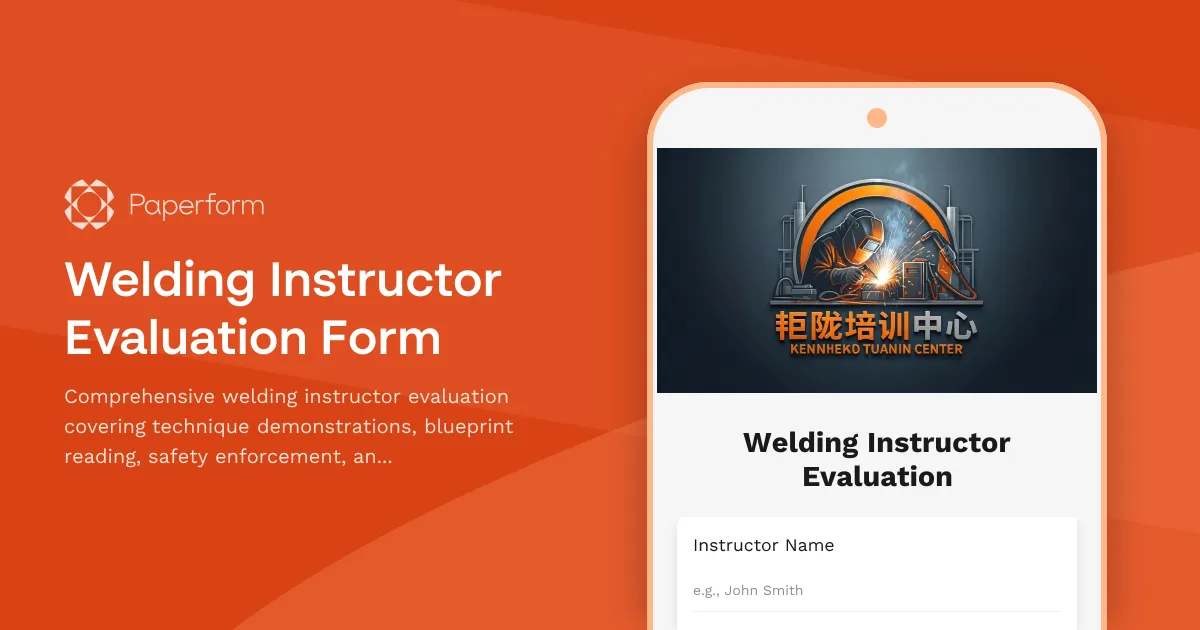
Professional Welding Instructor Evaluation Form Template
For vocational schools, technical colleges, and welding training centers, getting actionable feedback from students is essential to maintaining high-quality instruction and preparing the next generation of certified welders. This Welding Instructor Evaluation Form from Paperform gives students a structured way to assess their instructor's teaching across the core competencies that matter most: technique demonstration quality, blueprint reading instruction, safety equipment enforcement, and AWS certification preparation.
Why welding programs need specialized instructor evaluations
Welding is a highly technical, hands-on trade where instructor quality directly impacts student safety, skill development, and career readiness. Generic course evaluations miss the nuances of welding education—like whether the instructor demonstrates proper torch angles, enforces PPE usage, or prepares students for American Welding Society (AWS) certification exams.
This template is purpose-built for welding programs. It covers the teaching areas that distinguish great welding instructors from mediocre ones, and gives program directors concrete data to support professional development, accreditation reporting, and continuous improvement.
What this template evaluates
The form is organized around the four pillars of effective welding instruction:
Technique Demonstration Quality
Students rate how clearly the instructor demonstrates welding techniques—whether they can see hand positioning, travel speed, arc length, and other critical details. Questions cover live demonstrations, video replays, and the instructor's ability to break down complex techniques into teachable steps.
Blueprint Reading Instruction
Blueprint literacy is non-negotiable in professional welding. The form asks whether the instructor teaches students to interpret weld symbols, material specifications, joint types, and tolerances, and whether students feel confident reading prints independently after instruction.
Safety Equipment Usage Enforcement
Safety is paramount in any welding program. Students assess whether the instructor consistently enforces PPE requirements (helmets, gloves, respirators, sleeves), maintains a safe work environment, and models best practices in ventilation, fire prevention, and equipment handling.
AWS Certification Preparation
For students aiming to become certified welders, this section evaluates how well the instructor prepares them for AWS exams—whether they cover code requirements, test formats, practice welds to certification standards, and provide feedback aligned with AWS criteria.
Beyond these core areas, the form includes sections for overall teaching effectiveness, communication, responsiveness to questions, and open-ended feedback for suggestions and highlights.
How vocational programs and training centers use this form
- Technical colleges and trade schools use it at the end of each term to identify instructors who need support in specific teaching areas, and to recognize standout educators.
- Apprenticeship programs collect feedback after each training block to ensure apprentices are getting the hands-on instruction and safety training required by union or industry standards.
- Private welding academies use it to maintain teaching quality, inform hiring decisions, and market their programs based on instructor ratings.
- Community colleges tie evaluation results to faculty development plans, accreditation self-studies, and program improvement initiatives.
Because the form is anonymous by default, students can give honest feedback without fear of retaliation, leading to more accurate and actionable data.
Paperform makes welding program administration easier
With Paperform, you can embed this evaluation directly into your learning management system, send it via email after each course, or share it as a standalone link. Responses are collected in real time, and you can view submission summaries, filter by instructor or course, and export data to Excel or Google Sheets for deeper analysis.
Conditional logic lets you ask follow-up questions based on student responses—for example, if a student rates safety enforcement as poor, you can prompt them to describe specific incidents. AI Insights can summarize hundreds of open-ended comments into key themes, saving program directors hours of manual review.
If you're running evaluations across multiple instructors, campuses, or certification tracks, you can duplicate this template, customize branding, and manage everything from one Paperform account.
Automate reporting and follow-up with Stepper
For programs that want to close the feedback loop, Stepper (stepper.io) can turn each evaluation submission into a workflow. You might:
- Automatically flag evaluations with low safety scores and notify the department head.
- Route positive feedback to a recognition channel or instructor portfolio.
- Schedule follow-up surveys to see if improvements were noticed in the next term.
- Push evaluation data into your student information system or accreditation reporting tool.
This keeps evaluation data from sitting in a spreadsheet and turns it into action—whether that's coaching conversations, curriculum updates, or public recognition for top instructors.
Built for trade education, trusted by vocational programs
Paperform is trusted by over 500,000 teams worldwide, including schools, training centers, and workforce development organizations. With SOC 2 Type II compliance, GDPR readiness, and role-based permissions, you can collect sensitive student feedback with confidence. And because Paperform is no-code, program coordinators and department heads can own the evaluation process without waiting on IT.
Whether you're running a single welding program or managing evaluations across an entire technical college, this template gives you a professional, customizable starting point that reflects the real-world demands of welding education.
Start collecting better feedback, supporting your instructors, and building stronger welding programs with Paperform.
More templates like this
IT Certification Boot Camp Instructor Evaluation Form
Comprehensive evaluation form for IT certification boot camp instructors, measuring teaching effectiveness, technical expertise, lab quality, and exam preparation support.
Beauty School Student Client Satisfaction Survey
Gather valuable feedback from clients about their beauty school service experience, student performance, and overall satisfaction to improve training programs.
Driver's Education Teacher Assessment Form
Evaluate your driving instructor's teaching effectiveness, safety practices, and DMV test preparation to help improve driver's education programs and student outcomes.
Electrical Apprenticeship Instructor Assessment
Evaluate electrical apprenticeship instructors on code compliance training, circuit design instruction, safety procedures, and journeyman exam preparation effectiveness.

Planetarium Presenter Evaluation Form
Evaluate planetarium presenter performance including astronomy content accuracy, narration quality, audience engagement, and technical operation skills for planetarium shows and educational programs.
Preschool Teacher Assessment Form
Evaluate preschool teacher performance across developmental milestone tracking, play-based learning, parent communication, and safety protocols with this comprehensive assessment form.
School Cafeteria Manager Assessment
Comprehensive evaluation form for assessing school cafeteria manager performance across nutrition standards, food safety, budget management, and dietary accommodations.
Substitute Teacher Performance Evaluation
A comprehensive evaluation form for school administrators to assess substitute teacher performance, including classroom management, lesson plan adherence, and student feedback summaries.

Teacher Performance Review Form
A comprehensive teacher evaluation form that combines classroom observations, student outcomes, parent feedback, and professional development planning to support educator growth and excellence.
Academic Advisor Evaluation Form
Comprehensive evaluation form for students to provide feedback on their academic advisor's performance, covering degree planning, course guidance, graduation timeline support, and career counseling.
Academic Continuing Education Instructor Evaluation
A comprehensive feedback form for evaluating academic continuing education instructors, focusing on pedagogical innovation, classroom management techniques, and curriculum development guidance.
Academic Department Program Review Form
Comprehensive program evaluation form for assessing curriculum relevance, learning outcomes, faculty qualifications, resource allocation, and enrollment sustainability in academic departments.