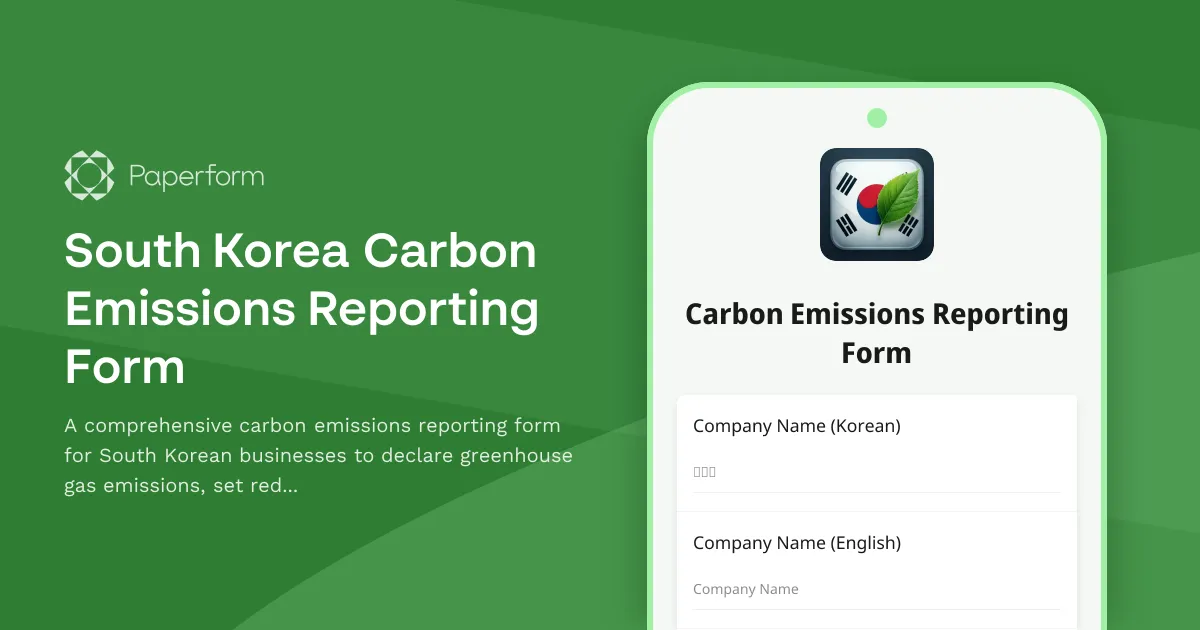
South Korea Carbon Emissions Reporting Made Simple
As South Korea strengthens its commitment to carbon neutrality by 2050, businesses operating in the country face increasing requirements to measure, report, and reduce their greenhouse gas emissions. Whether you're complying with the Korean Emissions Trading Scheme (K-ETS), preparing for regulatory audits, or voluntarily tracking your environmental impact, accurate carbon reporting is essential.
This South Korea Carbon Emissions Reporting Form provides a structured, compliant solution for businesses to declare their annual emissions data, establish reduction targets, and document offset strategies—all in one streamlined digital form.
Built for Korean regulatory compliance
Designed specifically for businesses operating under South Korean environmental law, this template helps you capture all the critical data points required by the Ministry of Environment and related agencies. The form collects facility information, emissions data across Scope 1, 2, and 3 categories, reduction commitments, and offset purchase plans, ensuring your submissions meet regulatory standards.
With Paperform's conditional logic, the form adapts based on your business type and emission levels, showing only relevant questions and streamlining the reporting process for both large industrial operations and smaller commercial enterprises.
Streamline reporting workflows with automation
Manual carbon reporting often involves juggling spreadsheets, emails, and multiple departments. With this Paperform template, you can centralise your emissions data collection and automatically trigger the right next steps using Stepper, Paperform's AI-native workflow automation tool.
Route completed reports to environmental managers for review, sync data to your sustainability tracking systems, notify compliance teams when reduction targets are set, or automatically generate follow-up tasks for offset procurement. Stepper keeps your entire carbon management workflow connected and moving forward without manual handoffs.
Professional, accessible design for stakeholders
Carbon reporting isn't just for regulators—it's increasingly important for investors, customers, and employees who care about your environmental commitments. This form template uses Paperform's document-style editor to create a professional, on-brand experience that you can embed on your sustainability page or share directly with stakeholders.
Customize the colors, fonts, and layout to match your company's branding, add your logo, and create a polished submission experience that reflects your commitment to transparency and environmental responsibility.
Secure, SOC 2 compliant data handling
Environmental data can be sensitive, especially when it involves proprietary processes or competitive information. Paperform is SOC 2 Type II compliant and offers data residency controls, ensuring your emissions data is handled securely and stored in accordance with Korean data protection requirements.
With built-in encryption, role-based permissions, and audit trails, you can confidently collect and manage carbon reporting data while maintaining the highest standards of security and compliance.
Integrations that fit your sustainability stack
Connect your carbon reporting form to the tools your environmental and compliance teams already use. Push submissions to Google Sheets or Airtable for analysis, send notifications to Slack when reports are submitted, sync data to your CRM or ERP system, or trigger custom workflows via webhooks and Stepper.
Whether you're managing a single facility or coordinating reporting across multiple locations, Paperform's integrations help you build a seamless carbon management system that scales with your organization.
Trusted by businesses across South Korea and around the world, this carbon emissions reporting template gives you a professional, compliant, and efficient way to manage your environmental obligations while demonstrating your commitment to a sustainable future.

More templates like this
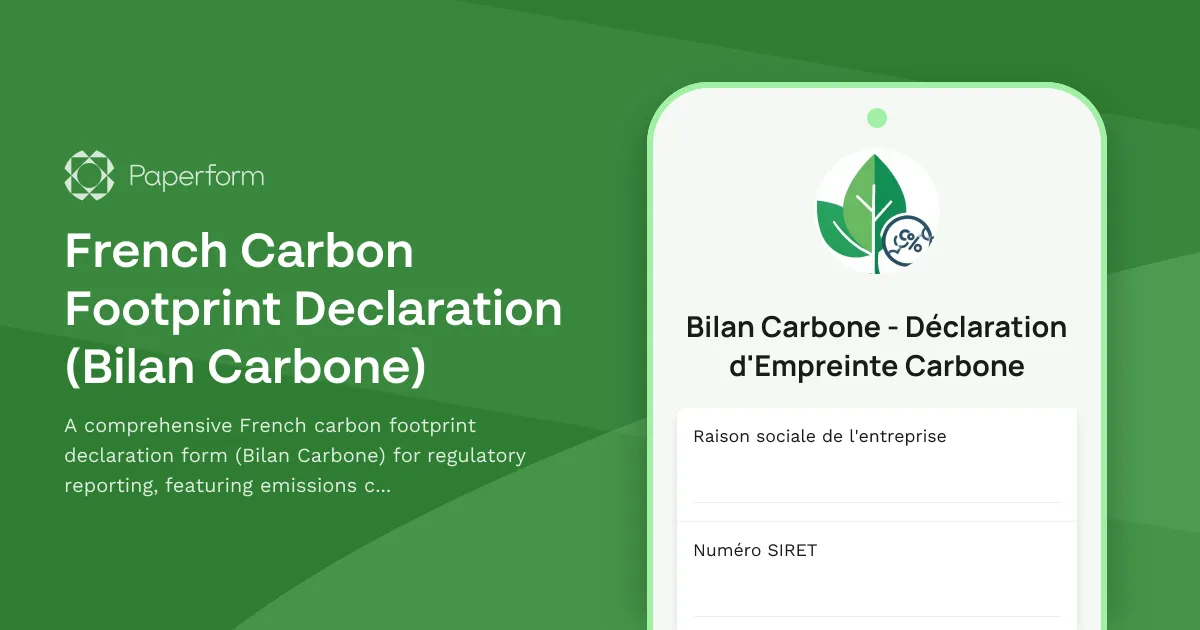
French Carbon Footprint Declaration (Bilan Carbone)
A comprehensive French carbon footprint declaration form (Bilan Carbone) for regulatory reporting, featuring emissions calculations, reduction plans, and compliance with French environmental regulations.
Stakeholder Engagement Summary Report
A comprehensive ESG reporting form to document stakeholder consultations, feedback, grievance procedures, and response actions for transparency and accountability.
Climate Litigation Risk Assessment Form
A comprehensive form to assess climate litigation exposure, document pending cases, evaluate insurance coverage, and develop proactive risk mitigation strategies for ESG compliance.
ESG Assurance Readiness Assessment
Evaluate your organization's readiness for ESG assurance engagements, assess data quality, determine material topics, and define external verification scope for comprehensive sustainability reporting.
ESG Data Management System Documentation Form
A comprehensive form for documenting ESG data management systems, including data sources, collection methodologies, quality controls, and assurance processes to ensure transparent and reliable ESG reporting.
ESG Forward-Looking Statement & Target-Setting Framework
A comprehensive framework for establishing science-based ESG targets, documenting forward-looking sustainability commitments, and implementing progress tracking mechanisms with third-party validation protocols.
Finnish Environmental Permit Application Form
A comprehensive environmental permit application form for Finnish businesses, including emission calculations, Y-tunnus validation, and compliance with Finnish environmental regulations.
French Business Energy Efficiency Audit Declaration
A comprehensive energy efficiency audit declaration form for French businesses to report consumption data, improvement recommendations, and demonstrate regulatory compliance with French energy efficiency requirements.
French Environmental Compliance Declaration Form
A comprehensive environmental compliance form for French businesses to declare waste management procedures, emissions reporting, and ICPE authorization status in accordance with French environmental regulations.
Nigeria LNG Supplier Prequalification Form
A comprehensive prequalification form for suppliers seeking to work with Nigeria Liquefied Natural Gas (NLNG) Limited, capturing company credentials, technical capacity, HSE records, and regulatory compliance documentation.
Vietnam Water Resource Extraction Permit Application Form
Comprehensive application form for industrial water extraction permits in Vietnam, including source specification, volume limits, usage details, and environmental compliance requirements.
Annual ESG Performance Report Template
Comprehensive ESG reporting template for publicly-traded companies aligned with GRI Standards, featuring materiality assessment, stakeholder engagement disclosure, and key performance indicators across environmental, social, and governance dimensions.