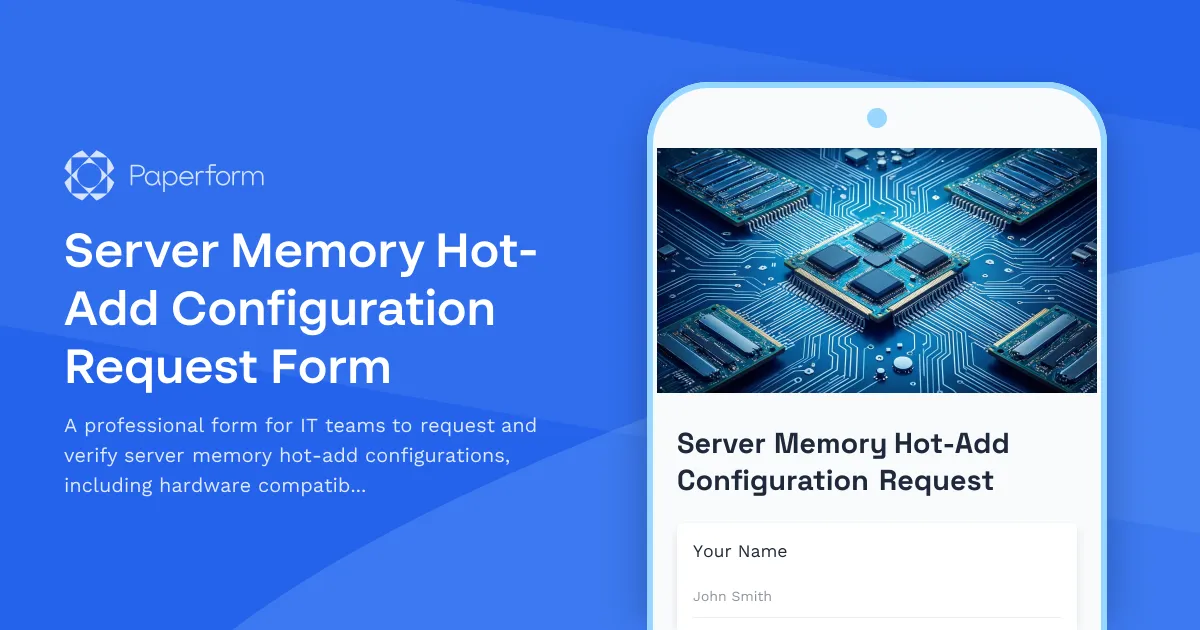
Streamline Server Memory Hot-Add Requests with Paperform
Managing server infrastructure requires precision, documentation, and clear workflows—especially when dealing with live memory additions that can't afford downtime. This Server Memory Hot-Add Configuration Request Form is designed specifically for IT professionals who need to capture hardware capability verification, OS compatibility, and resource balancing details in one organized workflow.
Built for IT Infrastructure Teams
Whether you're managing on-premise data centers, hybrid cloud environments, or enterprise virtualization clusters, this template helps you standardize memory hot-add requests across your organization. IT administrators, system engineers, and infrastructure managers can use this form to ensure every memory upgrade follows proper validation procedures before implementation.
The form captures critical information including server identification, current memory configuration, hardware capability verification, operating system compatibility, planned addition details, and resource balancing considerations—all in a structured format that reduces errors and speeds up approval workflows.
Automate Your Infrastructure Workflows
Once a memory hot-add request is submitted, you can use Stepper (stepper.io) to automatically route the request to the right team members for approval, create tickets in your ITSM platform, update your CMDB, and trigger follow-up notifications once the configuration is complete. Connect Paperform to ServiceNow, Jira Service Management, or your monitoring tools to keep your entire infrastructure stack in sync.
With conditional logic built into the template, the form adapts based on hardware vendor, OS type, and environment criticality—showing only relevant fields and validation steps. This ensures your team captures exactly what they need without overwhelming requesters with unnecessary questions.
Enterprise-Grade Security for IT Operations
Paperform is SOC 2 Type II compliant and offers SSO, role-based permissions, and audit logs—giving you the security and control needed for production infrastructure changes. Store sensitive server details with confidence, knowing your data meets enterprise compliance standards.
Ready to bring order to your server memory management? This template gives your IT operations team a professional, no-code solution that works as hard as you do.



More templates like this
Backup Server Configuration Request Form
Request backup server configuration with custom retention policies, backup windows, backup types, and restoration testing plans for your infrastructure.
Data Center Server Rack Allocation Request Form
A professional form for requesting server rack space allocation in data centers, including power requirements, cooling specifications, network connectivity needs, and cabinet space details.
Data Center Server Room Access Request Form
Request secure access to data center server rooms with two-factor authentication setup, equipment authorization, and compliance acknowledgment for IT professionals and technicians.
Disaster Recovery Site Setup Request Form
Request form for disaster recovery infrastructure setup with RTO/RPO requirements, replication methods, failover testing schedules, and runbook documentation for business continuity planning.
DNS Record Modification Request
Submit DNS record change requests for A, CNAME, MX, and other record types with subdomain creation and TTL configuration for network infrastructure management.
Infrastructure Security Incident Response Form
Report and respond to infrastructure security incidents with threat classification, containment protocols, forensic preservation, and stakeholder communication tracking.
IT Network Segmentation Change Request Form
Submit network segmentation change requests including VLAN configuration, security zones, and access control list modifications with technical details and approval workflow.
IT Security Tool Integration Testing Change Request
A comprehensive change request form for IT security tool integration testing, including connectivity validation, data flow verification, and performance benchmarking assessments.
IT System Decommissioning Change Request
Submit and track IT system decommissioning requests with data retention, asset disposal, and access revocation management for secure infrastructure changes.
Monitoring System Alert Configuration Change Request
Submit and manage change requests for monitoring system alert configurations, including threshold adjustments, escalation procedures, and on-call rotation updates.
Network Access Control Implementation Request Form
Submit detailed requests for implementing Network Access Control (NAC) policies with device profiling, remediation workflows, and compliance checking to secure your network infrastructure.
Network DDoS Mitigation Request Form
Submit a request to activate DDoS protection services, configure traffic scrubbing parameters, set detection thresholds, and whitelist legitimate traffic sources for your network infrastructure.