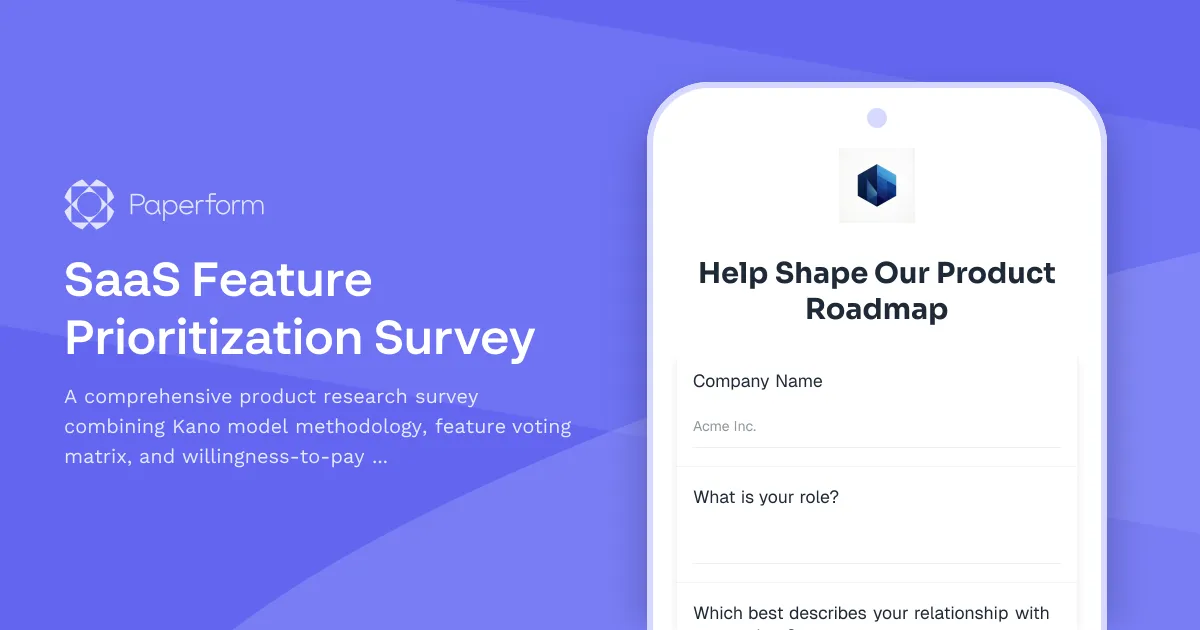
Build Your Product Roadmap with Real Customer Data
For SaaS product managers, the hardest decisions often aren't about what to build—they're about what to build first. Feature requests pile up, stakeholders have opinions, and engineering capacity is finite. That's where this SaaS Feature Prioritization Survey template comes in.
Built specifically for product teams in software, technology, and SaaS companies, this template combines three powerful research methodologies into one efficient survey: Kano model analysis to understand which features delight vs. satisfy, a feature voting matrix to gauge relative importance, and willingness-to-pay questions that reveal actual value perception. Together, they give you the data-driven foundation you need to build a roadmap that customers actually want—and will pay for.
Why Product Managers Choose Paperform
Paperform makes it easy to create professional, on-brand surveys that look polished and perform well—without needing design or technical skills. The doc-style editor lets you blend questions, explanations, images, and logic seamlessly, creating a survey experience that feels thoughtful rather than transactional.
For product managers running prioritization research, this means:
- Conditional logic that adapts questions based on previous answers, keeping the survey relevant and reducing drop-off
- Calculation fields that can score features in real-time or create custom weighting systems
- Native integrations with tools like Notion, Airtable, Slack, and your CRM to push insights directly into your workflow
- AI Insights to automatically summarize open-ended feedback into themes and priorities, saving hours of manual analysis
Once you've collected responses, you can connect this survey to Stepper (stepper.io) to automatically route high-priority feature requests to your product backlog, notify your team in Slack when a critical insight comes in, or segment responses by user type and push them into different tools or reports.
Who This Template Is For
This survey template is perfect for product managers, product marketing managers, UX researchers, founders, and growth teams at SaaS companies, software startups, and tech businesses looking to validate roadmap decisions with real customer feedback. Whether you're planning your next quarter or preparing for a major release, this survey helps you move from opinion to evidence—and build features that truly move the needle.
More templates like this
Feature Bundling & Pricing Preferences Survey
Gather customer insights on product bundling preferences, pricing sensitivity, and integration needs to inform your SaaS product strategy and roadmap decisions.
SaaS Pricing Feedback Survey
Gather valuable pricing insights from your users with this comprehensive survey covering willingness to pay, feature bundling preferences, and competitive pricing analysis to optimize your SaaS pricing strategy.
Beta Program Customer Effort Score Survey
Measure customer effort and identify friction points in your beta program. Collect ease-of-use ratings and actionable feedback to optimize your product before launch.
Cloud Storage Service Feature Validation Survey
Validate cloud storage features, assess security requirements, and understand collaboration tool priorities to guide product development and market positioning.

Virtual Event Platform Feature Validation Survey
A comprehensive market research survey designed to validate virtual event platform features, prioritize attendee engagement tools, assess networking functionality needs, and understand sponsorship and technical support expectations.

Cryptocurrency Exchange User Experience Study
A comprehensive user research survey designed to understand trader needs, priorities, and preferences for cryptocurrency exchange platforms, covering trading features, security measures, educational resources, and fee structures.

Data Maturity Assessment Quiz
Evaluate your organization's data analytics maturity and discover how a customer analytics platform can help you unlock actionable insights from your customer data.

E-learning Platform Content Gap Analysis Survey
A comprehensive market research survey to identify content gaps, assess subject matter demand, understand instructor quality expectations, evaluate certification value, and determine pricing model preferences for e-learning platforms.
Early Access Product-Market Fit Survey
Validate product-market fit with early adopters through problem validation, solution fit scoring, and strategic decision-making input for your beta launch.
Email Marketing Platform Feature Validation Survey
Gather insights on email marketing platform needs, including automation priorities, segmentation requirements, design flexibility, and deliverability concerns to inform product development and feature prioritization.
Food Delivery App Feature Survey
Gather consumer insights on food delivery app features, restaurant discovery preferences, ordering flow usability, loyalty programs, and delivery expectations to guide product development.

Mobile vs Desktop Experience Survey
A comprehensive survey designed for SaaS teams to gather user feedback on mobile and desktop experience differences, assess feature parity gaps, and understand cross-device workflow preferences.