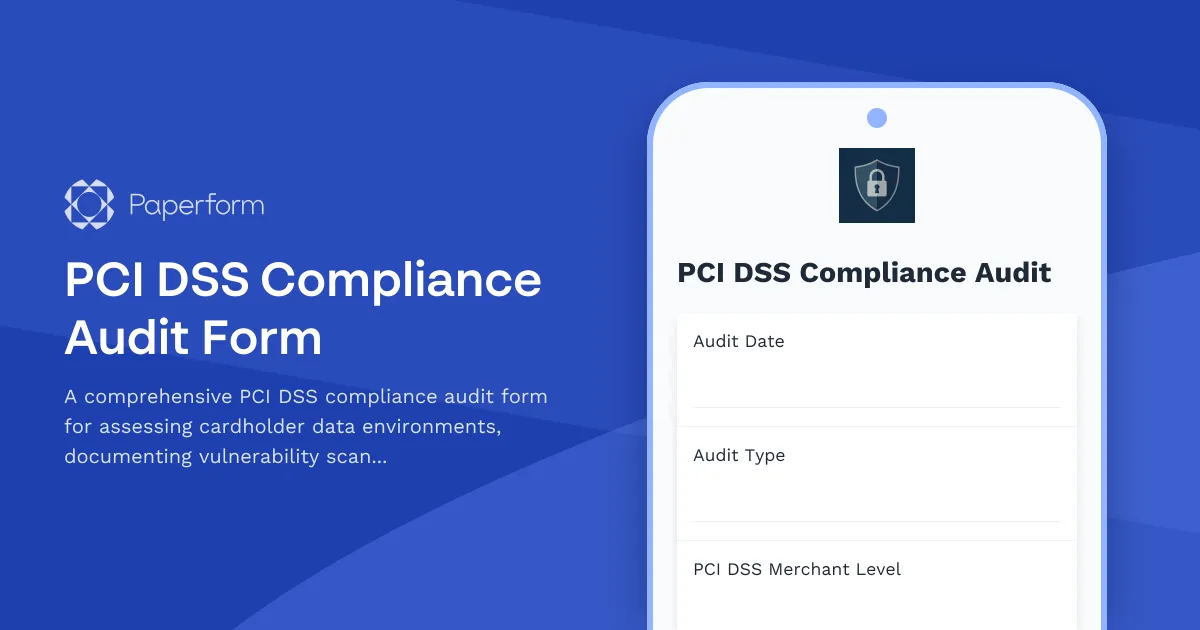
Streamline Your PCI DSS Compliance with Paperform
Maintaining PCI DSS (Payment Card Industry Data Security Standard) compliance is critical for any business that processes, stores, or transmits cardholder data. Whether you're an IT security team, a QSA (Qualified Security Assessor), or a compliance officer, this PCI DSS Compliance Audit Form provides a structured, professional approach to documenting your cardholder data environment (CDE) assessment, vulnerability scan results, and remediation tracking.
Why Use This PCI DSS Audit Template?
This form template helps IT professionals and security teams conduct thorough compliance audits while maintaining clear documentation trails required by the PCI Security Standards Council. Instead of juggling spreadsheets, emails, and disconnected tools, you can capture all critical audit information in one secure, organized form that's easy to share with stakeholders and auditors.
Key features of this template include:
- Comprehensive assessment of all 12 PCI DSS requirements
- Structured cardholder data environment (CDE) documentation
- Vulnerability scan result tracking and analysis
- Remediation action planning with priority levels
- Responsible party assignment and deadline management
- Evidence attachment capabilities for audit trails
Perfect for IT Security and Compliance Teams
This form is designed for organizations across industries that need to demonstrate PCI DSS compliance—from retail and e-commerce to hospitality, healthcare billing, and professional services firms that handle payment card transactions. It's particularly valuable for:
- IT Security Managers conducting internal compliance assessments
- Compliance Officers preparing for external QSA audits
- System Administrators documenting CDE configurations
- Managed Service Providers supporting multiple client audits
Automate Your Compliance Workflows with Stepper
Once an audit is submitted, you can connect this form to Stepper to automatically trigger compliance workflows. For example, route high-priority vulnerabilities to security teams, send remediation tasks to responsible parties, update compliance tracking systems, or create tickets in your IT service management platform—all without manual handoffs.
Secure, Compliant Data Handling
Paperform is SOC 2 Type II certified and offers data residency controls, making it a trusted platform for handling sensitive compliance documentation. While Paperform itself is not a payment processor, this form helps you document the security controls around your payment processing environment to meet PCI DSS audit requirements.
Get started with this professional PCI DSS compliance audit template and bring structure, efficiency, and accountability to your security compliance program.



More templates like this
Security Policy Exception Request & Approval Form
A comprehensive form for requesting exceptions to security policies, including risk assessment, compensating controls, and approval workflow with annual recertification tracking.
CMMC Self-Assessment for Defense Contractors
A comprehensive self-assessment form for defense contractors to evaluate their cybersecurity maturity level against CMMC requirements, document practice implementation evidence, and develop gap remediation plans.
Privileged Access Management Change Request Form
Streamline privileged access requests with automated approval workflows, audit trails, and time-based access controls for enhanced security compliance.
Backup and Disaster Recovery Security Audit Form
A comprehensive security audit form for evaluating backup systems, encryption compliance, restoration testing, and offsite storage protocols to ensure business continuity and data protection.
Cybersecurity Exception Approval Request Form
A comprehensive form for requesting cybersecurity policy exceptions with risk assessment, compensating controls, business justification, and remediation plans requiring CISO authorization.
Data Breach Incident Report Form
Document and manage data breach incidents with comprehensive system impact analysis, user assessment, response tracking, and regulatory notification timelines.
Data Loss Prevention Policy Violation Investigation Form
A comprehensive security investigation form for tracking DLP policy violations, analyzing user intent, documenting content inspection findings, and managing remediation actions.
FISMA Compliance Annual Assessment Form
Comprehensive FISMA compliance assessment form for federal contractors to verify NIST 800-53 security controls and document continuous monitoring evidence for annual audits.
ISO 27001 Internal Audit Checklist
A comprehensive ISO 27001 internal audit form for systematically testing information security controls, tracking non-conformities, and planning corrective actions across all Annex A domains.
IT Security Compliance Attestation Workflow Change Request
A comprehensive form for managing IT security compliance change requests, enabling control owners to submit attestations, review evidence, and track certification deadlines throughout the approval workflow.
IT Security Incident Response Communication Template Change Request
Request changes to your organization's IT security incident response communication templates, including branding customization, approval workflows, and distribution list updates.
IT Supply Chain Security Change Request Form
Comprehensive IT change request form for supply chain security assessments, including vendor evaluations, software bill of materials (SBOM), and risk analysis for secure technology implementations.