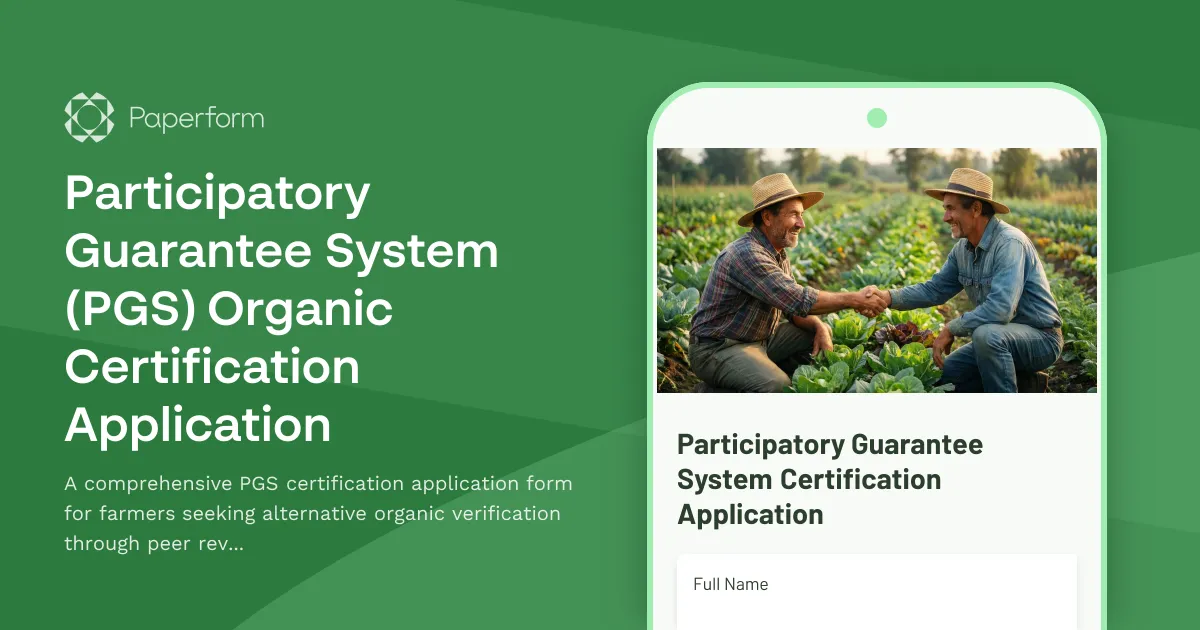
Streamline Your PGS Organic Certification with Paperform
Finding an affordable, community-centered path to organic certification can be transformative for small and medium-scale farmers committed to sustainable practices. Participatory Guarantee Systems (PGS) offer an alternative to costly third-party certification, emphasizing peer review, farmer-to-farmer inspections, and trust-building within local food systems.
This PGS certification application template is designed specifically for agricultural cooperatives, farmer networks, and local food hubs managing community-based organic verification programs. Instead of paper-heavy processes and disconnected spreadsheets, this form brings the entire application workflow into one streamlined, professional experience.
Built for Agricultural Communities and Local Food Systems
Whether you're a farmers' cooperative coordinator, agricultural extension officer, or sustainable agriculture advocate, this template helps you collect detailed farm information, organic practice documentation, and peer review commitments in a single, well-organized form. Applicants can provide comprehensive details about their farming operations, certification history, production methods, and community participation—all while you maintain clear records for your PGS verification process.
The form's conditional logic adapts questions based on farm type, previous certification status, and production scale, ensuring each farmer only sees relevant questions. This intelligent branching keeps applications focused and reduces confusion, especially important when working with diverse farming operations from market gardens to livestock operations.
From Application to Inspection Scheduling—All Connected
Paperform isn't just about capturing farm data. Once a farmer submits their PGS application, you can use Stepper (stepper.io) to automatically trigger your verification workflow:
- Send the application details to your cooperative's management system or CRM
- Notify peer review committee members about new applications requiring assignment
- Schedule farm inspection dates by connecting to calendar tools
- Create inspection checklists and documentation templates for visiting farmers
- Route applications through approval stages with automatic status updates
- Generate certification documentation once peer review is complete
This end-to-end automation means less administrative burden on coordinators and faster processing times for farmers eager to join your local organic network.
Secure Documentation with Papersign
Once a farmer's application is approved through peer review, you can use Papersign (papersign.com) to formalize the certification with digital signatures. Send the PGS certification agreement, community standards commitment, and inspection authorization forms for secure eSignature, creating a complete audit trail linked directly to the original application. This is particularly valuable for:
- Annual certification renewal agreements
- Organic production standards commitments
- Peer inspection authorization and privacy waivers
- Community standards pledge documents
- Market access agreements for certified PGS farmers
Why Farmers and Food Cooperatives Choose Paperform
Agricultural organizations managing PGS programs need flexibility, not rigid survey software. Paperform's document-style editor lets you customize every detail—from adding your cooperative's logo and photos of successful certified farms, to embedding video explanations of your verification process. You can match your brand perfectly while keeping the form professional and trustworthy.
The platform's calculation features are especially useful for PGS programs. Automatically calculate certification fees based on farm acreage, crop diversity, or cooperative membership level. Display dynamic pricing that updates as farmers complete the form, ensuring transparency and building trust from the first interaction.
Mobile-friendly design is critical when your applicants are working farmers who may complete applications during breaks or in areas with limited connectivity. The form works seamlessly on any device, and with offline capabilities through embedded tools, you won't lose responses even in rural areas with spotty internet.
Built-In Payment Collection for Certification Fees
Many PGS programs charge modest fees to cover administrative costs, inspection travel, or documentation materials. With Paperform's native Stripe, PayPal, and Square integrations, you can collect application fees, annual dues, or inspection cost-sharing contributions directly in the form. Set up one-time payments or recurring subscriptions for annual recertification, keeping your program financially sustainable while maintaining the community-centered affordability that makes PGS accessible.
AI-Powered Insights for Program Improvement
As your PGS program grows, analyzing applications helps you understand farmer needs, identify training opportunities, and improve your certification process. Paperform's AI Insights can automatically summarize trends across applications:
- Which organic practices are most commonly adopted?
- What barriers do farmers face in transitioning to organic methods?
- Which crop types or livestock operations are most represented?
- What technical assistance topics come up most frequently?
These insights help coordinators shape peer learning workshops, target extension resources, and demonstrate program impact to funders or community stakeholders—all without manually reviewing hundreds of spreadsheet rows.
Trusted by Food and Agriculture Organizations
From permaculture cooperatives to regional organic farming networks, agricultural organizations worldwide rely on Paperform for professional forms that respect both farmers' time and coordinators' workflow needs. The platform is SOC 2 Type II compliant and GDPR-ready, ensuring farmer data is protected with enterprise-grade security—critical when handling sensitive business information about farming operations, land tenure, and market relationships.
With native integrations to Google Sheets, Airtable, Notion, Slack, and thousands of other tools via Stepper, Zapier, or webhooks, your PGS application data flows directly into whatever systems your organization already uses for cooperative management, inspection scheduling, or certification tracking.
Getting Started with Your PGS Certification Form
This template is ready to use immediately or customize to match your specific PGS program's standards, local requirements, and community values. Adjust the organic practice questions to align with your certification criteria, add questions about specific regional issues (water conservation, soil health, biodiversity), or include photo upload fields for farmers to document their operations visually.
Whether you're launching a new PGS initiative or digitizing an established peer review program, Paperform gives you a professional, efficient foundation that keeps the focus where it belongs—on building trust, supporting farmers, and strengthening local organic food systems.
Start with the free plan to test your form with a pilot group of farmers, then scale up as your PGS program grows. Paperform pricing is designed for nonprofits and cooperatives, with generous submission limits and transparent pricing that won't surprise you as your farmer network expands.



More templates like this
Cheese Cave & Aging Equipment Donation Form
A specialized donation form for non-cash contributions of cheese caves, aging equipment, and dairy production resources to support artisan cheesemaking programs and specialty food education initiatives.
Livestock Show Entry Form
A comprehensive form for registering animals and exhibitors for livestock shows, including class selection, health certificates, and automated fee calculation.
Agricultural Knowledge Exchange Platform Membership Form
Join a collaborative farming community where agricultural professionals share experiences, solve problems together, and accelerate innovation adoption through peer learning and community-based extension services.
Agricultural Land Conservation Easement Application
Apply for a conservation easement to protect agricultural land while maintaining farming operations. Submit property details, development restrictions, and stewardship plans for review.
Cheese Making Equipment Donation Form
A professional donation form for non-cash contributions of cheese making equipment to support dairy education and artisan food production training programs.
Climate-Smart Agriculture Grant Proposal Form
Apply for climate-smart agriculture grants with detailed practice adoption timelines, greenhouse gas accounting, and measurement of adaptation benefits and mitigation co-benefits.
Farm Animal Sanctuary Feed Storage System Failure Report
A comprehensive incident report form for documenting feed storage system failures at animal sanctuaries, prioritizing animal nutrition needs, emergency feed sourcing, and authorizing system repairs.
Farm Apprenticeship Agreement Form
A comprehensive farm apprenticeship agreement form that outlines mentorship structure, profit-sharing arrangements, land access terms, equipment use guidelines, and skill development milestones for agricultural training programs.
Farm-to-School Local Food Procurement Funding Request
A comprehensive funding application for farm-to-school programs seeking financial support for local food procurement, child nutrition integration, menu development, food safety compliance, and agricultural education initiatives.
Agricultural Grant Application Form
A comprehensive grant application form for farmers seeking agricultural funding. Includes project details, acreage information, conservation goals, budget breakdown, and USDA program compliance sections.
Agricultural Irrigation Drip Line Recycling Program Application
A comprehensive form for farmers and agricultural operations to register for drip line recycling services, schedule field collections, and participate in sustainable plastic reprocessing programs.
Beekeeping Operation Audit Checklist
Comprehensive audit checklist for beekeeping operations covering hive inspections, honey extraction sanitation, pesticide documentation, colony health monitoring, and product labeling compliance.