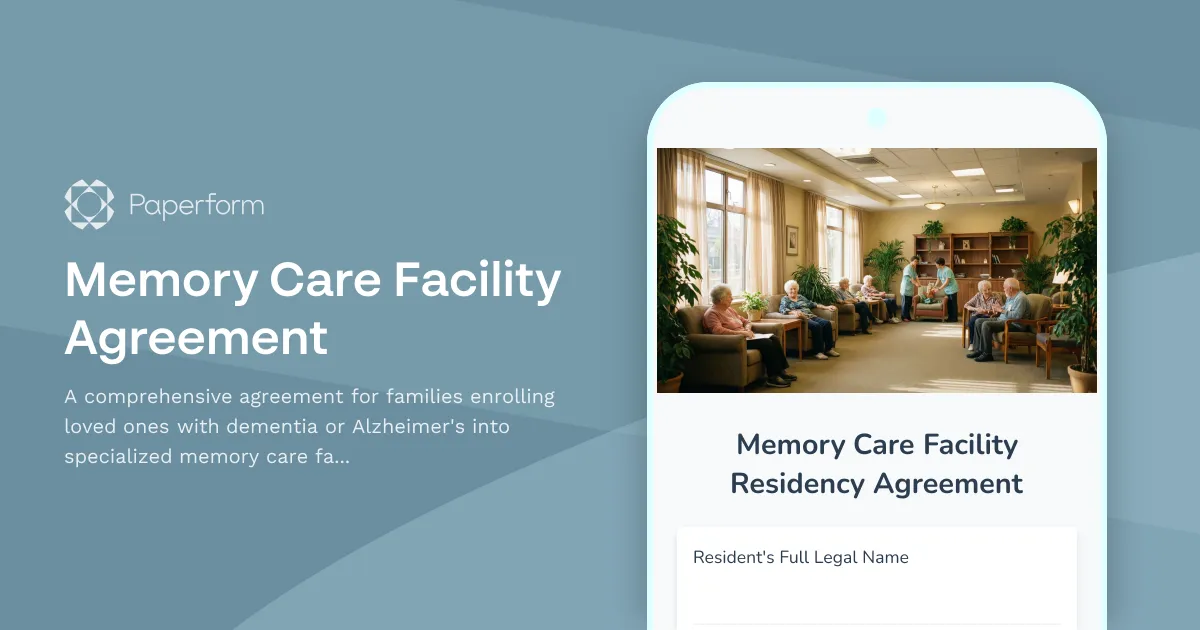
Professional Memory Care Facility Agreement Template
Finding the right memory care facility for a loved one with dementia or Alzheimer's is one of the most important and emotional decisions a family can make. This Memory Care Facility Agreement template helps memory care providers, assisted living facilities, and senior care communities create clear, compassionate agreements that protect both residents and their families while establishing expectations around specialized care, safety protocols, and financial arrangements.
Why Memory Care Facilities Need Comprehensive Agreements
Memory care is a specialized form of long-term care designed specifically for individuals with Alzheimer's disease, dementia, and other cognitive impairments. Unlike standard assisted living, memory care facilities provide secured environments, specially trained staff, and therapeutic programming tailored to residents' unique needs.
A well-structured agreement is essential for:
- Establishing care expectations: Clearly defining the level of care, staffing ratios, and specialized services provided
- Protecting resident safety: Documenting security measures, wandering prevention protocols, and emergency procedures
- Managing medications properly: Outlining medication administration, storage, and monitoring processes
- Setting financial terms: Providing transparent pricing, payment schedules, and policies for rate increases
- Defining move-in and move-out procedures: Creating smooth transitions while protecting both parties legally
This template addresses all these critical areas while maintaining a tone of compassion and partnership between the facility and the resident's family.
Who Benefits from This Template
This memory care agreement template is designed for:
- Memory care facilities offering specialized dementia and Alzheimer's care
- Assisted living communities with dedicated memory care units or wings
- Senior care providers expanding into cognitive care services
- Healthcare administrators managing admissions and resident agreements
- Elder law attorneys advising families and facilities on care contracts
- Long-term care consultants helping facilities professionalize their documentation
What's Included in This Memory Care Agreement
This comprehensive template covers all essential components of a professional memory care residency agreement:
Resident and Representative Information: Capture complete details about the resident, their medical history, responsible parties, emergency contacts, and healthcare representatives.
Specialized Care Approach: Document the facility's person-centered care philosophy, care plan development process, staff training in dementia care, and individualized service offerings.
Security and Safety Measures: Detail the facility's secured environment features, wandering prevention systems, monitoring protocols, and how the facility balances safety with dignity and independence.
Daily Activities and Programming: Outline therapeutic activities, cognitive stimulation programs, social engagement opportunities, and how activities are tailored to different stages of dementia.
Medication Management: Establish clear protocols for medication administration, storage, physician coordination, and family notification procedures.
Rate Structure and Financial Terms: Present transparent pricing including base rates, level-of-care fees, additional services, payment schedules, late payment policies, and procedures for rate adjustments.
Move-In Requirements: Define deposits, advance payments, required documentation, health screenings, and trial period policies if applicable.
Move-Out Terms: Clarify discharge procedures, notice requirements, refund policies, and circumstances that might require transfer to a higher level of care.
Legal Protections: Include liability limitations, dispute resolution procedures, and acknowledgment of resident rights.
Streamline Your Memory Care Operations with Paperform
Managing memory care admissions involves far more than collecting signatures—it requires coordinating with families, healthcare providers, legal representatives, and multiple departments within your facility. This Paperform template transforms a complex enrollment process into a smooth, professional experience.
Why Paperform is Perfect for Memory Care Facilities:
With Paperform's document-style editor, you can create an agreement form that feels personal and compassionate rather than cold and institutional. Add your facility's photos, include welcome videos, incorporate your branding, and write in a tone that reassures anxious families during a difficult time.
Conditional Logic for Personalized Agreements: Use Paperform's conditional logic to show or hide sections based on the resident's specific needs. For example, if a family indicates their loved one is in advanced stages of dementia, automatically display additional questions about end-of-life preferences, hospice coordination, or specialized behavioral support.
Secure Document Collection: Collect required documents—medical records, power of attorney paperwork, insurance information, physician orders—directly through the form using secure file upload fields. Everything stays organized in one submission rather than scattered across emails and filing cabinets.
Papersign for Legal eSignatures: Once a family completes the initial intake form, use Papersign (papersign.com) to convert the agreement into a legally binding contract ready for electronic signature. Papersign supports multiple signers, so the resident (if capable), responsible party, healthcare representative, and facility director can all sign in sequence. The entire audit trail is preserved for compliance and legal protection.
Automated Onboarding with Stepper: Connect your memory care agreement to Stepper (stepper.io) to trigger a complete move-in workflow the moment an agreement is signed. Automatically create the resident's file in your care management system, notify the nursing team, schedule the initial care plan meeting, assign the resident's room in your facility management software, and send welcome packets to the family—all without manual data entry.
For example, your Stepper workflow might:
- Create a new resident record in your senior care platform
- Send the nursing director a notification with the resident's care needs summary
- Schedule a care planning conference with the family within 48 hours
- Assign tasks to the activities director for initial interest assessment
- Update your billing system with rate structure and payment schedule
- Send the family a welcome email with move-in checklist and first-week expectations
Payment Integration: If you collect deposits, application fees, or first month's payment as part of the agreement, Paperform integrates with Stripe, Square, and PayPal to process payments securely within the same form. You can calculate prorated rent, apply community fees, and show the total due before payment—all automatically.
SOC 2 Compliant and HIPAA-Ready Infrastructure: While Paperform itself is not HIPAA compliant, it maintains SOC 2 Type II certification and provides enterprise-grade security suitable for collecting preliminary information before transferring to HIPAA-compliant systems. Many memory care facilities use Paperform for initial inquiries and non-PHI data collection, then transition to their secure EHR systems for protected health information.
Best Practices for Memory Care Agreements
When implementing this template, consider these best practices used by leading memory care communities:
Use Clear, Jargon-Free Language: Families are often overwhelmed and emotional during the placement process. Avoid legalese and medical terminology where possible, or provide clear definitions when technical terms are necessary.
Be Transparent About Costs: Unexpected costs are a major source of dissatisfaction in senior care. Clearly list all base fees, ancillary charges, and circumstances that might trigger rate increases. Transparency builds trust during an already difficult transition.
Address Common Fears Directly: Families worry about their loved one's safety, happiness, and dignity. Use your agreement to reassure them by explicitly addressing security measures, activity options, respect for residents, and family involvement opportunities.
Include a Trial Period: Many facilities offer a 30 or 60-day trial period, allowing families to ensure the community is the right fit before committing long-term. This reduces anxiety and shows confidence in your care quality.
Provide Multiple Contact Options: Make it easy for families to reach the right person. Include direct contact information for the director of nursing, executive director, and after-hours emergency contacts.
Review and Update Regularly: Memory care regulations, best practices, and care standards evolve. Review your agreement template at least annually to ensure it reflects current operations, regulations, and family expectations.
The Importance of Person-Centered Memory Care
The best memory care agreements reflect a philosophy that residents are individuals first, patients second. While the agreement must address medical, legal, and financial realities, it should also communicate your facility's commitment to honoring each resident's life story, preferences, and remaining abilities.
This template is designed to strike that balance—covering all necessary legal and operational ground while remaining warm, clear, and focused on partnership between your facility and the families you serve.
Get Started with This Memory Care Agreement Template
Whether you're opening a new memory care community, updating outdated paperwork, or looking to professionalize your admissions process, this Paperform template provides a strong foundation. Customize it to reflect your facility's unique approach to dementia care, add your branding and imagery, and start converting inquiries into smooth, stress-free move-ins.
With Paperform's flexibility, Papersign's eSignature capabilities, and Stepper's workflow automation, you can transform memory care admissions from a paperwork burden into a caring, efficient experience that sets the tone for the supportive relationship families expect from your community.



More templates like this
Home Health Care Service Agreement
A comprehensive agreement form for home health care services that outlines caregiver duties, emergency procedures, scheduling, and liability terms to protect both clients and caregivers.
Respite Care Service Agreement
A comprehensive respite care agreement for temporary care services, including emergency contacts, medication administration consent, and liability release for caregivers and families.
Adult Day Care Service Agreement
A comprehensive adult day care service agreement form that covers care schedules, transportation needs, activities, meals, medication administration, emergency contacts, and fee structures for senior care facilities.
Durable Medical Equipment (DME) Rental Agreement
A comprehensive rental agreement form for medical equipment providers to document equipment rentals, delivery details, insurance billing, patient responsibilities, and rental terms.
Geriatric Assessment Consent Form
Comprehensive consent form for geriatric assessment including cognitive screening, fall risk evaluation, medication review, and care coordination authorization.
Geriatric Social Work Assessment Consent Form
A comprehensive consent and assessment form for geriatric social work services, including isolation screening, elder abuse evaluation, community resources, and advance care planning discussions.
Healthcare Proxy Declaration Form
A legally compliant healthcare proxy form for designating a healthcare agent, authorizing medical decisions, granting HIPAA access, and documenting end-of-life care preferences.
Home Healthcare Services Consent & Authorization Form
A comprehensive consent form for home healthcare services including care plan authorization, HIPAA release, caregiver background checks, equipment delivery, and emergency protocols.
Home Healthcare Services Consent Form
A comprehensive consent form for home healthcare services covering patient authorization, caregiver background checks, and service agreements.
Hospice Care Admission and Consent Form
A comprehensive hospice care admission form to collect patient information, treatment consent, DNR preferences, pain management options, HIPAA authorization, and end-of-life care decisions with family notification settings.
Hospice Care Provider Code of Conduct Agreement
A comprehensive code of conduct form for hospice care providers ensuring dignity in end-of-life care, family support boundaries, and advance directive compliance.
Medical Home Care Authorization Form
Comprehensive authorization form for medical home care services including skilled nursing, aide supervision, equipment needs, and insurance certification requirements.