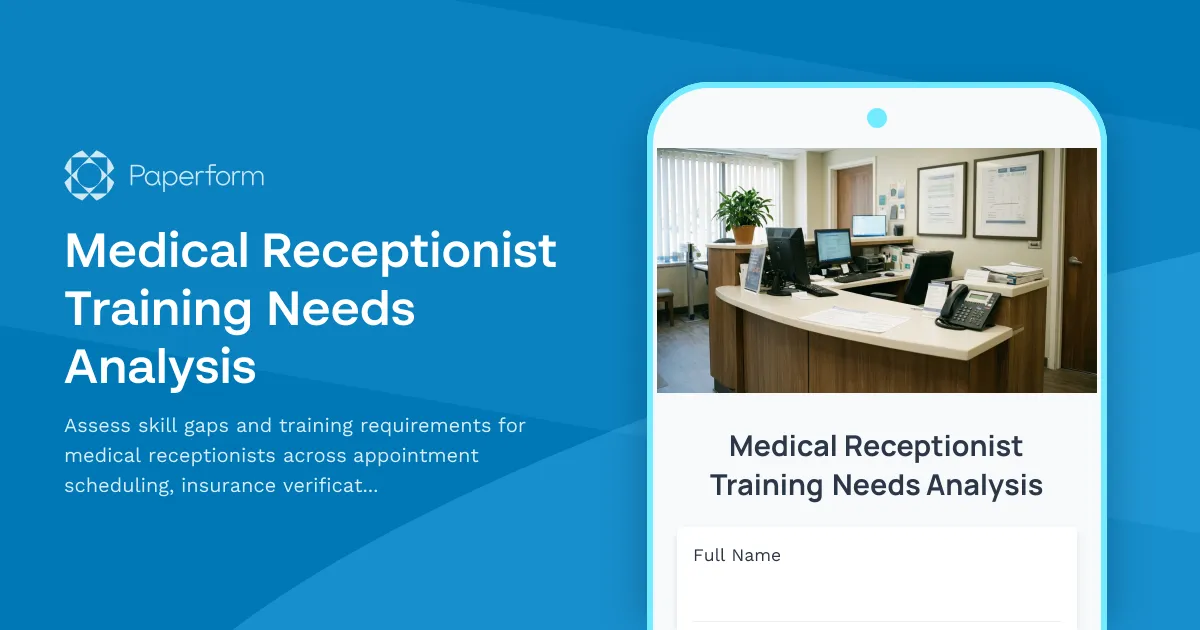
Identify Training Gaps and Build a Stronger Front Desk Team
Your medical receptionist team is the first point of contact for patients—and their skills directly impact patient satisfaction, clinic efficiency, and revenue cycle performance. This Medical Receptionist Training Needs Analysis helps healthcare administrators, practice managers, and HR teams identify where staff need additional support across appointment scheduling, insurance verification, patient registration, phone systems, and customer service.
Why use this template?
Whether you're onboarding new reception staff, conducting annual skills reviews, or responding to patient feedback, this template gives you a structured way to:
- Pinpoint specific skill gaps across core receptionist responsibilities
- Prioritize training investments based on actual needs, not assumptions
- Track competency levels across your front desk team
- Create personalized development plans that improve both confidence and performance
The form covers the five critical skill areas every medical receptionist needs to master—from handling difficult phone calls and navigating insurance portals to managing patient privacy and de-escalating tense situations in the waiting room.
Built for healthcare teams who care about patient experience
This template is designed for medical practices, clinics, hospitals, and healthcare organizations that understand the strategic importance of their front desk. It's particularly useful for:
- Practice managers conducting quarterly or annual skills assessments
- HR teams building targeted training programs for reception staff
- Office managers identifying coaching opportunities for new hires
- Training coordinators gathering data to justify budget for professional development
Once you've collected responses, you can use Paperform's AI Insights to quickly spot patterns—like whether your entire team struggles with a particular insurance verification process, or if phone etiquette is a consistent training need. From there, you can trigger follow-up workflows using Stepper to automatically assign training modules, schedule coaching sessions, or notify managers when a staff member requests urgent support in a specific area.
What makes Paperform perfect for skills assessments
Unlike clunky survey tools or static PDFs, Paperform lets you build a professional, on-brand training needs analysis that's easy to complete on any device. The conditional logic ensures staff only see follow-up questions relevant to their skill level, and you can customize the form to match your clinic's branding and tone. Plus, with integrations to your HRIS, LMS, or project management tools, you can seamlessly turn assessment data into action plans without manual data entry.
Start building a more confident, capable front desk team today—because great patient experiences start with great training.



More templates like this
Senior Care Staff Competency Assessment
A comprehensive skills assessment form for senior care facilities to evaluate staff competencies in dementia care, medication administration, fall prevention, and family communication.
Clinical Educator Skills Assessment Form
A comprehensive skills gap analysis form for clinical educators covering curriculum development, training delivery, competency assessment, and program evaluation capabilities.
Dental Hygienist Skills Gap Assessment
A comprehensive skills gap assessment for dental hygienists covering clinical competencies, patient care, technology proficiency, and professional development needs.
Dialysis Technician Competency Matrix
Assess dialysis technician skills across treatment procedures, machine operation, patient assessment, vascular access care, and documentation to identify training needs and competency gaps.
Emergency Medical Technician Training Needs Analysis
Comprehensive skills gap assessment for EMTs covering patient assessment, treatment protocols, equipment operation, documentation systems, and communication procedures to identify training priorities.
Medical Laboratory Technician Skills Gap Analysis
Assess competency levels across specimen processing, equipment operation, quality control, documentation, and safety protocols to identify training needs for medical laboratory technicians.
Occupational Therapist Assistant Competency Evaluation
Comprehensive skills assessment for occupational therapist assistants covering treatment techniques, documentation systems, equipment proficiency, patient education capabilities, and outcome tracking competencies.
Patient Access Representative Competency Assessment
Evaluate patient access staff competency across insurance verification, prior authorization, payment collection, and registration accuracy with this comprehensive healthcare assessment form.
Patient Care Technician Skills Assessment
A comprehensive skills gap analysis form for evaluating patient care technician competencies across vital signs monitoring, patient hygiene, mobility assistance, documentation systems, and communication skills.
Quality Improvement Coordinator Competency Evaluation
A comprehensive skills assessment form for evaluating quality improvement coordinator competencies across data collection, process analysis, regulatory compliance, reporting systems, and improvement initiatives.
Research Assistant Skills Gap Assessment
Evaluate research assistant competencies across literature review, data collection, statistical analysis, laboratory techniques, and documentation to identify training needs and development opportunities.
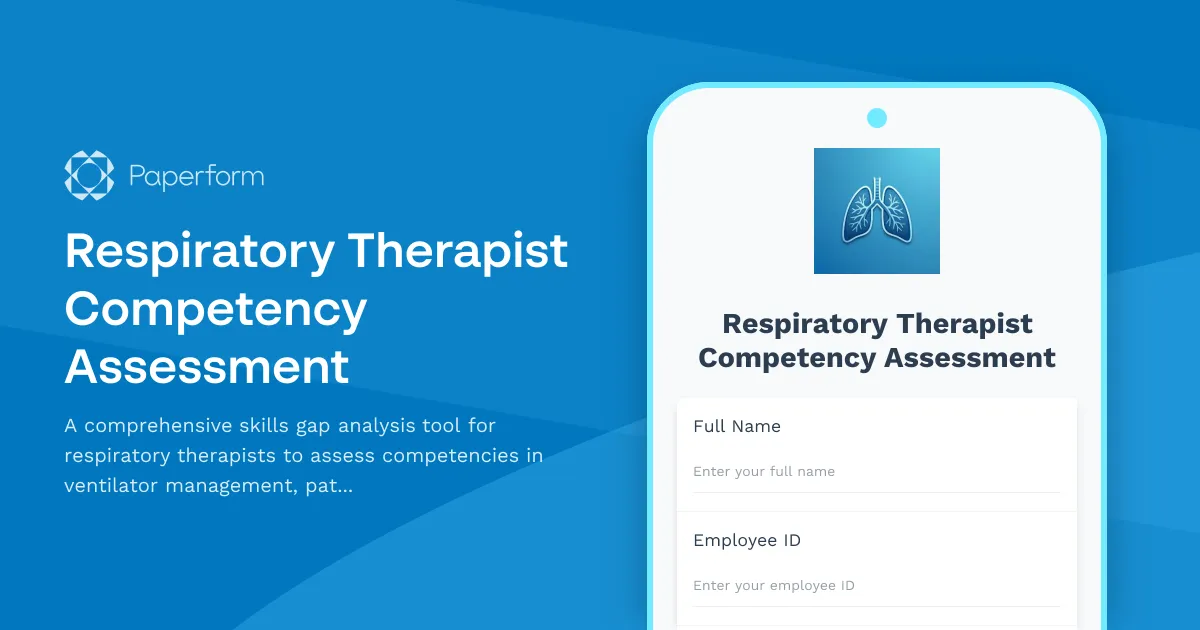
Respiratory Therapist Competency Assessment
A comprehensive skills gap analysis tool for respiratory therapists to assess competencies in ventilator management, patient assessment, treatment protocols, equipment maintenance, and clinical documentation.