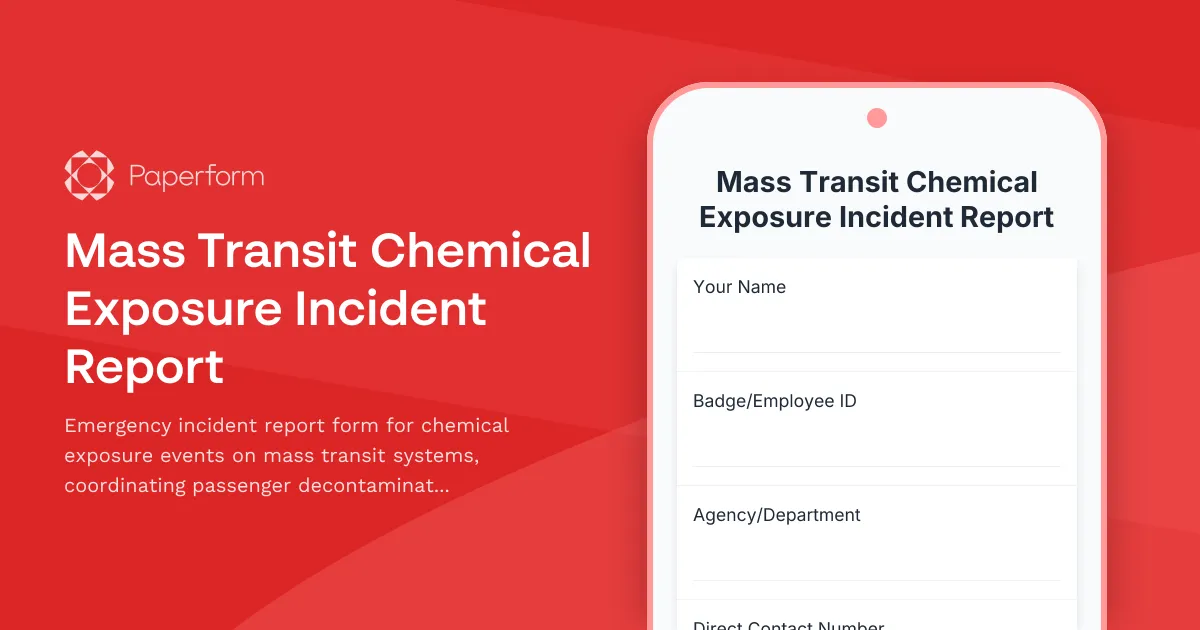
Mass Transit Chemical Exposure Incident Report Form
When seconds count during a chemical exposure incident on public transportation, having a standardized incident reporting system can save lives. This Mass Transit Chemical Exposure Incident Report form template is designed specifically for transit authorities, emergency response teams, and public safety agencies managing hazardous materials incidents in trains, buses, subways, and stations.
Why Mass Transit Chemical Incidents Require Specialized Reporting
Chemical exposure events in mass transit environments present unique challenges: confined spaces, high passenger volumes, multiple jurisdictional boundaries, and the need for rapid coordination between transit operations, hazmat teams, EMS, hospitals, and public health agencies. Traditional paper-based incident reports or email chains can't keep pace with the speed and coordination these emergencies demand.
This Paperform template creates a digital command center for chemical incident reporting—capturing critical details about the exposure, affected passengers, contamination zones, and response coordination while simultaneously triggering notifications to all relevant parties. Every field is optimized for speed and clarity when every second matters.
Who This Form Is For
This chemical exposure incident report template is built for:
- Transit Police & Security Teams documenting initial incident discovery and scene security
- Transit Operations Centers coordinating service disruptions and passenger management
- Hazmat Response Teams receiving detailed incident parameters before arrival
- Emergency Medical Services preparing for mass casualty decontamination and triage
- Hospital Emergency Departments activating surge capacity protocols
- Public Health Agencies tracking exposure patterns and community risk
- Transit Safety Officers conducting post-incident analysis and compliance reporting
Key Features of This Chemical Incident Report Form
Rapid Incident Classification The form opens with critical situational awareness questions: incident location with specific vehicle/station identification, estimated passenger exposure count, chemical characteristics (odor, vapor, liquid), and symptom severity. This front-loaded information allows command centers to make immediate resource deployment decisions.
Contamination Zone Mapping Specific fields capture the hot zone boundaries, warm zone decontamination areas, and cold zone staging locations—essential for establishing proper incident command structure and protecting responders from secondary contamination.
Passenger Decontamination Tracking Dedicated sections document decontamination operations including the number of passengers requiring gross decontamination, availability of decon facilities, water supply status, and privacy accommodation for mass decontamination procedures.
Hazmat Team Coordination Real-time status fields for hazmat team notification, estimated arrival time, monitoring equipment deployment, and air quality readings create a shared operational picture across all responding agencies.
Hospital Surge Capacity Notification Automatic fields calculate patient distribution across receiving hospitals based on exposure severity, triggering capacity alerts and ensuring no single facility is overwhelmed during mass casualty transport.
Witness & Evidence Documentation Structured fields for collecting witness statements, security camera locations, physical evidence markers, and chain of custody information support both immediate response and subsequent investigation.
How Transit Agencies Use This Form
Scenario: Suspicious Substance on Subway Train
A subway conductor reports passengers experiencing respiratory distress and watering eyes on a packed rush-hour train. The transit police officer first on scene opens the chemical exposure incident report on their mobile device, immediately documenting:
- Train line, direction, and station location
- Estimated 150 passengers in affected cars
- Strong chlorine-like odor reported
- 12-15 passengers showing respiratory symptoms
As they complete each section, the form's conditional logic automatically routes information to the appropriate response teams. The hazmat unit receives location and chemical characteristics. Area hospitals get preliminary patient count and symptom profiles to activate surge protocols. The transit operations center sees real-time updates to coordinate service rerouting.
By the time hazmat arrives 8 minutes later, they have a complete incident profile on their devices. The form's decontamination section helps them document passenger processing through triage, gross decon, medical evaluation, and transport—maintaining accountability for every exposed individual.
Integration with Emergency Response Systems
Paperform's native integration capabilities mean this chemical incident report doesn't live in isolation. Connect it to your existing emergency management infrastructure:
- Stepper workflows (stepper.io) automatically notify hospital emergency departments, trigger reverse 911 systems for area evacuation, update transit rider apps with service disruptions, and create incident case files in your records management system
- Real-time dashboards in Google Sheets or Airtable give command centers live visibility across multiple simultaneous incidents
- Slack or Microsoft Teams integration ensures all stakeholders receive immediate updates as the form is completed
- Webhook connections to CAD (Computer Aided Dispatch) systems maintain synchronization with broader emergency response
Built for Crisis Conditions
This form is designed for use during the most stressful conditions imaginable:
- Mobile-optimized for completion on smartphones and tablets in the field
- Offline capability through Paperform's progressive web app ensures data capture even when cellular networks are congested
- Conditional logic shows only relevant sections based on incident type and severity, reducing cognitive load on stressed responders
- Pre-populated dropdown lists for common chemicals, symptoms, and response actions minimize typing
- Photo upload fields for scene documentation, evidence, and contamination boundaries
Compliance & Documentation Standards
Mass transit chemical incidents trigger multiple reporting requirements across federal, state, and local agencies. This form template includes fields aligned with:
- National Response Framework incident reporting standards
- NFPA 472 hazmat incident documentation requirements
- FTA Emergency Preparedness compliance standards
- OSHA hazmat exposure record-keeping regulations
- EPA environmental release notification requirements
The form's structured data capture ensures your team has all necessary information for regulatory reports without the tedious work of reformatting handwritten notes or piecing together information from multiple sources.
Post-Incident Analysis & Training
Beyond immediate response, this form becomes a valuable tool for continuous improvement. The structured data enables transit agencies to:
- Identify response time trends and bottlenecks
- Analyze decontamination procedure effectiveness
- Track hospital patient outcomes by exposure type
- Train new responders using real incident scenarios (with PII redacted)
- Demonstrate compliance during safety audits and after-action reviews
Security & Confidentiality for Sensitive Incidents
Chemical exposure incidents may involve terrorism, criminal activity, or sensitive operational information. Paperform's SOC 2 Type II compliance ensures your incident reports are protected with enterprise-grade security. Role-based access controls limit form visibility to authorized personnel, while encrypted data transmission protects sensitive information from interception.
Get Started with Your Chemical Incident Response System
Whether you're a major metropolitan transit authority managing millions of daily riders or a regional bus system preparing for potential hazmat incidents, this Mass Transit Chemical Exposure Incident Report form gives your team the digital infrastructure to respond effectively when crisis strikes.
With Paperform, you can customize this template to match your agency's specific protocols, integrate it with your existing emergency systems via Stepper, and deploy it across your entire response organization—from patrol officers to command staff—in minutes, not months.
Ready to modernize your transit emergency response? Start with this proven template and adapt it to your specific needs, procedures, and jurisdictional requirements. In an emergency, clarity and coordination save lives—and this form delivers both.



More templates like this
Earthquake Building Collapse Rescue Accident Report
Document accidents and injuries during earthquake rescue operations, including structural failures, first responder injuries, and disaster response coordination details.
Emergency Medical Helicopter Crash Scene Command Report
Comprehensive incident command system report for medical helicopter crash scenes with integrated FAA notification, NTSB coordination, and mass casualty incident activation protocols.

National Park Missing Hiker Report
Report a missing hiker in a national park with detailed trail information, equipment, and experience level to activate search and rescue operations quickly and effectively.
Structure Fire Incident Report
Comprehensive fire department incident report form for documenting structure fires, determining cause of origin, recording casualties, and supporting insurance investigations.

Airport Missing Child Report Form
A comprehensive airport form for reporting missing children, capturing guardian details, flight information, physical descriptions, and coordinating with TSA and airport security for rapid response.

Airport Security Threat Report Form
A comprehensive security threat reporting form for airport personnel to document and escalate critical incidents, coordinate TSA notification, manage terminal evacuations, and facilitate law enforcement response.
Correctional Facility Riot Incident Report
Complete riot and critical incident documentation for correctional facilities, including tactical response, injury assessment, and state oversight notification requirements.
Crisis Intervention Team Officer Wellness Check
A comprehensive wellness check form for Crisis Intervention Team (CIT) officers to assess mental health call stress, de-escalation fatigue, training adequacy, and peer support needs.
Healthcare Facility Active Shooter Incident Report
Comprehensive incident report form for active shooter events in healthcare facilities, designed to document casualties, coordinate law enforcement response, and deploy trauma counseling resources efficiently.
Prison Facility Security Breach Report
A comprehensive incident reporting form for documenting security breaches, inmate accountability status, lockdown protocols, and immediate notifications to correctional authorities during critical facility incidents.
Wildland Firefighter Wellness Check Form
A comprehensive wellness assessment form for wildland firefighters to monitor physical exhaustion, smoke exposure, mental fatigue, sleep quality, and medical clearance during active fire operations.
Airport Terminal Evacuation Check-In Form
A comprehensive emergency evacuation form for airport terminals to track passengers, airline staff, retail workers, security personnel, and ensure safe headcount verification during emergency situations.