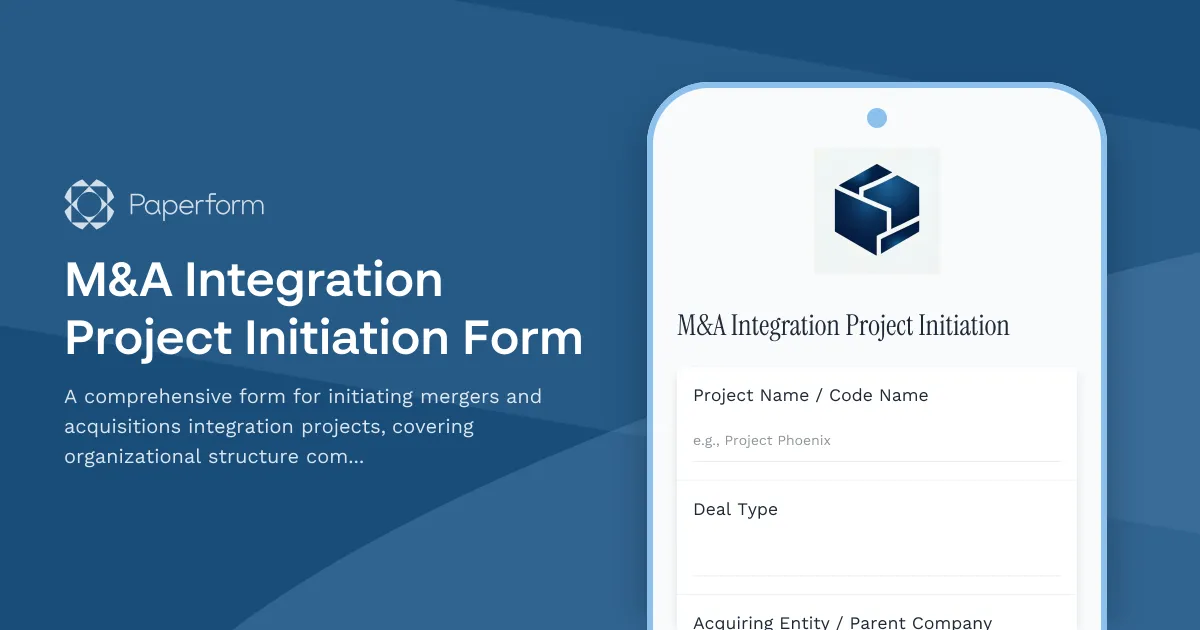
Streamline Your M&A Integration Planning with Paperform
Mergers and acquisitions require meticulous planning and seamless coordination across multiple workstreams. This M&A Integration Project Initiation Form template helps executives, project managers, and integration teams establish a solid foundation for post-merger success from day one.
Whether you're a private equity firm, corporate development team, management consultant, or business executive leading integration efforts, this template captures all critical dimensions of your M&A project: organizational structures, technology systems, cultural considerations, communication plans, and phased timelines.
Why This Template Works for M&A Integration
The form systematically guides your team through essential integration planning areas—from comparing organizational hierarchies and assessing IT system compatibility to developing cultural alignment strategies and stakeholder communication plans. By centralizing this information at project kickoff, you create a single source of truth that keeps integration teams aligned throughout the process.
Automate Your Integration Workflows with Stepper
Once your M&A integration brief is submitted, use Stepper to automatically route approvals to stakeholders, create project workstreams in your project management tool, notify relevant integration teams, and trigger due diligence workflows. Stepper's AI-native automation ensures every submission kicks off the right sequence of actions without manual handoffs.
Built for Complex Business Processes
With Paperform's conditional logic, you can tailor questions based on deal type, integration complexity, or organizational size. The platform's calculation engine supports timeline planning and resource allocation, while native integrations with tools like Monday.com, Asana, Slack, and your CRM ensure seamless data flow across your tech stack.
Trusted by professional services firms and enterprises worldwide, this template is SOC 2 Type II compliant and designed for teams that need both flexibility and security when handling sensitive M&A information.
More templates like this
Merger Integration Scope of Work Form
A comprehensive scope of work template for merger and acquisition integration projects, covering systems consolidation, process harmonization, cultural integration, and synergy tracking.
Corporate Carve-Out Stakeholder Update
A comprehensive stakeholder communication form for tracking corporate separation activities, Transition Service Agreement (TSA) status, standalone capability readiness, and Day 1 operational preparedness during carve-out transactions.
Executive Monthly Stakeholder Update Report
A comprehensive monthly reporting template for executives to communicate project status, KPIs, milestones, and budget performance to stakeholders with visual clarity.
Strategic Partnership Evaluation & Project Initiation Form
Comprehensive partnership assessment form for evaluating strategic opportunities, conducting due diligence, and planning integration. Perfect for businesses exploring joint ventures, alliances, and collaborative partnerships.
Change Management Scope of Work
A comprehensive change management scope of work template for defining stakeholder analysis, communication strategies, training plans, resistance mitigation, and adoption metrics for organizational change initiatives.
Corporate Operating Model Redesign Stakeholder Update
A comprehensive stakeholder communication form for tracking and reporting corporate operating model transformation initiatives, including organizational structure changes, role clarifications, decision rights, capability development, and culture evolution.
M&A Integration Post-Mortem & Cultural Alignment Review
A comprehensive post-mortem template for merger and acquisition integration teams to evaluate cultural alignment, system migration challenges, and synergy realization outcomes.
Sales Methodology Implementation Project Kickoff Form
A comprehensive project brief form for launching sales methodology implementation initiatives, covering framework selection, customization needs, training design, tool integration, and success metrics.
Strategic Planning Offsite Project Brief
A comprehensive project brief template for planning strategic offsite sessions, including pre-work assignments, facilitation details, agenda design, participant management, and action item tracking.
Supplier Diversity Program Launch Initiation Form
Launch your supplier diversity program with this comprehensive project brief. Define certification requirements, sourcing strategies, vendor development plans, spend tracking, reporting, and stakeholder engagement.
Third-Party Risk Assessment Project Kickoff Form
A comprehensive project brief for initiating third-party risk assessments. Capture vendor inventory, define risk criteria, establish assessment protocols, set remediation requirements, and configure ongoing monitoring schedules.
Agile Scaling Stakeholder Update
Comprehensive stakeholder update for agile scaling initiatives, tracking train formation, program increment planning, feature delivery, impediments, and business agility metrics across teams and releases.