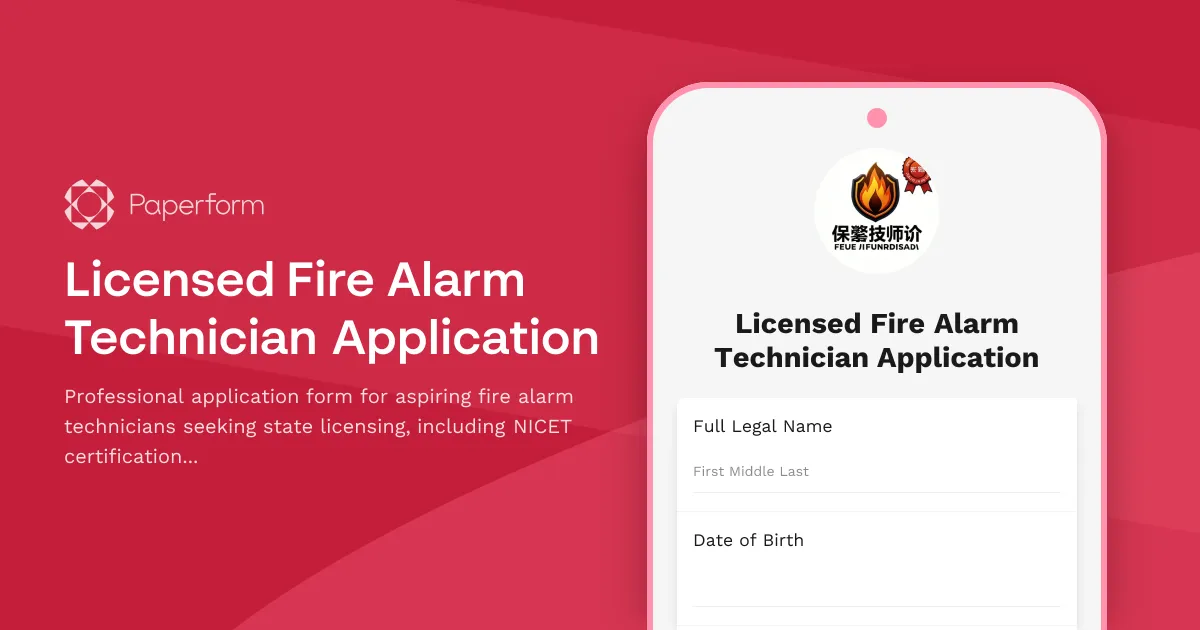
Licensed Fire Alarm Technician Application Form Template
Fire alarm technicians play a critical role in public safety, installing, inspecting and maintaining fire detection and alarm systems that protect lives and property. Whether you're applying for your first state license or upgrading your credentials, the path to becoming a licensed fire alarm technician requires careful documentation of your training, certification and experience.
This Licensed Fire Alarm Technician Application template is designed for state licensing boards, fire marshal offices and certification authorities that manage the credentialing process for fire alarm professionals. Built with Paperform, this form streamlines the entire application workflow—from initial qualification screening to exam scheduling—while maintaining the regulatory rigor required for life-safety professions.
What makes fire alarm technician licensing complex
Fire alarm system work sits at the intersection of electrical systems, building codes, and public safety regulation. Most states require technicians to demonstrate:
- Formal training in fire alarm theory, NFPA codes and system design
- NICET certification (National Institute for Certification in Engineering Technologies) at the appropriate level
- Documented work experience under a licensed technician or master electrician
- Background checks to ensure public trust in life-safety roles
- Continuing education to stay current with evolving technology and code changes
Coordinating these requirements across multiple applicants, scheduling state exams and tracking renewal cycles creates significant administrative overhead for licensing authorities.
How this template supports the fire alarm licensing workflow
This Paperform template captures everything your licensing board needs to evaluate applicants efficiently:
Applicant information and contact details establish identity and communication channels for the duration of the licensing process.
NICET certification verification collects certification level (I through IV), certification number and upload fields for official NICET credentials, allowing staff to quickly verify standing with NICET.
Training documentation gathers details on fire alarm system courses completed, including institution names, course dates, hours completed and certificates. Conditional logic shows different fields based on whether training was through a trade school, community college, manufacturer program or apprenticeship.
Work experience section documents employment history specific to fire alarm work—employer names, supervisor information, dates of employment, types of systems worked on (conventional, addressable, networked, voice evacuation, mass notification) and total hours logged. This section supports the common requirement for 2,000-4,000 hours of supervised experience.
State exam scheduling lets applicants select their preferred exam date, testing location and accommodation requests, automatically coordinating with your exam administration calendar.
Background check consent includes the legally required authorization language for criminal history checks, with fields for previous names, addresses and employer references.
Supporting document uploads allow applicants to attach transcripts, manufacturer certifications, proof of insurance (for contractors) and other supplementary credentials in one organized submission.
License type and fee calculation uses Paperform's payment fields to calculate application fees based on license level (apprentice, journeyman, master) and any expedited processing or exam rescheduling fees, with Stripe or PayPal integration for secure payment.
Why fire marshal offices and licensing boards choose Paperform
Regulatory compliance built in: Fire alarm licensing involves serious regulatory requirements. With Paperform's SOC 2 Type II compliance, you can trust that sensitive applicant data—including background check information and payment details—is handled to enterprise security standards, even though you're working with SMB-friendly tools.
Conditional logic for complex scenarios: Not every applicant follows the same path. Some have military training. Some hold reciprocal licenses from other states. Some are applying for renewal rather than initial licensing. Paperform's conditional logic shows only the relevant questions for each applicant's situation, reducing confusion and incomplete submissions.
Calendar integration for exam scheduling: Connect your Google or Outlook calendar to the appointment fields so applicants can only book exam slots when your testing facility has capacity and proctors available—no more double-bookings or phone tag.
Automated workflows with Stepper: After an application is submitted, use Stepper to automatically trigger your verification workflow—send NICET verification requests, schedule background checks, notify the applicant of missing documents and update your license database. Stepper's AI-native approach means you can describe your approval workflow in plain language and let it build the automation.
Digital signatures via Papersign: Once an application is approved, send the licensing agreement, code of professional conduct or scope-of-practice acknowledgment for eSignature through Papersign. The signed document links back to the original application for a complete audit trail when inspectors or courts request licensing documentation.
Multi-location exam coordination: If your state offers testing at regional sites, use Paperform's dropdown and conditional fields to show available dates based on the applicant's chosen location. Confirmation emails can include site-specific directions, parking instructions and what to bring.
Transparent fee calculation: Fire alarm licensing often involves tiered fees (application fee, exam fee, background check fee, license issuance fee). Paperform's real-time calculation engine shows applicants exactly what they're paying for before they submit payment, reducing disputes and payment failures.
Designed for fire safety professionals and licensing authorities
This template is ideal for:
- State fire marshal offices managing fire alarm technician licensing programs
- Local building departments issuing municipal fire alarm permits and credentials
- Trade associations administering voluntary fire alarm certifications beyond state minimums
- Training providers coordinating student applications for state exams after course completion
- Fire protection engineering firms tracking internal certification requirements for staff
The form's professional design and clear structure reflect the seriousness of fire alarm work while remaining approachable for applicants who may be submitting their first professional credential application.
Customization for your jurisdiction's requirements
Every state has slightly different fire alarm licensing requirements. This template is fully customizable within Paperform's doc-style editor:
- Add or remove NICET levels based on whether your state recognizes all four levels or only requires Level II for journeyman work
- Adjust experience requirements to match your state's hour thresholds and acceptable types of supervised experience
- Include reciprocity questions for applicants licensed in other states seeking expedited approval
- Add specialty endorsements for specific system types like mass notification, integrated security or healthcare applications
- Embed training provider lists so applicants select from approved schools rather than free-form entry
- Link to state statute references so applicants understand the legal basis for each requirement
The form can also be embedded directly into your department's website or hosted on a custom domain like licensing.firemarshal.state.gov for a seamless, on-brand experience.
Fast setup, ongoing automation
Unlike legacy government forms that require IT tickets and month-long procurement cycles, you can customize and launch this Paperform template in an afternoon. Non-technical licensing coordinators own the entire form without waiting for developers, and can make updates when regulations change or exam schedules shift.
Integration with CRMs (HubSpot, Salesforce), project management tools (Asana, Monday) and communication platforms (Slack, Teams) means application data flows directly into your existing systems. Google Sheets or Airtable connections give your team a real-time dashboard of pending applications, upcoming exams and expiring licenses.
For high-volume periods (when training cohorts graduate or license renewals cluster in certain months), Paperform's scalable infrastructure handles the traffic without slowdown or added cost per submission.
A professional licensing process that earns trust
Fire alarm technicians are responsible for life-safety systems. The public, building owners and fire departments need confidence that licensed technicians meet rigorous standards. A clear, well-organized application process is the first signal that your licensing authority takes those standards seriously.
With Paperform's professional design, secure data handling, automated workflows and integrated payments, this Licensed Fire Alarm Technician Application template helps you run a licensing program that's efficient for your team and trustworthy for applicants—so the right people can get credentials faster and start protecting communities.
Whether you're a state fire marshal's office processing hundreds of applications annually or a county building department managing a smaller regional program, this template gives you the structure and automation to keep fire alarm licensing moving smoothly.



More templates like this

Finnish Professional Exam Application for Regulated Trades
Apply for professional qualification exams in Finnish regulated trades. Submit apprenticeship verification, work experience, and required documentation for licensed professions.
Licensed Asbestos Abatement Contractor Application
Apply for professional asbestos abatement contractor certification. Submit EPA training credentials, hazmat certifications, and schedule your contractor examination.
Licensed Backflow Tester Recertification Application
Apply for backflow prevention tester license renewal with continuing education verification, field testing updates, and state exam registration.
Licensed Confined Space Entry Supervisor Application
Professional application for confined space entry supervisor certification, including training verification, rescue procedures assessment, and supervisor competency examination.
Licensed Elevator Mechanic Certification Application
Professional certification application for licensed elevator mechanics, including apprenticeship completion verification, NEIEP training documentation, and mechanic licensing exam eligibility assessment.
Licensed Explosives Technician Certification Application
Apply for professional explosives technician certification with comprehensive blasting safety training verification, explosives handling experience documentation, and ATF licensing exam eligibility assessment.
Licensed Fire Sprinkler Contractor Application
Professional application for licensed fire sprinkler contractor certification with NICET credentials, installation experience verification, and contractor licensing exam scheduling.
Licensed Lead Abatement Contractor Application
Professional application form for licensed lead abatement contractors seeking EPA RRP certification, demonstrating lead-safe work practices, and scheduling contractor competency examinations.
Licensed Mold Remediation Contractor Application
Apply for professional mold remediation contractor certification. Complete licensing requirements including microbial training verification, containment procedures knowledge, and contractor exam scheduling.

Licensed Pool and Spa Contractor Application
Apply for your pool and spa contractor license. Submit construction experience, hydraulics training, and schedule your contractor licensing exam all in one place.
Licensed Radon Mitigation Specialist Application
Professional application for radon mitigation specialist certification with training verification, system installation experience, and NRPP exam requirements.
Licensed Septic System Installer Application
Professional application for licensed septic system installer certification, including training verification, installation experience, and exam registration.