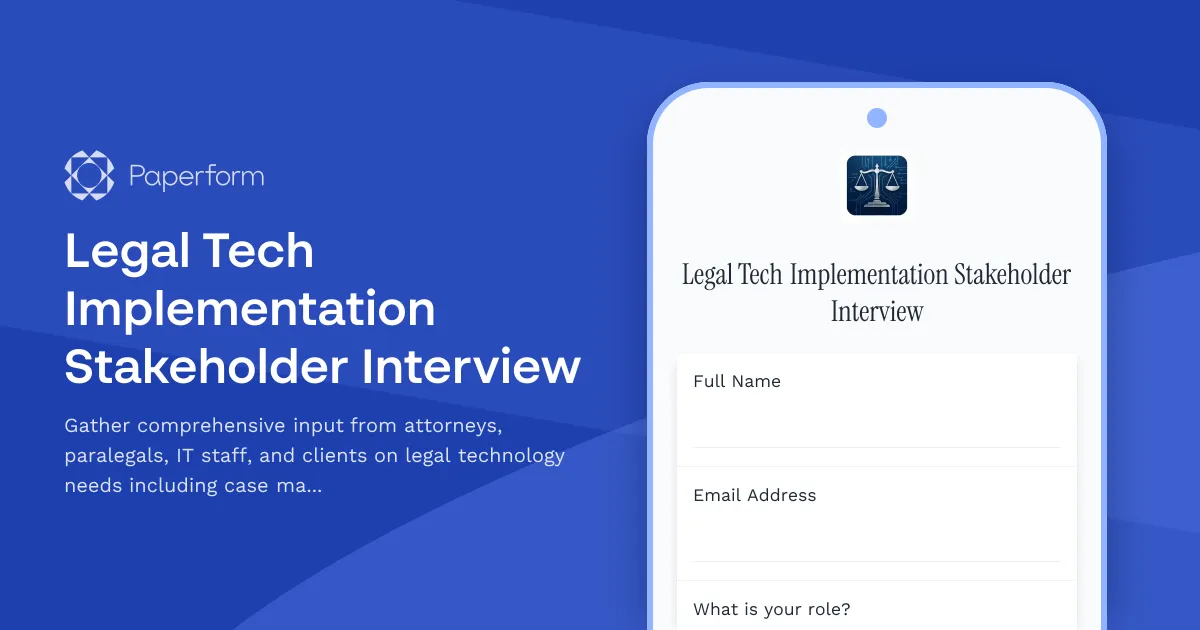
Streamline Legal Tech Implementation with Stakeholder Interview Forms
Implementing new legal technology requires input from everyone it will impact—attorneys, paralegals, IT staff, and even clients. This Legal Tech Implementation Stakeholder Interview form helps law firms and legal departments gather comprehensive feedback on case management needs, document automation requirements, collaboration preferences, security standards, and billing integration expectations.
Why this template works for legal professionals
Law firms need technology that serves multiple stakeholders with different priorities. Attorneys need efficiency and client service tools. Paralegals need streamlined workflows. IT teams need security and integration capabilities. Clients need transparency and communication. This template captures all perspectives in one structured interview format.
Using Paperform's conditional logic, the form adapts based on the stakeholder's role—asking attorneys about client communication needs, paralegals about document assembly workflows, IT staff about security protocols, and clients about portal preferences. This ensures every voice is heard without creating survey fatigue.
Automate your implementation workflow
Once you've gathered stakeholder input, use Stepper to automate your implementation planning. Route attorney feedback to practice management committees, compile IT requirements into technical specifications, and create implementation roadmaps based on priority rankings. Stepper can aggregate responses, identify common themes, and trigger follow-up interviews with key stakeholders automatically.
Who benefits from this template
This form is ideal for law firms evaluating case management systems, legal departments implementing new technology stacks, legal tech consultants conducting discovery, and software vendors gathering requirements from potential clients. It's designed for managing partners, legal operations managers, IT directors, and anyone leading digital transformation in legal services.
With Paperform's professional design capabilities, your stakeholder interview form maintains the polished, trustworthy appearance your legal practice requires while gathering the detailed input needed to make informed technology decisions.
More templates like this
Data Governance Framework Stakeholder Interview
Gather strategic input from data owners, analysts, compliance officers, and IT teams to establish comprehensive data governance standards, access controls, and stewardship responsibilities.
Agile Transformation Stakeholder Interview
Gather critical insights from development teams, product owners, and executives about current process pain points, collaboration challenges, and requirements for a successful agile transformation.
Litigation Support Software Request Form
Request specialized litigation support software for case management, document review, depositions, and trial presentations. Streamline your legal team's workflow with the right tools.
NIST 800-171 System Security Plan (SSP)
A comprehensive system security plan template for contractors handling controlled unclassified information (CUI), ensuring NIST 800-171 compliance with detailed security controls and implementation documentation.
Commercial Dispute Witness Statement Form
A comprehensive witness statement form designed for commercial disputes, capturing detailed testimony about contract breaches, financial impacts, and supporting arbitration or litigation preparation.
Compliance Reporting System Access Request
Request access to compliance reporting systems with role-based permissions, audit trail viewing capabilities, and regulatory report generation tools while maintaining strict confidentiality requirements.
CRM Implementation Discovery Form
A comprehensive discovery form for CRM implementation projects that captures sales process requirements, lead management workflows, integration needs, and data migration planning to ensure successful CRM deployment.
Cybersecurity Initiative Stakeholder Interview
Gather strategic input from IT staff, executives, and end users on cybersecurity priorities, threat assessment, compliance needs, and training requirements to inform your security roadmap.
Cybersecurity Services Data & Network Access Consent Form
Obtain client consent for managed cybersecurity services including network vulnerability scans, security monitoring, employee training tracking, and threat intelligence sharing.
Czech Cloud Service Agreement with GDPR Data Processing Terms
A comprehensive cloud service agreement template for Czech businesses requiring data residency in the Czech Republic and full GDPR processor compliance terms.
Data Mapping Exercise Documentation Form
A comprehensive form for documenting personal data processing activities and data flows across systems to maintain Article 30 GDPR Records of Processing Activities (RoPA) compliance.
Data Processing Impact Assessment for Cloud Services
A comprehensive GDPR-compliant questionnaire for assessing data processing activities, security risks, and privacy implications when adopting cloud services within the EU.