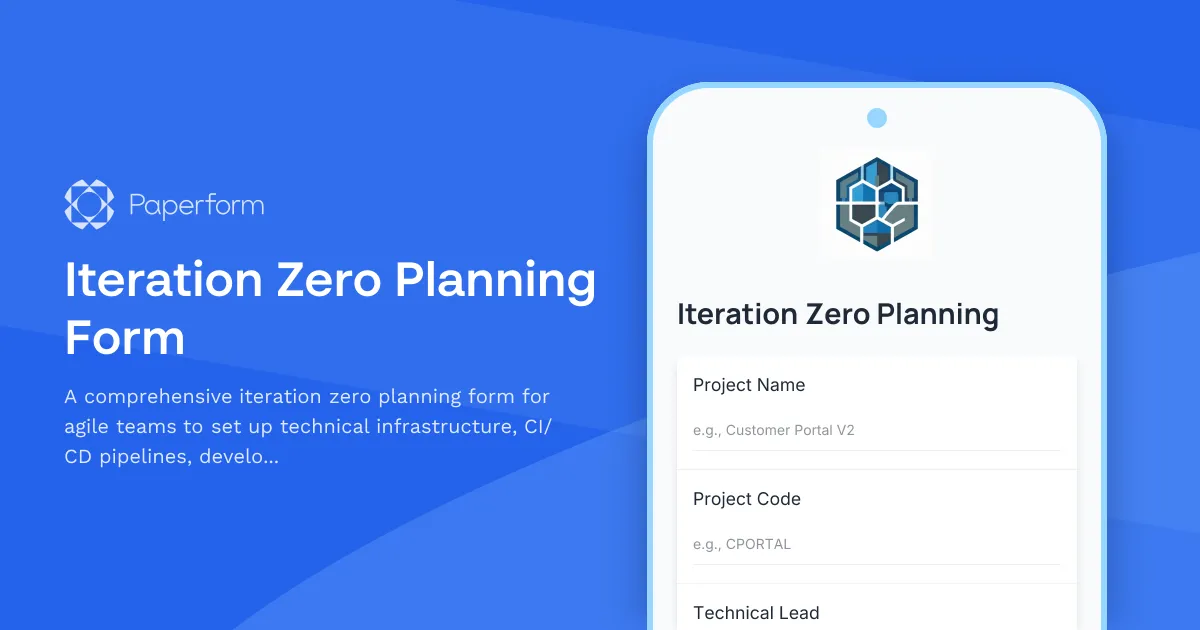
Streamline Your Iteration Zero with a Professional Planning Form
Starting a new project or product? Iteration zero is your foundation—the crucial pre-sprint phase where development teams establish technical infrastructure, tooling, and architectural decisions that will support every sprint to come.
Our Iteration Zero Planning Form helps software development teams, product managers, and engineering leaders capture all the essential setup requirements in one structured workflow. Instead of scattered emails, Slack threads, and meeting notes, you get a single source of truth for your project's technical foundation.
Perfect for Development Teams and Engineering Managers
Whether you're a startup CTO setting up your first production environment, an agency managing multiple client projects, or an enterprise team launching a new product line, this form template ensures nothing falls through the cracks during iteration zero. Capture decisions about infrastructure, CI/CD pipelines, development environments, monitoring, security, and architectural patterns—all before your first sprint begins.
From Planning to Action with Paperform + Stepper
This form doesn't just collect information—it kicks off your project the right way. Use Stepper to automatically create tickets in Jira or Linear, provision access in GitHub or GitLab, notify team members in Slack, and update project documentation in Confluence or Notion. Every submission becomes a structured project kickoff that routes tasks to the right people and keeps your iteration zero on track.
Built for Agile Teams Who Move Fast
With conditional logic that adapts to your technology stack and deployment model (cloud, on-premise, or hybrid), this template fits your specific needs. The clean, professional layout keeps stakeholders aligned while the structured sections ensure technical leads cover infrastructure, security, testing, and deployment concerns before code hits production.
Trusted by development teams worldwide, Paperform makes it easy to standardize your iteration zero process, maintain consistency across projects, and get from planning to first sprint faster.
More templates like this
Agile Definition of Ready Checklist
Ensure user stories are fully prepared and ready for sprint planning with this comprehensive Definition of Ready checklist covering story completeness, dependencies, acceptance criteria, and team understanding.
Agile Team Skills Matrix Form
Track team competencies, learning goals, and knowledge sharing opportunities to optimize sprint planning and resource allocation in agile teams.
Sprint Capacity Planning Form
Plan your sprint capacity with team availability, PTO tracking, velocity estimates, and commitment levels. Perfect for agile teams running Scrum or Kanban workflows.
Agile Metrics Dashboard Submission Form
Track sprint performance with comprehensive agile metrics including velocity, cycle time, lead time, and quality indicators for continuous team improvement.
Agile Team Capacity Planning Form
Calculate sprint capacity based on team availability, skill sets, focus factors, and planned time off. Perfect for sprint planning and resource allocation in agile teams.
Agile Team Working Agreement
Establish team norms, communication protocols, core hours, and collaboration standards for agile teams to improve workflow and reduce friction.
API Development Project Brief
A comprehensive project brief template for planning API development projects, covering endpoint specifications, authentication, rate limiting, documentation standards, and versioning strategies.

Community of Practice Coordination Form
A comprehensive form for coordinating community of practice sessions, defining learning objectives, organizing knowledge sharing activities, and fostering team collaboration.
Legacy System Modernization Project Kickoff Form
Comprehensive project brief template for legacy system modernization initiatives, capturing technical debt assessment, business process analysis, technology evaluation, implementation planning, and change management requirements.
PI Planning Form for SAFe Teams
Streamline your Program Increment planning with this comprehensive SAFe-aligned form. Capture team objectives, identify dependencies, and conduct confidence votes—all in one place.
Sprint Commitment Form
A comprehensive sprint planning form to capture team commitments, selected user stories, stretch goals, sprint risks, and capacity acknowledgments for agile teams.
Team Dependency Coordination Form
Streamline sprint planning by mapping team dependencies, blocking items, integration points, and shared resources to keep your agile teams aligned and moving forward.