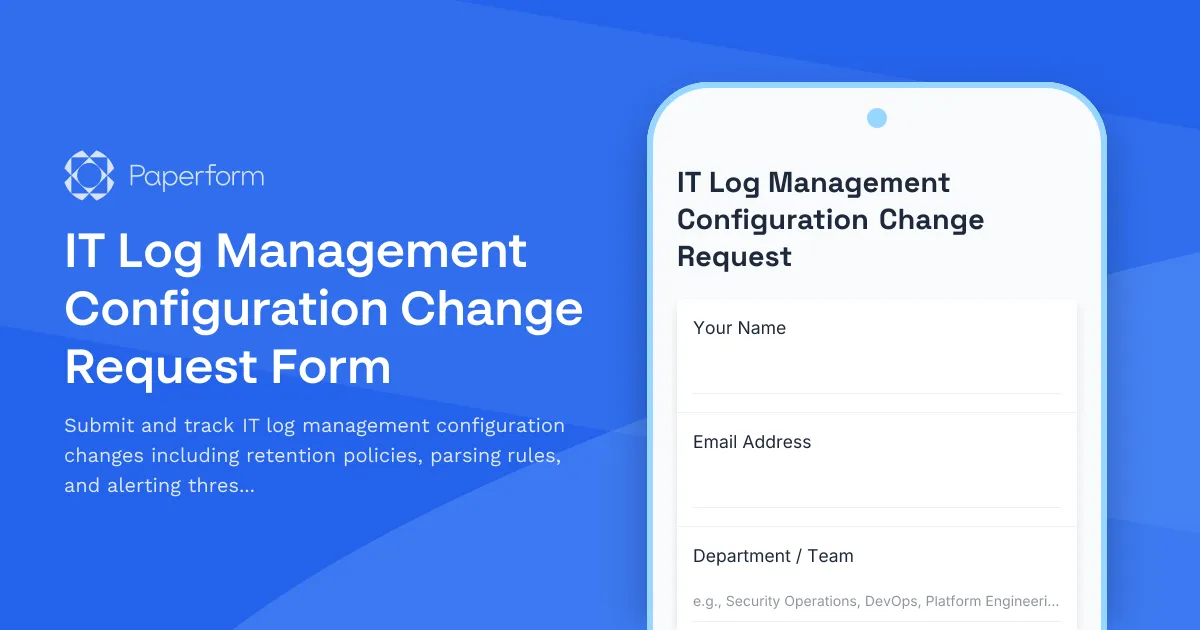
Streamline Your IT Log Management Changes with Paperform
Managing log configurations across your IT infrastructure requires careful planning, proper approval workflows, and detailed documentation. Whether you're adjusting retention policies, implementing new parsing rules, or fine-tuning alerting thresholds, this IT Log Management Configuration Change Request Form helps IT teams submit, track, and approve changes efficiently—all without the complexity of traditional ticketing systems.
Why Log Management Configuration Changes Need a Structured Process
In modern IT operations, logs are critical for security monitoring, compliance auditing, troubleshooting, and performance analysis. But as your infrastructure scales, managing log configurations becomes increasingly complex. Without a proper change management process, teams risk:
- Compliance violations from incorrect retention policies
- Missed security incidents due to misconfigured alerts
- Storage cost overruns from overly aggressive log retention
- Data loss from parsing rules that filter out critical information
- Audit trail gaps when changes aren't properly documented
This form template provides IT teams, DevOps engineers, security analysts, and system administrators with a centralized way to request, document, and approve log configuration changes before they're implemented in production.
What This IT Change Request Form Covers
The template is specifically designed for log management systems (like Splunk, ELK Stack, Datadog, Sumo Logic, or similar platforms) and includes sections for:
Change request details – Capture who's requesting the change, what system is affected, the urgency level, and the business justification
Configuration type – Specify whether you're modifying retention policies, parsing rules, alerting thresholds, log sources, or other configuration elements
Technical specifications – Document the current configuration, proposed changes, expected impact, and any dependencies on other systems
Risk assessment – Evaluate the potential impact on storage, performance, compliance, and security monitoring
Implementation planning – Define rollback procedures, testing requirements, and implementation schedules
Approval workflow – Route requests through the appropriate technical and business stakeholders
How IT Teams Use This Form
Security Operations Centers (SOCs) use it to request new alerting rules when threat intelligence changes or to adjust retention policies for compliance requirements like GDPR, HIPAA, or SOC 2.
DevOps and platform teams submit requests to add new log sources when deploying applications, or to modify parsing rules when log formats change after software updates.
Compliance and audit teams use the form to ensure retention policies align with regulatory requirements and to document configuration changes for audit trails.
IT managers and technical leads use the submission data to review, approve, and prioritize configuration changes, ensuring changes align with capacity planning and don't introduce operational risk.
Automate Your Change Management Workflow with Stepper
Once a log configuration change request is submitted through Paperform, you can connect it to Stepper to automate your entire approval and implementation workflow:
- Route requests automatically based on change type, urgency, or affected systems to the right approval groups
- Trigger notifications in Slack or Microsoft Teams when approvals are needed or when changes are approved
- Update your ITSM platform (ServiceNow, Jira Service Management, Freshservice) with change details
- Create implementation tickets automatically in your project management tools
- Log configuration changes in your documentation systems or configuration management databases (CMDB)
- Schedule follow-up reviews to verify changes were implemented correctly and achieved the intended result
This automation eliminates manual handoffs, reduces approval delays, and ensures every configuration change follows your established governance process.
Built for IT Professionals Who Need Speed and Precision
Unlike generic change request forms, this template understands the specific terminology and concerns of log management: retention periods, parsing expressions, alert thresholds, log volume estimation, and storage impact. It guides requesters to provide the technical details approvers need to make informed decisions quickly.
The form's conditional logic shows relevant fields based on the type of configuration change, keeping the form focused and preventing information overload. For example, retention policy changes show fields for compliance requirements and storage cost estimates, while alerting threshold changes show fields for false positive rates and notification channels.
Why IT Teams Choose Paperform for Change Management
No-code flexibility – IT managers and change coordinators can customize the form without developer support, adding fields for new log platforms or adjusting approval routing as your process evolves.
Professional, on-brand experience – Unlike clunky ITSM portals, Paperform forms can match your IT operations portal or internal tools, creating a consistent experience that encourages proper change documentation.
Powerful integrations – Connect submissions to Slack, email, Google Sheets, your CMDB, monitoring tools, and thousands of other platforms via native integrations, webhooks, or Stepper.
Audit-ready reporting – All submissions are automatically logged with timestamps, approver information, and change details, providing the audit trail compliance teams require.
SOC 2 Type II compliance – Paperform's security controls meet the standards IT teams need, with data residency options, SSO support, and role-based permissions for larger organizations.
Get Started in Minutes
This template is ready to use immediately for common log management scenarios, or you can customize it to match your specific platforms, approval processes, and documentation requirements. Whether you're managing a handful of servers or a complex multi-cloud environment, this form brings structure and accountability to your log configuration changes—without the overhead of enterprise ITSM tools.
Trusted by IT teams worldwide, this template helps you balance operational agility with the governance and documentation that compliance, security, and audit teams expect.
More templates like this
AI Model Deployment Approval Form
A comprehensive approval form for AI model deployments that evaluates training data, bias assessment, performance metrics, security controls, and ethical considerations before production release.
IT Attack Surface Management Change Request Form
Comprehensive IT change request form for managing attack surface changes, with asset discovery, exposure assessment, and risk prioritization capabilities.
API Gateway Configuration Change Request
Submit requests for API gateway configuration changes including rate limiting, authentication, and endpoint modifications. Streamlined approval workflow for development and operations teams.
Cloud Storage File Metadata & Access Request Form
Request file metadata, access logs, sharing permissions, and version history from your cloud storage service. Comprehensive data access request form for IT administrators and users.
IT Cloud Security Posture Management Change Request Form
A comprehensive cloud security change request form with automated misconfiguration detection, compliance validation, and remediation workflow triggers for IT teams managing cloud infrastructure security.
IT Container Security Scanning Change Request Form
Submit and track container security scanning changes with image registry integration, vulnerability thresholds, and automated remediation workflows for DevOps and security teams.
IT Infrastructure Change Request Form
Submit and manage IT infrastructure changes with comprehensive risk assessment, rollback planning, and structured approval workflow for enterprise environments.
IT Network Segmentation Change Request Form
Submit network segmentation change requests including VLAN configuration, security zones, and access control list modifications with technical details and approval workflow.
IT Secure Software Development Lifecycle Change Request Form
Comprehensive SDLC change request form with built-in security gates, testing requirements, and release criteria for secure software deployments.
IT Security Architecture Exception Approval Form
Request and approve security architecture exceptions with technical justifications, alternative approaches, risk assessments, and time-bound permissions for IT change management.
IT Security Architecture Review Board Submission Form
Submit security architecture proposals to the review board for evaluation, approval, and decision documentation with comprehensive risk assessments and compliance considerations.
IT Security Code Review Tool Integration Change Request
Request approval for integrating security code review tools with static analysis configuration, finding workflows, and developer training requirements.