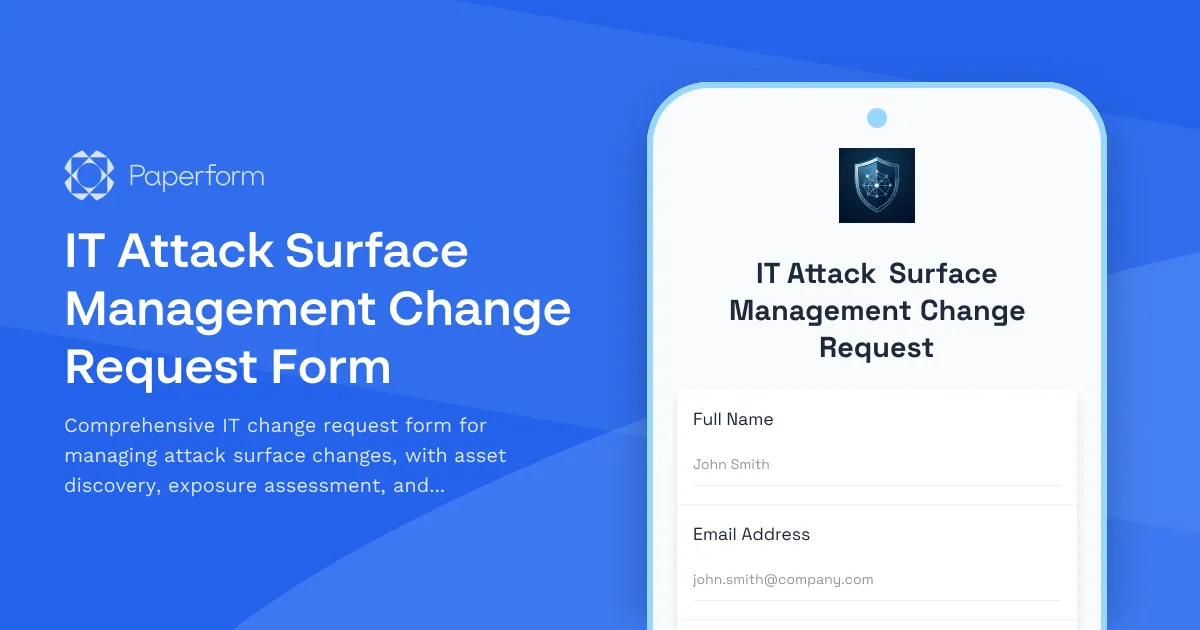
Streamline Your IT Security Changes with Attack Surface Management
In today's rapidly evolving threat landscape, managing your organization's attack surface is critical to maintaining a strong security posture. Every IT change—whether it's deploying new infrastructure, modifying network configurations, or updating software—can introduce new vulnerabilities or expose critical assets. This IT Attack Surface Management Change Request Form helps IT teams, security professionals, and risk managers systematically evaluate and approve changes while keeping your organization protected.
Why Attack Surface Management Matters for IT Changes
Your attack surface encompasses all the points where an unauthorized user could try to enter or extract data from your environment. As businesses adopt cloud services, remote work tools, and interconnected systems, this surface grows exponentially. Traditional change management processes often focus on operational impact but may overlook security implications like exposed ports, misconfigured services, or new external-facing assets.
This template bridges that gap by integrating asset discovery, exposure assessment, and risk prioritization directly into your change request workflow. Instead of treating security as an afterthought, your team can evaluate the security impact upfront, identify potential vulnerabilities, and make informed decisions about whether a change should proceed, be modified, or require additional controls.
Built for IT Security and Operations Teams
This form is designed for organizations where IT operations, security operations centers (SOCs), and risk management teams need to collaborate on change approvals. It's particularly valuable for:
- IT Security Teams managing vulnerability assessments, penetration testing, and continuous monitoring who need visibility into what's changing across the infrastructure
- Network and Systems Administrators requesting changes to servers, networks, cloud environments, or applications that could affect the organization's attack surface
- DevOps and Cloud Engineers deploying new services, containers, or infrastructure-as-code that create new exposure points
- Risk and Compliance Managers who need to ensure changes align with security frameworks like NIST, ISO 27001, or CIS Controls
- IT Managers and CISOs responsible for approving high-risk changes and maintaining overall security posture
Comprehensive Asset Discovery and Classification
The form guides requesters through identifying all assets affected by the proposed change—from servers and network devices to cloud resources and third-party integrations. By categorizing assets by type, criticality, and environment (production, development, DMZ), your team gains immediate context about what's at stake.
Understanding whether a change affects internet-facing assets versus internal systems is crucial. This template specifically captures asset exposure details, helping security teams quickly identify changes that expand the external attack surface versus those that only impact internal operations.
Exposure Assessment and Vulnerability Analysis
One of the most powerful features of this form is the structured exposure assessment section. Requesters document what new services, ports, or endpoints will be exposed, what data flows will change, and what authentication mechanisms protect the assets. This forces a security-first mindset during the planning phase rather than discovering issues during post-implementation reviews.
The form also prompts teams to consider whether the change introduces known vulnerabilities, affects existing security controls like firewalls or intrusion detection systems, or creates new trust relationships between systems. This holistic view helps security teams spot potential issues before they become real threats.
Risk Prioritization and Approval Workflow
Not all changes carry the same risk. A minor configuration update to an internal development server differs dramatically from exposing a customer database to the internet. This form includes a built-in risk scoring mechanism that evaluates changes based on:
- Asset criticality (business impact if compromised)
- Exposure level (internal, external, internet-facing)
- Data sensitivity (public, internal, confidential, regulated)
- Security controls (authentication, encryption, monitoring)
Based on these factors, the form helps categorize changes as low, medium, high, or critical risk, enabling appropriate approval routing and additional security reviews for high-risk modifications.
Integrate with Your Existing Tools Using Stepper
This Paperform template is just the beginning of a modern, automated change management workflow. Connect it to Stepper, your AI-native workflow automation platform, to transform each submission into an intelligent, multi-step process:
- Automatic routing to the right approvers based on risk level—low-risk changes might auto-approve while critical changes route to your CISO
- Create tickets in ServiceNow, Jira Service Management, or other ITSM platforms so change requests integrate with your existing change advisory board (CAB) process
- Trigger security scans using vulnerability management tools or attack surface management platforms to validate the proposed change doesn't introduce unexpected risks
- Update asset inventories in CMDBs, asset management systems, or cloud management platforms
- Send notifications to security, network, and operations teams via Slack, Microsoft Teams, or email
- Generate audit logs for compliance reporting and change history documentation
With Stepper, your attack surface management workflow becomes a living system that keeps your security, IT operations, and compliance teams perfectly synchronized.
Flexible, On-Brand and Conversion-Focused
Unlike rigid IT forms that feel like spreadsheets, this Paperform template gives you complete control over the look and feel. Match your organization's brand with custom fonts, colors, and layouts. Embed the form directly into your IT portal, security wiki, or intranet, or use it as a standalone page with a custom domain.
The doc-style editor makes it easy to add company-specific security policies, helpful tooltips, or examples that guide requesters through complex questions. Conditional logic ensures people only see questions relevant to their specific change type, keeping the form streamlined and reducing submission errors.
Security and Compliance Built In
Paperform is SOC 2 Type II compliant, ensuring your change request data is handled with enterprise-grade security. Use single sign-on (SSO) to integrate with your identity provider, set up roles and permissions so only authorized teams can submit or view requests, and enable data residency controls to keep sensitive information in specific geographic regions.
For organizations with audit requirements under frameworks like SOC 2, ISO 27001, or PCI DSS, this form creates a clear audit trail of who requested what changes, what security considerations were evaluated, and who approved the modifications. Export submissions to create evidence for auditors or compliance officers.
Start Managing Your Attack Surface Today
Whether you're a growing startup building your first formal change management process or an established enterprise looking to integrate security deeper into IT operations, this IT Attack Surface Management Change Request Form gives you the structure, flexibility, and automation capabilities you need.
With Paperform's intuitive builder, native integrations with security and IT tools, and Stepper's workflow automation, you can deploy a world-class attack surface management process in hours, not months—without writing a single line of code.
Ready to reduce risk and improve visibility? Start with this template, customize it to your specific security policies and risk appetite, then connect it to your existing security stack. Your IT and security teams will appreciate the clarity, your auditors will love the documentation, and your organization will benefit from a more resilient security posture.
More templates like this
IT Network Segmentation Change Request Form
Submit network segmentation change requests including VLAN configuration, security zones, and access control list modifications with technical details and approval workflow.
IT Security Architecture Exception Approval Form
Request and approve security architecture exceptions with technical justifications, alternative approaches, risk assessments, and time-bound permissions for IT change management.
Network DDoS Mitigation Request Form
Submit a request to activate DDoS protection services, configure traffic scrubbing parameters, set detection thresholds, and whitelist legitimate traffic sources for your network infrastructure.
AI Model Deployment Approval Form
A comprehensive approval form for AI model deployments that evaluates training data, bias assessment, performance metrics, security controls, and ethical considerations before production release.
API Gateway Configuration Change Request
Submit requests for API gateway configuration changes including rate limiting, authentication, and endpoint modifications. Streamlined approval workflow for development and operations teams.
IT Cloud Security Posture Management Change Request Form
A comprehensive cloud security change request form with automated misconfiguration detection, compliance validation, and remediation workflow triggers for IT teams managing cloud infrastructure security.
IT Log Management Configuration Change Request Form
Submit and track IT log management configuration changes including retention policies, parsing rules, and alerting thresholds for approval and implementation.
IT Secure Software Development Lifecycle Change Request Form
Comprehensive SDLC change request form with built-in security gates, testing requirements, and release criteria for secure software deployments.
IT Security Architecture Decision Record (ADR) Change Request
Document security architecture decisions, technical choices, and rationale with structured approval workflows for IT change management and governance.
IT Security Architecture Review Board Submission Form
Submit security architecture proposals to the review board for evaluation, approval, and decision documentation with comprehensive risk assessments and compliance considerations.
IT Security Control Testing Evidence Collection Change Request
Streamline security control testing evidence collection with structured change requests, artifact management, retention policies, and complete audit trails for compliance and governance.
IT Supply Chain Security Change Request Form
Comprehensive IT change request form for supply chain security assessments, including vendor evaluations, software bill of materials (SBOM), and risk analysis for secure technology implementations.