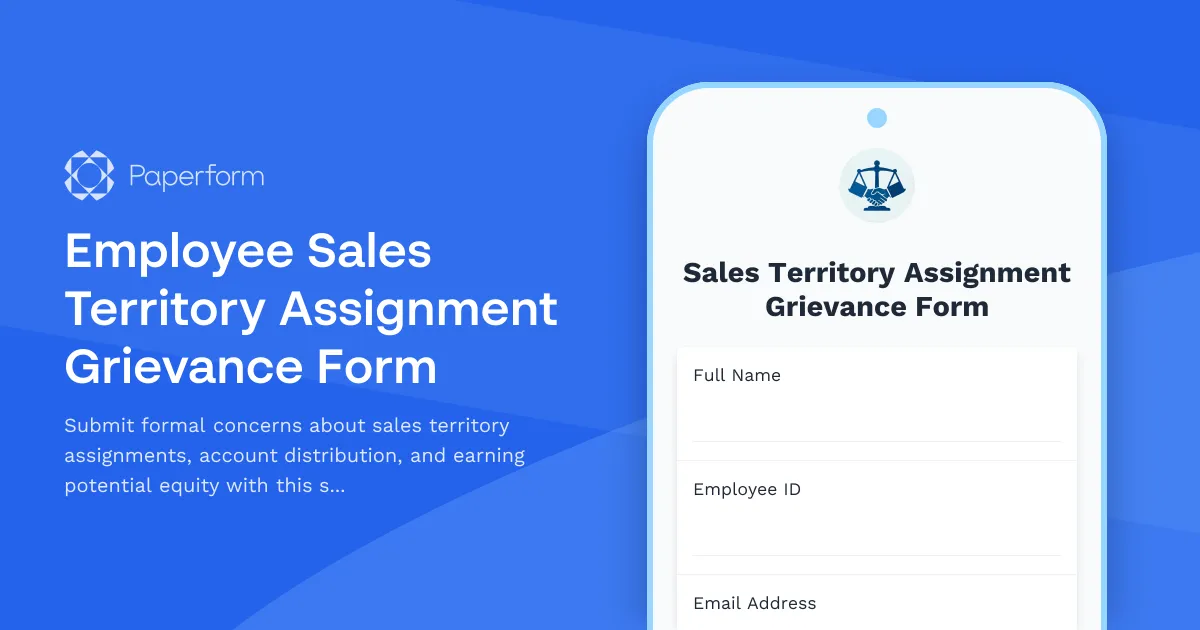
Employee Sales Territory Assignment Grievance Form Template
Sales territory assignments can make or break a sales representative's earning potential and career trajectory. When territory distributions feel unfair, account allocations seem imbalanced, or geographic assignments don't align with performance or equity, sales professionals need a clear, structured way to raise formal concerns with management.
This Employee Sales Territory Assignment Grievance Form provides a professional framework for sales teams and HR departments to document and address territory-related complaints with transparency and fairness.
Why Territory Assignment Grievances Matter
In sales organizations, territory assignments directly impact commission earnings, customer relationships, and long-term career growth. Common grievances include:
- Earning potential disparities between territories of similar size or scope
- Geographic fairness concerns when territories require excessive travel or cover challenging markets
- Account distribution transparency issues when high-value accounts are reassigned without clear criteria
- Market saturation where some territories are oversaturated while others have untapped potential
- Historical performance metrics that don't reflect current market conditions
Without a formal process for raising these concerns, resentment builds, top performers leave, and sales teams become demoralized. This template helps organizations address territory grievances before they escalate into retention issues.
What This Form Captures
The form is designed to gather comprehensive information about territory assignment concerns:
- Employee and territory details including current assignment and tenure
- Specific grievance type (earning potential, geographic fairness, account distribution, or other concerns)
- Detailed description of the issue with supporting evidence
- Comparison data showing disparities between territories
- Revenue and performance impact on the employee's earnings
- Previous attempts to resolve the issue informally
- Proposed solutions from the employee's perspective
- Supporting documentation such as territory maps, account lists, or performance data
Who Should Use This Form
This template is ideal for:
- Sales organizations with field sales teams, inside sales reps, or account executives
- HR departments managing sales compensation and territory planning
- Sales operations teams responsible for territory design and account assignment
- Business development teams with geographic or vertical territory structures
- Franchise organizations dealing with territory overlap or encroachment issues
- Professional services firms with client assignment or book-of-business concerns
Key Features for Fair Territory Management
Structured Documentation: The form creates a clear record of grievances with specific details, dates, and supporting evidence that HR and sales leadership can review objectively.
Confidentiality Options: Employees can choose whether to submit anonymously or allow their manager to be notified, protecting those who fear retaliation.
Evidence-Based Assessment: Fields for quantitative data (revenue comparisons, account counts, travel requirements) ensure grievances are evaluated on facts, not just feelings.
Solution-Oriented Approach: By asking employees to propose solutions, the form encourages collaborative problem-solving rather than just complaint lodging.
How Paperform Enhances the Grievance Process
With Paperform's conditional logic, you can show different follow-up questions based on grievance type—for example, asking about travel expenses only when geographic fairness is selected, or requesting account revenue data only when earning potential is the concern.
File upload fields let employees attach territory maps, account lists, commission statements, and competitive intelligence that support their case, keeping everything organized in one submission.
Connect this form to your HR management system via Stepper or native integrations to automatically create tickets, notify the appropriate reviewers, and track resolution timelines—ensuring no grievance falls through the cracks.
Use Papersign to document the resolution agreement, having both the employee and manager sign off on territory changes, timeline commitments, or compensation adjustments, creating a clear audit trail for compliance.
Building Trust Through Transparency
Territory assignment grievances often stem from a lack of transparency in how decisions are made. By implementing a formal grievance process with this template, organizations signal that they take fairness seriously and are willing to review and adjust assignments based on merit.
AI Insights can help sales operations teams identify patterns across multiple grievances—perhaps certain territories consistently generate complaints, or specific managers have higher grievance rates—enabling proactive territory redesign.
For sales-driven organizations where territory equity directly impacts retention and performance, this form isn't just an HR formality—it's a strategic tool for maintaining a motivated, fairly-compensated sales force.
Paperform's professional design capabilities ensure the form feels official and trustworthy, encouraging employees to speak up when they have legitimate concerns, while its automation features help HR teams respond promptly and consistently to every submission.
Whether you're a growing startup establishing your first formal territory policies or an enterprise sales organization refining your grievance procedures, this template provides the structure you need to handle territory disputes with professionalism and fairness.
More templates like this
Employee Customer Assignment Bias Grievance Form
A formal grievance form for employees to report concerns about unfair customer assignment practices, commission impact, relationship credit disputes, and account distribution favoritism in the workplace.
Accent and Language Discrimination Complaint Form
Report workplace discrimination based on accent, language, or national origin. Document harassment, policy bias, translation denial, and Title VII violations with confidential support.
AI Monitoring & Bias Complaint Form
A comprehensive form for employees to report concerns about AI-powered monitoring systems, including facial recognition errors, algorithmic bias, and discriminatory surveillance practices.
Appearance and Grooming Policy Discrimination Complaint Form
A confidential form for employees to report discrimination, bias, or denial of religious and cultural accommodations related to workplace appearance and grooming policies.
Caregiver Discrimination Grievance Form
A comprehensive form for employees to report caregiver discrimination, FMLA interference, family responsibility bias, schedule accommodation denials, and related Title VII violations in the workplace.
Company Communication Access Grievance Form
A formal grievance form for employees to report communication inequities, information access issues, remote worker exclusion, and concerns about decision-making transparency in the workplace.
Company Event Exclusion Complaint Form
A professional form for employees to report concerns about company event accessibility, scheduling conflicts, cultural sensitivity, or exclusion from team-building opportunities.
Compelled Speech & Belief Complaint Form
A professional HR form for employees to report concerns about compelled speech, belief mandates, DEI training objections, political coercion, and conscience protection requests in the workplace.
Constructive Discharge Complaint Form
Document intolerable working conditions, resignation timeline, and coordinate unemployment benefits with this comprehensive constructive discharge complaint form.
Constructive Discharge & Workplace Grievance Report Form
A confidential form for employees to document potential constructive discharge situations, unreasonable workload demands, and evidence of forced resignation strategies in the workplace.
Cultural Appropriation & Insensitivity Complaint Form
Report incidents of cultural appropriation, insensitive workplace events, or diversity policy violations. Confidential form for documenting concerns about culturally inappropriate themes, decorations, or behaviors in the workplace.
Employee Achievement Recognition Disparity Complaint Form
Document concerns about unfair recognition practices, award nomination bias, and visibility inequity in the workplace. Help HR address recognition disparities and improve morale.