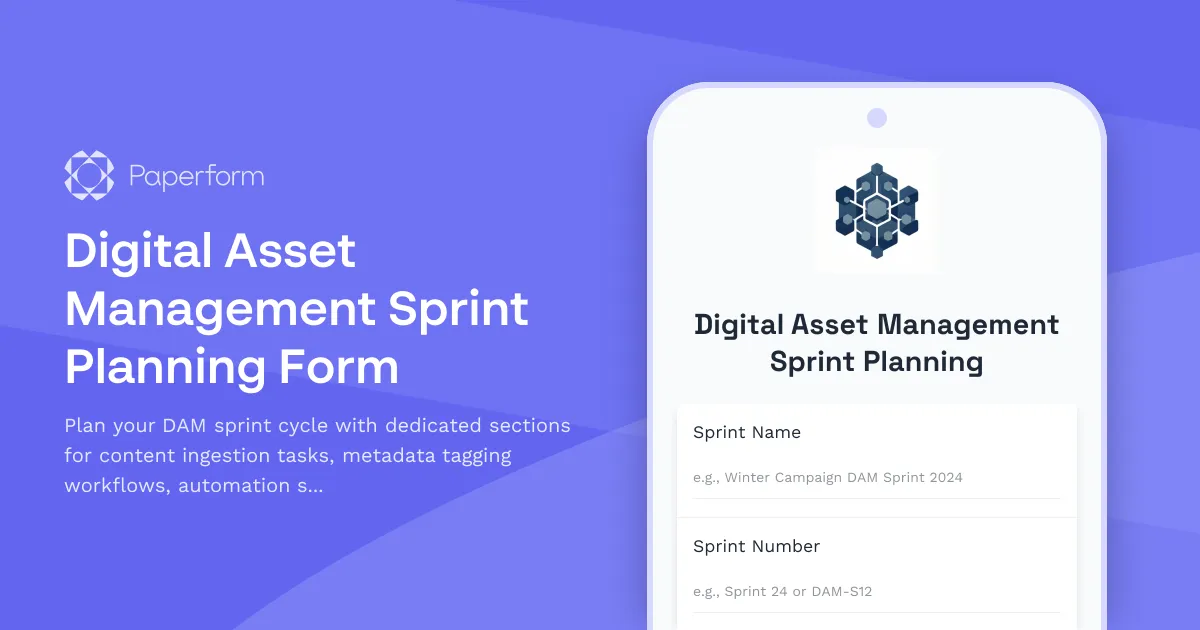
Managing digital assets at scale requires careful sprint planning that accounts for content ingestion pipelines, metadata taxonomies, workflow automation rules, and multi-channel distribution strategies. This Digital Asset Management Sprint Planning Form gives marketing teams, creative agencies, and media operations professionals a structured framework to organize their agile ceremonies around the unique workflows of DAM systems.
Whether you're onboarding thousands of new assets, refining your tagging schema, building approval workflows, or optimizing distribution to partner platforms, this template helps you capture sprint goals, prioritize backlogs, assign ownership, and define success metrics—all in one place. Perfect for DAM administrators, content operations managers, and agile teams working with platforms like Bynder, Cloudinary, Adobe Experience Manager, or custom asset libraries.
Why Paperform for DAM sprint planning?
With Paperform's conditional logic and calculation fields, you can dynamically surface relevant questions based on sprint focus areas—whether you're tackling ingestion bottlenecks or rolling out new metadata fields. Submit your sprint plan and instantly trigger workflows in Stepper to create tickets in Jira or Asana, notify stakeholders in Slack, update project boards in Notion or Airtable, and sync priorities across your tech stack—no code required.
Need sign-off from creative directors or compliance teams before locking in the sprint? Use Papersign to turn approved sprint plans into formal agreements with secure eSignatures, keeping your team aligned and accountable throughout the iteration.
This template is trusted by digital marketing teams, brand management departments, eCommerce operations, and media production studios who need to move fast without losing visibility into complex DAM workflows. With Paperform's SOC 2 Type II compliance and data residency controls, your sprint planning data stays secure while your team stays agile.
More templates like this
Content Creation Project Brief
A comprehensive project brief template for planning blog content strategy, including editorial calendar, SEO objectives, keyword research, content pillars, tone of voice guidelines, and content repurposing plans.

Omnichannel Marketing Strategy Project Brief
A comprehensive project brief template for planning and launching omnichannel marketing campaigns with customer journey mapping, channel analysis, and attribution requirements.
Agile Content Sprint Planning Form
Plan and execute agile content sprints with backlog prioritization, story point estimation, capacity planning, and velocity tracking for high-performance marketing teams.
Branded Content Performance Measurement Framework
A comprehensive framework for measuring branded content performance across the full customer journey, from awareness through advocacy, with executive-ready reporting and competitive benchmarking.
Content Accessibility Conformance Monitoring Form
Monitor and track content accessibility compliance with automated scanning schedules, manual testing protocols, issue tracking, and remediation workflows to maintain WCAG certification.
Content Remix Request Form
Streamline content repurposing across multiple channels with this comprehensive remix request form. Perfect for marketing teams looking to maximize content ROI through strategic multi-platform distribution.
Evergreen Content Update Request Form
Streamline your content refresh process with a structured workflow for identifying outdated content, coordinating research updates, SEO optimization, design modernization, and planning re-promotion campaigns.
Marketing Campaign Kickoff Form
A comprehensive campaign brief form to align teams on goals, channels, content plans, influencer partnerships, and KPIs before launch.
Marketing Campaign Launch Checklist
A comprehensive pre-launch checklist for marketing campaigns covering creative approval, tracking setup, budget confirmation, and stakeholder sign-off to ensure nothing falls through the cracks.
Sales Enablement Content Project Initiation Form
A comprehensive project brief form for planning and launching sales enablement content initiatives, including buyer persona analysis, content gap assessment, and distribution strategy.
Content Attribution Modeling Form
Track and analyze content performance across multi-touch campaigns with touchpoint mapping, influence scoring, and budget allocation insights to optimize your content marketing ROI.

Content Marketing Attribution & Customer Journey Mapping Form
A comprehensive form for mapping customer journeys, analyzing content touchpoints, modeling attribution influence, and generating data-driven recommendations for optimizing content marketing investments.