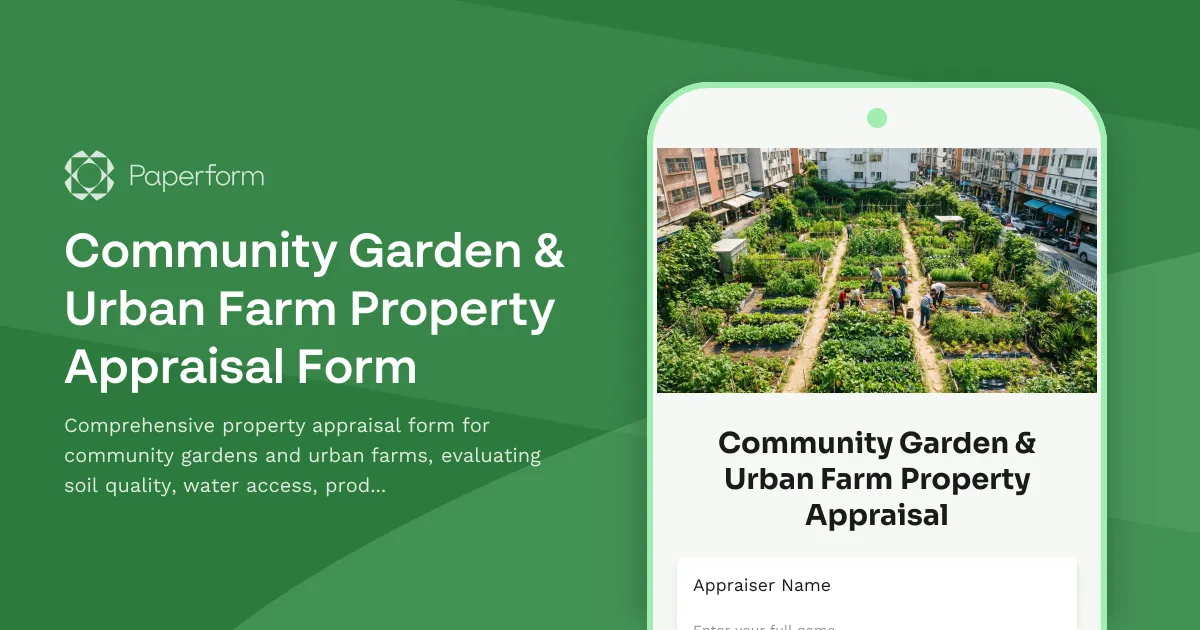
Streamline Urban Agriculture Property Assessments with Paperform
As urban farming and community gardens become vital parts of sustainable city planning, property appraisals in this sector require specialized evaluation criteria that go far beyond traditional real estate assessments. Our Community Garden & Urban Farm Property Appraisal Form template is purpose-built for agricultural consultants, urban planners, community garden coordinators, real estate appraisers, and municipal officials who need to conduct thorough, standardized evaluations of urban agricultural properties.
Why This Template is Essential for Urban Agriculture Professionals
Traditional property appraisal forms don't capture the unique value drivers of urban farming spaces. This template addresses the specific factors that determine whether a property is suitable and valuable for community gardening or urban farming—from soil contamination levels to water infrastructure, from growing season productivity to community engagement potential.
Whether you're assessing a vacant lot for conversion to a community garden, evaluating an existing urban farm for expansion, or conducting compliance reviews for agricultural zoning, this form guides you through every critical evaluation point with professional structure and clarity.
Comprehensive Assessment Across All Critical Dimensions
The template covers six essential evaluation areas:
Property & Location Information establishes the foundational details, including precise location data, current ownership structures, lot dimensions, and existing land use. This section ensures you have all the baseline property information needed for a complete appraisal record.
Soil Quality Testing Results captures the agricultural viability of the land through detailed soil composition analysis, pH levels, contamination screening (critical for urban environments), nutrient profiles, and drainage characteristics. For urban agriculture, soil quality isn't just a nice-to-have—it's the foundation of productivity and food safety.
Water Access Verification documents all water sources available to the property, from municipal connections to rainwater harvesting systems. This section evaluates water pressure, irrigation infrastructure, seasonal availability, and compliance with local water use regulations—essential factors that can make or break an urban farming operation.
Growing Season Productivity Assessment examines the property's agricultural output potential through sunlight exposure analysis, microclimate conditions, historical or projected yields, and growing season length. This data-driven approach helps stakeholders understand the realistic productive capacity of the space.
Community Engagement Assessment evaluates the social dimensions that make community gardens thrive—accessibility for diverse populations, community interest levels, volunteer capacity, educational program potential, and neighborhood integration. Urban agriculture succeeds or fails based on community participation, making this evaluation crucial.
Agricultural Zoning & Compliance ensures the property meets all legal requirements for urban farming, including zoning classifications, permitted agricultural activities, structure allowances, livestock permissions, and any variances or special permits required.
Perfect for Real Estate, Urban Planning, and Agricultural Professionals
This template serves multiple professionals in the urban agriculture ecosystem:
Real Estate Appraisers and Assessors can use this form to provide specialized valuations for properties with agricultural use, ensuring all unique value factors are properly documented and quantified.
Urban Planners and Municipal Officials benefit from standardized assessment data when evaluating properties for community garden designation, agricultural zoning changes, or urban greening initiatives.
Community Garden Coordinators and Nonprofit Directors can conduct site assessments for potential garden locations, ensuring they select properties with the highest likelihood of success and community impact.
Agricultural Consultants and Extension Officers use this comprehensive evaluation framework to provide expert recommendations on urban farming viability, soil remediation needs, and productivity optimization.
Property Developers and Investors interested in sustainable development can assess properties for urban agriculture potential as part of mixed-use projects or community benefit programs.
How Paperform Enhances Your Urban Agriculture Assessments
Paperform transforms this comprehensive appraisal process from a cumbersome paper-based checklist into a streamlined digital workflow that saves time and improves data quality.
The document-style editor lets you customize the form to match your organization's branding and specific assessment protocols. Add your logo, adjust terminology to match local regulations, or include additional sections for region-specific requirements—all without needing technical skills.
Conditional logic ensures evaluators only see relevant follow-up questions based on their initial responses. For example, if contamination is detected in soil testing, additional remediation questions automatically appear. If no municipal water is available, the form focuses on alternative water source evaluation. This intelligent branching keeps the form focused and prevents unnecessary questions.
File upload fields allow appraisers to attach soil test reports, photographs of the property, zoning documents, community survey results, and other supporting documentation directly within the submission. Everything stays organized in one place, creating a complete digital record.
Calculation fields can automatically score properties across multiple dimensions—soil quality scores, water access ratings, productivity potential, community readiness indices—providing an objective, data-driven assessment summary that supports decision-making.
For teams conducting multiple appraisals, Paperform's dashboard and reporting features let you compare properties side-by-side, identify the most promising sites, and track assessment progress across your portfolio.
Automate Your Urban Agriculture Workflows with Stepper
Once an appraisal is submitted, Stepper can automate what happens next, turning your assessment into action without manual coordination.
Set up workflows that automatically:
- Route high-potential properties to acquisition teams or garden coordinators for immediate follow-up
- Send soil remediation recommendations to environmental consultants when contamination is detected
- Generate PDF reports summarizing the appraisal findings and email them to stakeholders
- Update property databases or CRM systems with assessment results and status tags
- Trigger approval workflows for properties requiring zoning variances or special permits
- Notify community organizations when suitable garden sites are identified in their neighborhoods
These automations mean your appraisal data immediately drives action, rather than sitting in an inbox waiting for manual processing. Your team can focus on high-value evaluation work while Stepper handles the administrative coordination.
Built for Professional Standards and Compliance
Urban agriculture appraisals often involve multiple stakeholders—municipal agencies, community organizations, property owners, and funding bodies. Paperform's SOC 2 Type II compliance ensures your assessment data is handled with enterprise-grade security, while roles and permissions let you control who can access sensitive property information.
For consultants managing appraisals across multiple clients or municipalities, Agency+ features allow you to maintain separate forms and data for each client under one account, with proper segregation and white-label branding options.
Integration with Your Property Management Stack
Paperform connects seamlessly with the tools real estate and urban planning professionals already use:
- Send appraisal results to Airtable or Google Sheets to build searchable property databases
- Create tasks in Asana or Monday.com when follow-up actions are required
- Update property records in Salesforce or HubSpot for properties under consideration
- Store appraisal documents in Dropbox or Google Drive for long-term archival
- Notify teams via Slack when priority properties are identified
With thousands of integration options through Stepper, Zapier, Make, and webhooks, your appraisal data flows automatically to wherever it needs to go.
Making Urban Agriculture Accessible and Sustainable
Community gardens and urban farms provide enormous benefits—fresh food access, community building, environmental education, green space, and sustainable land use. But successful urban agriculture requires careful site selection based on comprehensive assessment of agricultural viability, regulatory compliance, and community readiness.
This Paperform template brings professional structure to that assessment process, ensuring evaluators consistently capture all the critical data needed to make informed decisions about urban agricultural properties. Whether you're a city planning to expand urban greening programs, a nonprofit establishing community gardens, or a real estate professional navigating the emerging urban agriculture sector, this template provides the framework you need.
Start with this template, customize it for your specific requirements, and transform your urban agriculture property appraisals from time-consuming paperwork into efficient, data-rich assessments that drive better decisions and stronger communities.
Ready to modernize your property assessment process? This template is included in Paperform's library of 30,000+ professional form templates, available on all plans. Try it free and discover how Paperform makes complex evaluations simple.


More templates like this

Coworking Space Inspection Form
A comprehensive inspection form for evaluating coworking spaces, including workspace layout, technology infrastructure, common areas, lease terms, and member amenities.

Equestrian Property Inspection Form
A comprehensive inspection form for evaluating equestrian properties, including stables, pastures, arenas, fencing, and water systems to assess overall condition and suitability for horse keeping.
Tax Assessment Dispute Form
Challenge your property tax assessment with a comprehensive dispute form that documents property valuation, comparable sales, and assessment methodology for tax appeals board hearings.

Farmers Market Venue Appraisal Form
A comprehensive venue appraisal form for evaluating permanent farmers market locations, including vendor space assessment, customer flow analysis, parking verification, facility adequacy, and seasonal revenue documentation.
German Commercial Property Due Diligence Checklist
Comprehensive due diligence checklist for German commercial property acquisitions, covering title verification, environmental assessments, tenant status reviews, and regulatory compliance requirements.

Green Building Certification Inspection Form
A comprehensive inspection form for green building certification that evaluates LEED criteria, energy efficiency, sustainable materials, and environmental impact to support sustainable construction and certification processes.
Green Building Certification ROI Calculator
Calculate the return on investment for LEED, BREEAM, or other green building certifications. Estimate energy savings, lease premiums, tenant attraction benefits, and available regulatory incentives.

Homebuyer Education Class Registration Form
Register for homebuyer education classes with first-time buyer certification, income qualification screening, and class format preferences to help you prepare for your home purchase journey.
Junkyard & Auto Salvage Property Appraisal Form
Comprehensive property appraisal form for auto salvage yards and junkyards, featuring inventory assessment, environmental compliance checks, and recycling revenue documentation.

Property Appraisal Client NDA & Confidentiality Agreement
Secure property appraisal engagement form with NDA provisions, valuation methodology protection, comparable data confidentiality, and integrated payment processing for appraisal services.
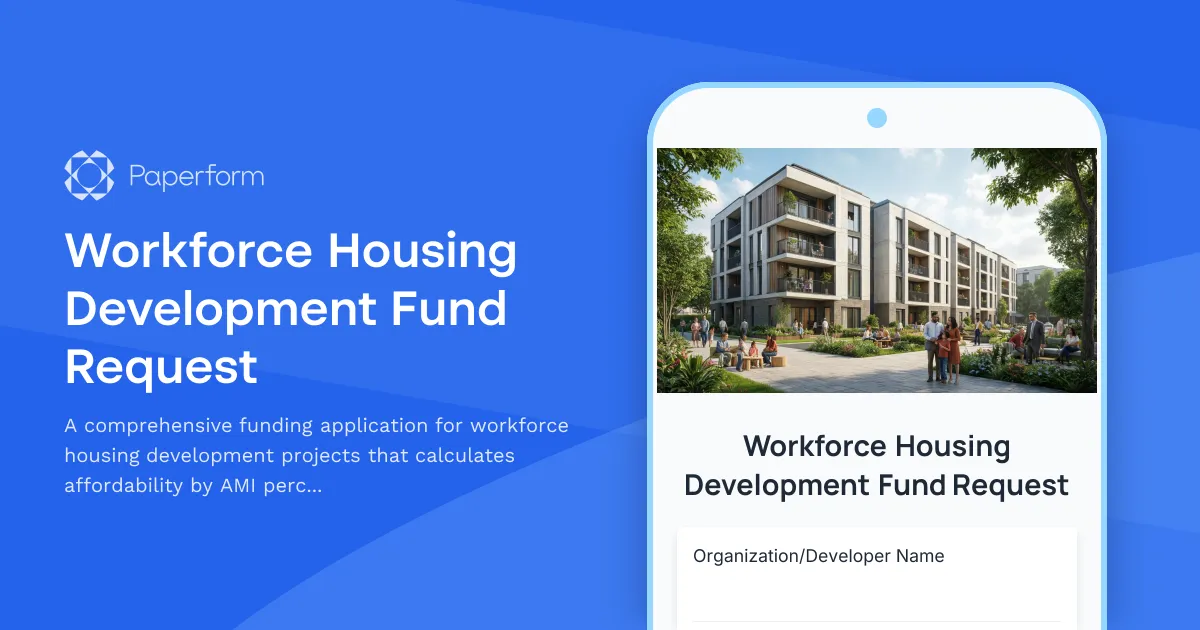
Workforce Housing Development Fund Request
A comprehensive funding application for workforce housing development projects that calculates affordability by AMI percentage, tracks employer contributions, manages construction budgets, and outlines tenant selection and property management plans.
Zero Waste Retail Store Inspection Form
Comprehensive inspection form for zero waste retail stores covering bulk storage systems, refill stations, packaging-free operations, customer education spaces, and sustainability certification requirements.