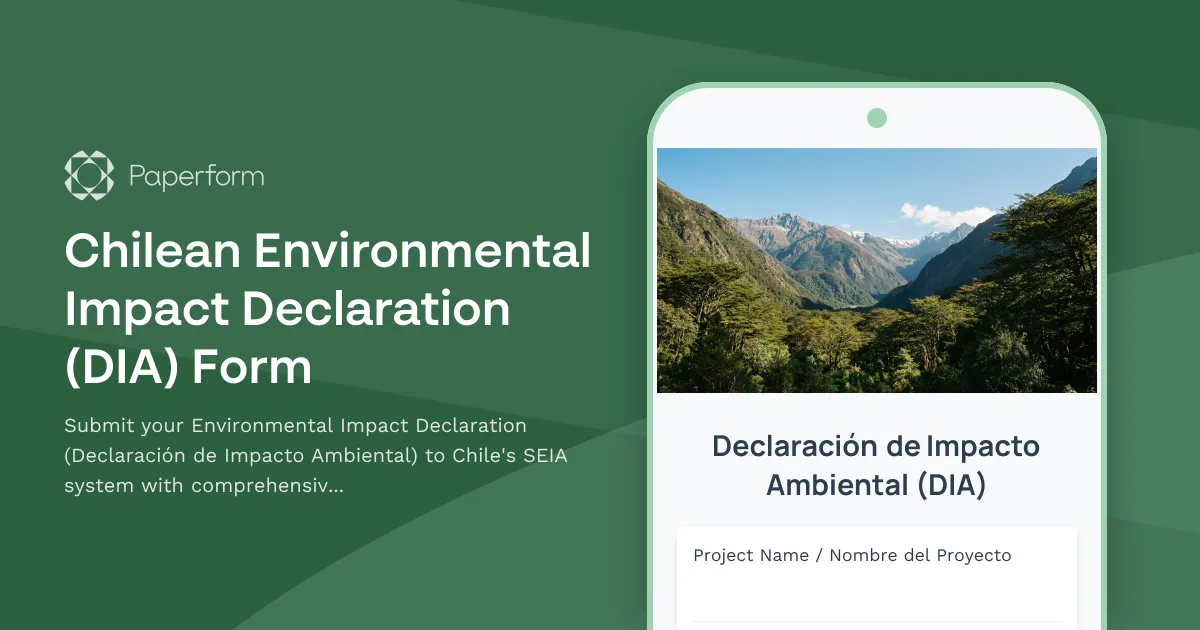
Streamline Your Chilean Environmental Impact Declaration with Paperform
If you're planning a development project in Chile that requires environmental assessment, navigating the Environmental Impact Assessment System (SEIA - Sistema de Evaluación de Impacto Ambiental) can feel overwhelming. The Environmental Impact Declaration (DIA - Declaración de Impacto Ambiental) is a critical regulatory requirement for projects that generate localized environmental impacts but don't require the more comprehensive Environmental Impact Study (EIA).
This Chilean Environmental Impact Declaration form template helps project developers, environmental consultants, engineering firms, and regulatory compliance professionals submit complete, organized DIAs to Chile's Servicio de Evaluación Ambiental (SEA). Instead of wrestling with paper forms or scattered documentation, you can gather all required project information, environmental baseline data, impact assessments, and mitigation measures in one streamlined digital form that meets SEIA standards.
Why This DIA Form Template Matters for Chilean Projects
Chile's environmental regulations require rigorous documentation before project approval. The DIA process applies to projects like small-scale mining operations, aquaculture facilities, energy transmission lines, water extraction projects, industrial installations, and infrastructure developments that don't trigger the EIA threshold.
This form template is designed specifically for the Chilean regulatory context, capturing all the essential elements the SEA reviews: project identification, location and territorial planning compliance, baseline environmental conditions, potential impacts on protected components, mitigation and compensation measures, monitoring plans, and stakeholder engagement records.
For environmental consultants managing multiple client projects, this template ensures consistency across submissions while reducing preparation time. For project developers and engineers, it provides a clear roadmap of exactly what information regulators need, preventing costly delays from incomplete applications. For legal and compliance teams, it creates a documented audit trail showing due diligence at every stage of the environmental assessment process.
Key Features Built for Chilean Environmental Compliance
This DIA form captures comprehensive project information including RUT (Rol Único Tributario) identification, SII tax documentation references, and all required SEIA classification details. The template uses conditional logic to show relevant sections based on project type, environmental components affected, and territorial jurisdiction.
You'll document your project's technical specifications, geographic coordinates, land use classifications, proximity to protected areas, and relationships with indigenous communities or cultural heritage sites. The form includes structured sections for describing baseline environmental conditions across air quality, water resources, soil characteristics, flora and fauna, noise levels, and socioeconomic context.
Critical impact assessment sections help you systematically evaluate effects on each environmental component, assign significance ratings, describe direct and indirect impacts, and detail your proposed mitigation hierarchy: avoidance, minimization, remediation, and compensation measures. You can upload supporting documentation including technical drawings, environmental baseline studies, monitoring protocols, and stakeholder consultation records.
Because DIA submissions often require coordination between technical specialists, project managers, and legal advisors, this form works seamlessly with tools Chilean professionals already use. Paperform integrations let you send completed submissions to Google Drive for document management, Slack for team notifications, or your CRM to track project timelines. For firms managing complex approval workflows, Stepper (stepper.io) can automate the next steps after form submission—routing the DIA package to internal reviewers, scheduling follow-up meetings with SEA officials, or triggering compliance milestone tracking in your project management system.
Beyond Data Collection: Building Complete Environmental Submissions
The real power of moving your DIA process to Paperform isn't just digitizing a form—it's creating a professional, compliant submission package that demonstrates environmental responsibility and regulatory competence. The form's document-style layout lets you include explanatory text, images of project sites, maps showing environmental sensitivities, and embedded guidance to help team members complete sections accurately.
You can customize the form's appearance to match your consulting firm's branding or maintain a professional, neutral aesthetic for direct submission to authorities. The form works equally well as an internal data-gathering tool before official submission or as a client-facing intake form for environmental consulting services.
Conditional logic ensures respondents only see questions relevant to their specific project type and environmental setting. If a project affects marine ecosystems, marine-specific impact questions appear. If the project is near an indigenous community, stakeholder engagement sections expand to capture required consultation details. This intelligent branching keeps the form focused and prevents information overload while ensuring comprehensive coverage of all regulatory requirements.
Designed for Chilean Environmental Professionals and Project Developers
This template serves multiple stakeholders in Chile's environmental compliance ecosystem:
Environmental consulting firms can use it as a standardized intake tool across all DIA projects, ensuring junior consultants capture the same quality of information as senior specialists. The structured format reduces review time and improves consistency across your practice.
Mining, energy, and infrastructure companies can deploy this form internally during project planning phases to identify environmental risks early, budget appropriately for mitigation measures, and prepare robust submissions that move through SEIA review efficiently.
Engineering and architecture firms can integrate this into their project development workflow, using it to document environmental considerations from feasibility through permitting, creating a single source of truth for environmental compliance data.
Legal teams and regulatory advisors benefit from the comprehensive documentation trail, which demonstrates due diligence and supports any administrative reviews or stakeholder challenges to project approval.
Automation That Supports Compliance Teams
Once a DIA form is submitted, the real work of project coordination begins. With Stepper, you can build sophisticated workflows that trigger automatically:
- Send the completed DIA package and attachments to designated SEA regional offices
- Generate internal task lists for technical reviewers to verify completeness
- Set calendar reminders for regulatory response deadlines and follow-up actions
- Update project tracking systems with submission dates and assigned reference numbers
- Alert project managers when additional information requests arrive from SEA
- Route approved DIAs to construction teams to proceed with implementation
This level of automation means your environmental compliance doesn't end with form submission—it becomes part of an integrated project management system that keeps everyone informed and accountable through every stage of the SEIA process.
Trusted Platform for Regulatory Compliance
Paperform's SOC 2 Type II compliance and enterprise-grade security features make it suitable for handling sensitive project information, competitive business data, and confidential environmental baseline studies. For consulting firms managing DIAs for multiple clients, Agency+ features let you create separate branded forms for each client while maintaining centralized oversight and reporting.
Whether you're an independent environmental consultant submitting your first DIA, a multinational corporation managing dozens of projects across Chilean regions, or a government liaison helping proponents navigate SEIA requirements, this form template provides the structure, flexibility, and professional presentation needed for successful environmental permitting.
Get your Chilean projects approved faster with a DIA submission process that's comprehensive, organized, and built for the specific requirements of Chile's environmental regulatory system.
More templates like this
Brazilian Indigenous Peoples Free Prior and Informed Consent Form
A comprehensive FPIC documentation form for development projects requiring consultation with indigenous communities in Brazil, ensuring compliance with ILO Convention 169 and Brazilian constitutional requirements.
French Environmental Impact Study Submission Form
Submit your environmental impact study (étude d'impact) for regulatory review in France. Comprehensive form for project description, mitigation measures, and public consultation requirements.
NEMA Environmental Impact Assessment Registration Form
A comprehensive EIA registration form for NEMA compliance in Kenya, capturing project details, location coordinates, environmental impacts, and mitigation measures for development projects requiring environmental assessment.
Australian Environmental Impact Statement
Comprehensive environmental impact statement form for Australian development projects, covering EPA requirements, flora and fauna surveys, and community consultation records in compliance with Australian environmental legislation.
DENR Environmental Compliance Certificate Application Form
Apply for an Environmental Compliance Certificate (ECC) from DENR with environmental impact assessment documentation and public consultation records for projects in the Philippines.
Egypt Coastal Zone Development Permit Application
Official application form for coastal development permits in Egypt, including environmental impact assessment, public access preservation compliance, and maritime boundary verification.
Borehole Drilling Permit Application Form
Official application form for borehole drilling permits in Kenya, including hydro-geological survey details, water testing results, and WRMA compliance documentation.
Chilean Electricity Generation Permit Application (CNE)
Complete permit application form for electricity generation projects in Chile, designed for submission to the National Energy Commission (CNE) with environmental impact assessment, grid connection details, and capacity certification.
CNPJ Environmental License Application Form
A comprehensive environmental license application form for Brazilian businesses to submit CNPJ details, activity descriptions, environmental impact assessments, and required documentation to regulatory agencies.
CNPJ Mining Concession Application Form
Complete CNPJ mining concession application form for Brazilian regulatory compliance, including exploration area coordinates, environmental licensing, and royalty agreements for mineral extraction operations.
Colombian Green Building Certification Application Form
A comprehensive application form for Colombian green building certification that evaluates environmental criteria, energy efficiency, and sustainable materials compliance with local DIAN and regulatory standards.
Czech Environmental Impact Assessment Form
Comprehensive environmental impact assessment form designed for Czech businesses and project developers to submit EIA documentation to the Ministry of Environment in compliance with Czech regulatory requirements.