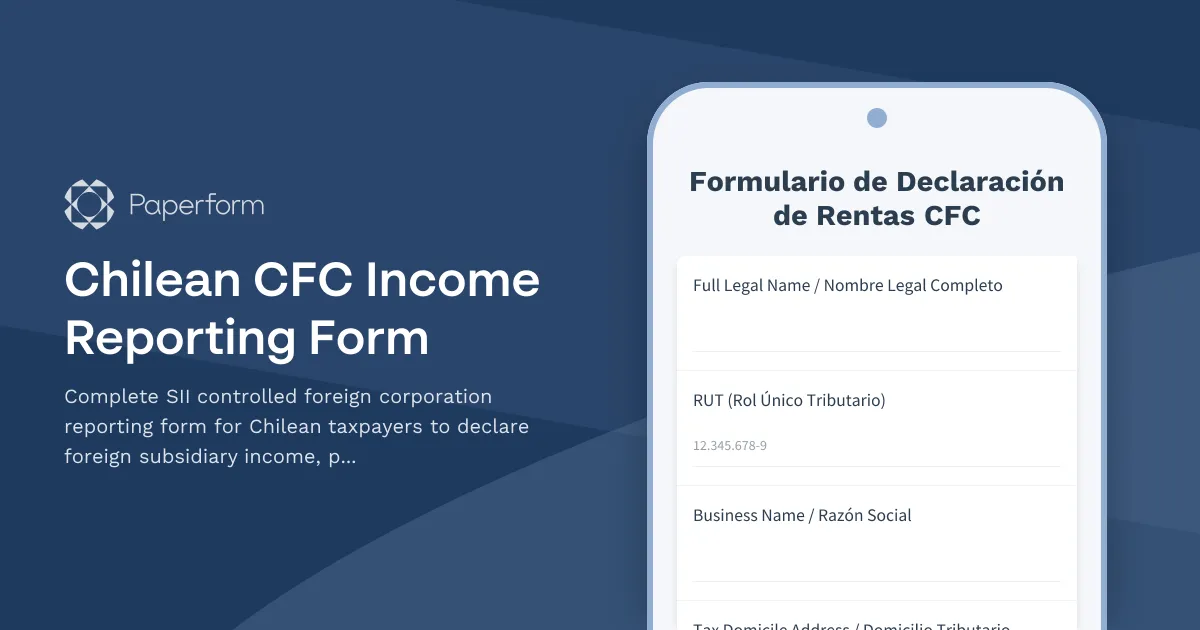
Simplify Your Chilean CFC Tax Compliance with Paperform
If you're a Chilean business owner managing controlled foreign corporations (CFCs), you know that Servicio de Impuestos Internos (SII) reporting requirements can be complex and time-consuming. Our Chilean CFC Income Reporting Form template streamlines the entire process, helping tax professionals, accountants, and business owners meet their regulatory obligations accurately and efficiently.
What is CFC Reporting in Chile?
Under Chilean tax law, taxpayers with controlling interests in foreign corporations must report passive income and certain types of foreign subsidiary earnings to the SII. The controlled foreign corporation rules require detailed attribution analysis, income categorization, and deferral calculations to ensure proper tax treatment of foreign-sourced income.
This comprehensive form template guides you through every step of the CFC reporting process, from basic taxpayer identification and RUT verification to detailed income attribution schedules and supporting documentation uploads.
Why Choose Paperform for Chilean Tax Compliance?
Paperform transforms complex regulatory forms into intuitive, user-friendly experiences. Instead of wrestling with static PDFs or spreadsheets, you get a clean, professional form that works seamlessly across all devices—perfect for accountants working with multiple clients or businesses managing their own compliance.
Our doc-style editor makes it easy to customize the template to match your firm's branding or specific client needs. Add your logo, adjust colors to match your corporate identity, and include custom instructions or guidance notes inline with each question. The result is a polished, professional form that inspires confidence and reduces errors.
Built for Chilean Tax Professionals and Businesses
This template is specifically designed for:
- Accounting firms serving Chilean businesses with international operations
- Tax advisors and consultants specializing in cross-border taxation
- Corporate finance teams at Chilean companies with foreign subsidiaries
- Business owners with controlling interests in foreign corporations
- Legal professionals assisting with international tax compliance
The form captures all essential information required by the SII, including taxpayer identification details, RUT numbers, fiscal year information, foreign subsidiary details, income attribution calculations, passive income categorization, and deferral analysis documentation.
Smart Conditional Logic Reduces Complexity
One of the biggest challenges with CFC reporting is managing different scenarios—not every foreign subsidiary triggers the same reporting requirements. This template uses conditional logic to show only relevant questions based on previous answers, making the form feel shorter and less overwhelming.
For example, if a taxpayer indicates they have multiple foreign subsidiaries, additional subsidiary detail sections automatically appear. If passive income exceeds certain thresholds, specialized attribution questions are revealed. This intelligent flow ensures complete, accurate reporting while avoiding unnecessary questions.
Secure File Uploads for Supporting Documentation
CFC reporting requires substantial supporting documentation—financial statements, ownership certificates, income schedules, and more. The template includes secure file upload fields for all required attachments, keeping everything organized in one place. No more juggling email threads, shared drives, or physical documents.
All submissions are stored securely with SOC 2 Type II compliance, ensuring client data remains protected throughout the reporting process.
Streamline Your Workflow with Stepper Automation
Once you've collected CFC reporting data through your Paperform, Stepper can automate what happens next. You can set up workflows that:
- Automatically extract key data and populate SII filing templates
- Send client-specific reports to your accounting software or practice management system
- Route submissions to senior tax advisors for review based on complexity thresholds
- Trigger reminder emails for missing documentation or clarifications
- Update client databases and CRM records with current CFC positions
This automation transforms hours of manual data entry and follow-up into streamlined, reliable processes that let your team focus on high-value tax advisory work instead of administrative tasks.
Calculations Built Right Into the Form
Chilean CFC reporting involves numerous calculations—foreign income attribution percentages, taxable income adjustments, deferral amounts, and tax credits. While this template collects the raw data needed for these calculations, you can extend it with Paperform's calculation fields to provide real-time estimates or validation checks as users complete the form.
This helps identify potential errors or inconsistencies before submission, reducing back-and-forth revisions and improving data quality.
Perfect for Multi-Client Practices
If you're an accounting firm or tax advisory practice serving multiple Chilean businesses, Paperform's Agency+ plan lets you manage separate forms for different clients, each with their own branding and custom domains. You can create client-specific variations of this template while maintaining centralized oversight and reporting.
Submissions can be automatically tagged by client, routed to the appropriate team members, and integrated with your existing practice management software—all without requiring technical expertise or developer resources.
Seamless Integration with Your Existing Tools
Connect your Chilean CFC reporting form to the tools you already use:
- Google Sheets or Airtable for creating searchable databases of CFC positions across your client base
- Slack for instant notifications when urgent submissions arrive
- Email marketing platforms to send compliance reminders during tax season
- Cloud storage (Dropbox, Google Drive, OneDrive) to automatically organize supporting documents
- Webhooks for custom integrations with specialized tax software
With thousands of integration options available through Stepper, Zapier, Make, and native connections, Paperform fits seamlessly into your existing compliance workflow.
Mobile-Friendly for On-the-Go Compliance
Chilean business owners and their advisors don't always work from a desk. This form template is fully responsive and works beautifully on smartphones and tablets, making it easy to collect information during client meetings, while traveling, or from remote locations.
Get Started in Minutes
No coding or technical skills required. Simply customize this template with your branding and specific requirements, share it via link or embed it on your website, and start collecting CFC reporting data immediately.
Whether you're a solo practitioner handling a handful of clients or a large firm managing complex international tax compliance for dozens of Chilean businesses, Paperform gives you the tools to make SII CFC reporting faster, more accurate, and significantly less stressful.
Ready to transform your Chilean tax compliance workflow? Start with this professional CFC reporting template and experience the Paperform difference—where regulatory complexity meets user-friendly design.



More templates like this
Chilean Cross-Border Services VAT Declaration Form
Complete cross-border services VAT declaration form for Chilean businesses handling international transactions with reverse charge mechanism and country of consumption compliance for SII reporting.
SII Auditor Designation Form - Chilean Tax Audit
Official form for designating a qualified tax auditor for mandatory SII (Servicio de Impuestos Internos) tax audits in Chile, with professional qualification verification.
SII Tax Payment Plan Request Form (Convenio de Pago)
Request a tax payment plan (convenio de pago) with Chile's SII. Consolidate tax debts and calculate installment options for individuals and businesses.
AFIP Annual Corporate Income Tax Return (Sociedad Anónima)
Complete annual corporate income tax declaration form for Argentine S.A. companies with financial statement reconciliation and AFIP compliance requirements.
Altinn Transfer Pricing Documentation Form
Comprehensive Norwegian transfer pricing documentation form for reporting related party transactions, arm's length analysis, and country-by-country reporting to Altinn and Skatteetaten.
C-Corporation Earnings and Profits (E&P) Calculation Worksheet
Calculate accumulated and current earnings and profits (E&P) for C-corporations, reconcile tax vs. book income, and properly characterize distributions for federal tax compliance.
Chilean Corporate Restructuring Notification Form
Official notification form for corporate restructuring operations in Chile. Report mergers, splits, and transformations to the SII with comprehensive details about the involved entities and transaction structure.
Colombian Dividends Withholding Tax Form
Professional form for Colombian companies to process dividend distributions with shareholder RUT information, withholding tax calculations, and automatic tax certificate generation for DIAN compliance.

Commercial Dispute Witness Statement Form
A comprehensive witness statement form designed for commercial disputes, capturing detailed testimony about contract breaches, financial impacts, and supporting arbitration or litigation preparation.
CRA T1134 Information Return - Foreign Affiliates
Report controlled and non-controlled foreign affiliates to the CRA. Comprehensive T1134 information return for Canadian corporations and individuals with foreign affiliate interests.
CRO Mortgage or Charge Registration Form
Register a mortgage or charge with the Companies Registration Office (CRO) in Ireland. Secure filing for company security documents and charge particulars.
CRO Section 723 Unlimited Company Financial Statements Exemption Notification
Notify the Companies Registration Office of an unlimited company's intention to claim exemption from filing financial statements under Section 723 of the Companies Act 2014.